by Stuart Crainer
In 2015 Thinkers50 presented an award for putting ideas into practice to Zhang Ruimin, then the CEO of the Chinese white goods company, the Haier Group. The work of Haier first came to our attention in 2005 when it deconstructed itself into a series of self-managing business units. As part of this, Haier established the inverted-pyramid organisation, a way of putting users first and reorganising the structure of the company.
Then in 2012 Haier effectively eliminated 12,000 middle manager roles and transformed the company’s original pyramid into a flat structure. The headlines screamed “Debureaucratisation! The smashing of middle management!” And for once they were entirely accurate. From Haier’s 80,000 employees, those with entrepreneurial willingness and capability were screened to form more than 4,000 autonomously operating micro-enterprises (MEs). The former middle managers had two choices: either seek opportunities elsewhere or become entrepreneurs within the Haier system, becoming ME owners or core members, serving as resource providers for the MEs.
Over the years since then we have witnessed at first hand Mr Zhang’s relentless quest to create an organisation truly fit for the twenty-first century and his similarly relentless curiosity.
Haier came from near bankruptcy in a semiderelict factory to become a modern international corporation. In 2025 it achieved a record high 426.8 billion RMB ($63 billion) in global revenue and 32.2 billion RMB ($4.75 billion) in total profit. But the issues that Haier has encountered and approached in its unique way are truly universal. Inefficient and indifferent organisations, and unhappy people within them, exist throughout the world. And at the same time, wonderfully imaginative, progressive, and successful organisations flourish.
The Haier philosophy was first articulated in 2005 and is called RenDanHeYi. This Mandarin word is a compelling distillation of what is important in organisations. In RenDanHeYi Ren refers to the value of employees, Dan refers to the value of users, and HeYi means that the value of employees is realized through the value they create for users. The fusing of the creativity of employees and the needs of users lies at the heart of RenDanHeYi. In the language of Haier, the objective must be to continually insist on Zero Distance between employees and users, to continuously iterate and upgrade that relationship.
The spirit of continual improvement and iteration lies at the heart of Zhang Ruimin’s worldview. He is now the company’s chairman emeritus and remains intent on continually pushing the ideas and practice forward. We have spent the last few months working on a book together which combines the insights and experience of Haier with other inspiring examples of progressive management in organisations worldwide.
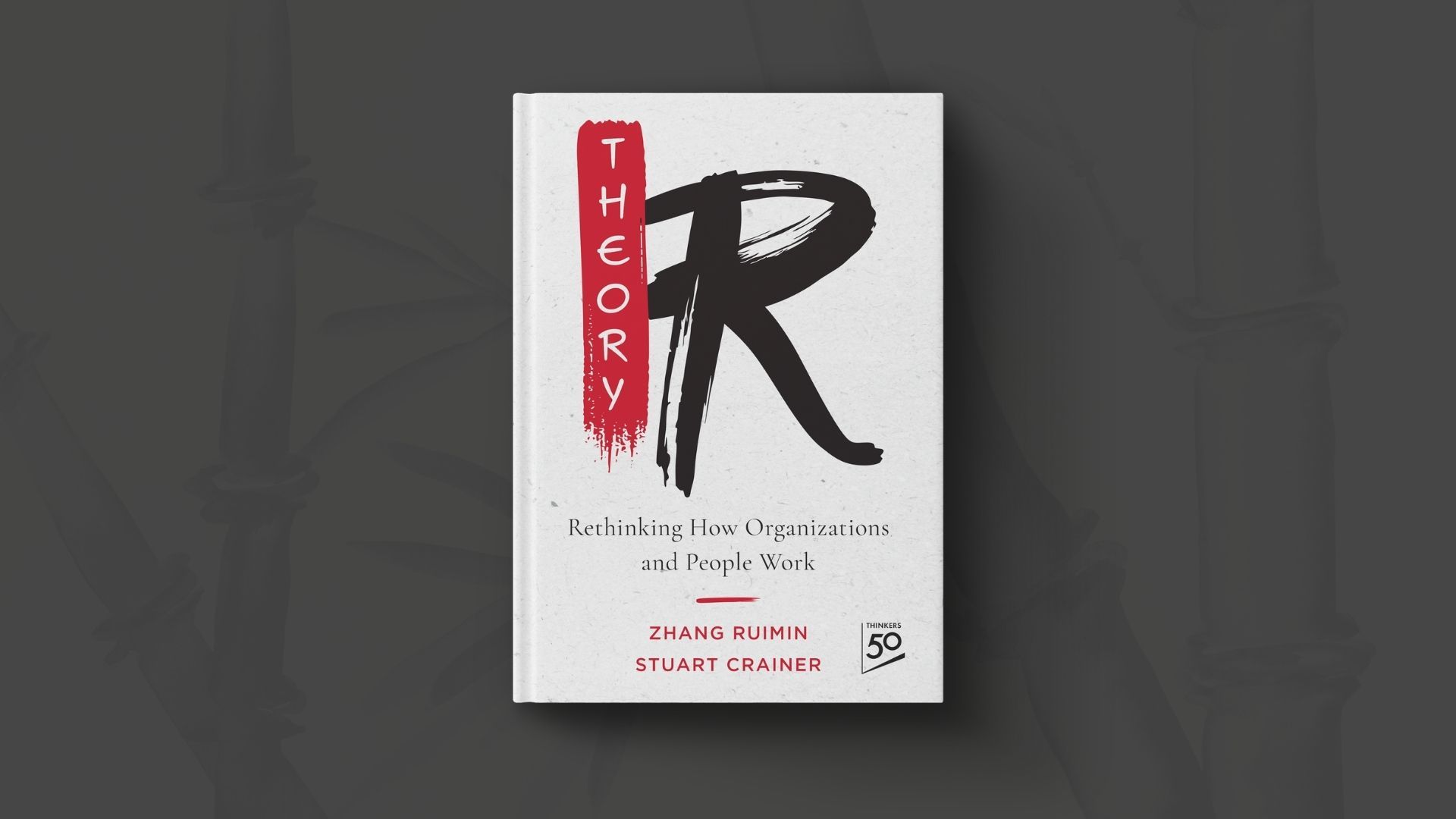
Working together we have sought to truly understand how ideas and best practices fit together. The result is Theory R: Rethinking How People and Organizations Work which will be published by Amplify later in 2026. The concept of Theory R takes the ideas and practices of RenDanHeYi as its foundation—as well as its first letter. Theory R is a distillation and translation of the original philosophy, intended to facilitate understanding and the application of the ideas in practice globally. It reflects the encouraging reality that organisations worldwide are taking these ideas and using them to reconfigure their own contexts.
Theory R aims to enable organisations to move toward a state of self-organisation, with autonomous individuals and lifelong users in an infinite loop of connection and collaboration to fuel constant change, learning, refinement, and performance. More pithily, Theory R is focused on how we can maximise human value in organisations.
And while we label it a theory and think of it as a philosophy, Theory R is practical. It is working today throughout the world.
The primary distinction between Theory R and classical management models lies in their ultimate purpose. The classical model is material centric, reflecting what may be called a product-based economic paradigm. This paradigm pursues the appreciation of capital and wealth, benefiting only shareholders. Because capital belongs to shareholders, the model is inherently oriented toward shareholder value. The flaw is clear: shareholders can only share value, not create it. This explains why the classical model lacks an intrinsic engine for sustainable growth.
Though both are business models, Theory R and classical approaches differ radically in their development philosophies. We cannot comprehend Theory R through the lens of classical thinking, just as we cannot understand mobile phones through the logic of landlines. They represent two fundamentally distinct concepts.
Theory R is people centric, seeking the appreciation of human value—and that necessarily depends on human awakening or, more precisely, on self-enlightenment. By dismantling bureaucracy, Theory R enables every individual to move from being a mere executor to being a self-driven entrepreneur—an act of self-enlightenment.
Stuart Crainer is cofounder of Thinkers50.
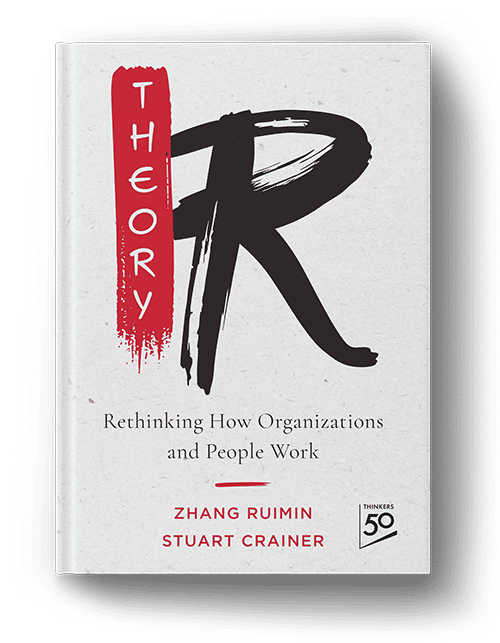
For two decades, Chinese white goods giant Haier has been rethinking the fundamentals of how organisations work – dismantling bureaucracy, replacing hierarchy with thousands of autonomous micro-enterprises, and putting employees directly in touch with the users they serve.
Now Haier chairman emeritus Zhang Ruimin and Thinkers50 co-founder Stuart Crainer are taking those ideas a step further. Their forthcoming book, Theory R: Rethinking How People and Organizations Work, published by Amplify later this year, distils the philosophy and practice of Haier’s RenDanHeYi model into a new framework for organisations everywhere – one centred not on maximising shareholder value, but human value.