
by Eric Partaker and Dr. Christian Poensgen
Key highlights
- Most organizations have designed work around constant availability, even though their most valuable work requires sustained attention.
- The Ultraproductive method connects three interdependent dimensions (focus, rest, and stress) into a framework for redesigning how individuals and teams perform at their best.
- Leaders can replace a culture of continuous activity with an operating rhythm of concentrated effort, deliberate recovery, and meaningful challenge.
What if the greatest obstacle to your organization’s productivity is the way you’ve organized work?
Modern businesses have become extraordinarily good at keeping people busy. Meetings fill calendars. Messages demand immediate answers. Working late signals commitment. Yet the thinking, judgment, and creativity on which performance depends are squeezed into whatever time remains.
This is the paradox of modern work: many of the behaviors organizations reward as productive are the very behaviors that undermine performance.
We learned this personally. At thirty-six, after years of sixty-to-eighty-hour workweeks, Eric suffered a heart attack aboard a plane at 36,000 feet. Christian, despite completing a PhD on stress and performance, worked eighty-hour weeks building a startup and came close to burnout when it collapsed. Our problem wasn’t a lack of ambition. It was a fundamentally flawed model of how people perform at their best.
That experience led to more than a decade studying neuroscience, physiology, and psychology, and applying the findings to help our executive coaching clients. In Ultraproductive, we bring those insights together in a framework built around three interdependent domains: focus optimization, rest optimization, and stress optimization.
The management implication is bigger than personal productivity. If organizations create the conditions that fragment attention, prevent recovery, and turn healthy challenge into permanent pressure, individual self-discipline will never be enough. Leaders must redesign the system.
From managing hours to designing rhythms
The traditional workday is largely linear: start working, stay available, and keep going until the day ends. Yet human performance isn’t linear. Alertness, attention, and our need for recovery fluctuate. Sleep science has long documented ultradian rhythms, with cycles through light sleep, deep sleep, and REM sleep averaging ninety minutes. These rhythms continue during the day: for about ninety minutes, we can focus well and perform at our best, before our energy dips and signals the need for a break.
The Ultraproductive method uses that principle to challenge an outdated assumption: that more continuous activity automatically produces more value. Its central proposition is that attention, recovery, and adaptive challenge are interconnected resources that leaders can deliberately design work around.
We identify three traps that make this assumption so costly: pseudoproductive busyness, pseudoproductive hustle, and pseudoproductive resilience. They correspond to the three management decisions leaders need to reconsider.
1. Focus: Less availability can produce more value
The first trap, pseudoproductive busyness, is driven by compulsive reactivity, compulsive collaboration, and compulsive task-switching. They create the appearance of progress while crowding out the work that actually moves an organization forward.
Attention researcher Gloria Mark has documented how quickly people switch tasks on their screens, often after less than a minute. Research on collaboration overload has also shown how meetings, email, and messages consume enormous portions of the knowledge worker’s day. The organizational problem isn’t a lack of effort. It’s an operating environment in which responsiveness is rewarded more reliably than results.
Our counterintuitive proposition is simple: to make teams more productive, leaders often need to make them less available.
For yourself, protect a daily Ultrafocus session: up to ninety minutes devoted to a consequential, demanding task without messages, meetings, or multitasking. Research from McKinsey & Company found that this amount of time spent in deep focus a day can double overall productivity. That is an illustrative estimate, not a guaranteed effect of one focus block, but it captures the value of doing meaningful work without fragmentation.
For your organization, change the collaboration contract. Establish protected focus periods, agree on response-time expectations, batch nonurgent communication, and reserve immediate interruption for genuine emergencies. In our book, we describe a coaching client at a tech company whose boss agreed to stop scheduling internal meetings before 10 a.m. and gave him a vacant meeting room for focused work at the start of his day. Colleagues began adopting the same practice, improving the conditions for focused work across the team.
The leadership question is no longer, “How quickly do my people respond?” It is, “How much important work can they complete without being interrupted?”
2. Rest: The most valuable break may be the one you don’t skip
The second trap, pseudoproductive hustle, consists of constant activity, constant availability, and constant alertness. It rests on a damaging assumption: if people stop working, productivity stops too.
But recovery isn’t the opposite of performance. It is one of its conditions. Research on psychological detachment from work, including that of organizational psychologist Sabine Sonnentag, helps explain why people need restorative time, not merely an absence of scheduled tasks, to return with energy and clarity.
For yourself, interrupt long periods of demanding work with a genuine reset. Step away from the screen, relax your eyes, or take a short walk around the block without your phone. Also, establish an end to the working day that allows you to detach, rather than continuing to answer messages until bedtime.
For your organization, make recovery structurally possible. Replace default sixty-minute meetings with fifty-minute meetings where appropriate to protect breaks. Stop treating evening or weekend responsiveness as a proxy for commitment. Make it acceptable (and normal) for leaders themselves to disconnect. Managers cannot dictate how much restorative sleep employees get, but they can stop establishing norms that make it harder.
This is not about asking people to do less meaningful work. It is about preventing avoidable fatigue from degrading the quality of their work. A high-performance culture should make recovery legitimate, not something employees have to hide.
3. Stress: Don’t eliminate pressure. Make it productive
The third trap is pseudoproductive resilience: unsustainable coping, unsustainable comfort, and an unsustainable mindset about stress. Some organizations glorify relentless pressure. Others treat all stress as harmful and aim to remove it. Both miss an essential distinction.
Chronic stress, meaning sustained strain without adequate recovery, erodes health and performance. Short-term, acute stress supports attention, learning, and adaptation. It’s our body’s natural response to challenging situations. It energizes us, sharpens our focus, and doubles our cognitive performance. This does not mean more pressure always improves productivity. Context, intensity, and recovery matter.
Our proposition is that the best organizations shouldn’t strive for permanently low stress, or permanently high stress. They should build the capacity to move deliberately between challenge and recovery. We call this stress-rest flexibility.
For yourself, reframe the discomfort that comes with meaningful challenges. More often than not, struggle and stress aren’t signs that something is wrong. They’re signs that you’re working on something that matters. At the same time, learn to slow down after demanding periods rather than carrying that stress into every evening and weekend.
For your team, set what we call stress goals: ambitions that stretch capability because the outcome matters, not because suffering is virtuous. Give people autonomy and support to tackle those challenges. Then explicitly plan recovery after big launches, intense projects, and major deadlines. A challenging goal without sufficient support or permission to recover isn’t a growth strategy, but an exhaustion strategy.
The Ultraproductive Organization
Focus, rest, and stress aren’t three separate issues. They form a mutually reinforcing system. Fragmented attention creates unfinished work and more pressure. More pressure spills into evenings and disrupts recovery. Poor recovery weakens the very attention the next day requires. The result is a downward spiral of busyness, hustle, and chronic strain.
The reverse is possible. Protected focus makes meaningful progress more likely. Better recovery restores the capacity to concentrate. Well-designed challenge builds capability without requiring permanent overload. The result is not merely a healthier individual, but a different way of organizing work.
Leaders can begin by asking three questions: How much uninterrupted time does our team actually have on a daily basis? Can people disconnect when the working day ends? And do our most demanding periods have deliberate recovery built in? These questions reveal more about a performance culture than the number of hours on everyone’s calendars.
In our book, we offer a free Team Launch Guide to help leaders put these principles into practice. It provides a structure for teams to establish shared habits around focus, recovery, and healthy challenge, turning individual practices into organizational norms.
In an age when AI is making activity easier to generate, leaders need to become more discerning about what counts as meaningful output. The organizations that thrive may not be those that demand the most uninterrupted work, but those that are best at alternating deep focus, deliberate recovery, and meaningful challenge.
Our central message is straightforward: stop treating people like machines. Start designing organizations for how humans actually perform.
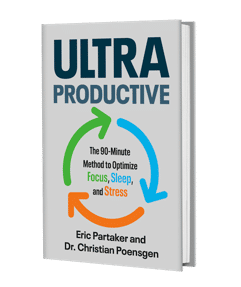
Ultraproductive: The 90-Minute Method to Optimize Focus, Sleep, and Stress was published in October 2026 and recommended by the Financial Times as a book to read that month.
 Eric Partaker is a CEO coach and thought leader in the fields of business, leadership, and peak performance. He’s known for helping CEOs, founders, and entrepreneurs scale their companies and become world-class leaders. Eric has advised Fortune 50 CEOs while at McKinsey & Company, helped build Skype’s multibillion-dollar success story, founded several companies, and helped scale more than six hundred businesses. In 2019, he was named CEO of the Year at the Business Excellence Forum. His work has been featured in The Wall Street Journal and The Economist, and on several major TV networks.
 Dr. Christian Poensgen is a scientist turned entrepreneur, writer, and executive coach. He holds a PhD (summa cum laude) on the relationship between stress and performance, and has spent more than a decade studying how research in neuroscience, physiology, and psychology can be translated into practical, real-world systems that help ambitious people perform at a high level without compromising health or well-being. Christian has served as senior fellow of the Future of Work think tank in the German federal parliament, as cofounder and director of the European Center for Digital Competitiveness at ESCP Business School, and as an agenda contributor at the World Economic Forum.
Eric and Christian are also cofounders of Ultra Labs, a coaching, training, and consulting company that helps ambitious people and organizations unlock their full potential. Learn more.
Selected sources
Cranston, Susie, and Scott Keller. “Increasing the ‘Meaning Quotient’ of Work.” McKinsey & Company, January 2013.
Cross, Rob. Beyond Collaboration Overload: How to Work Smarter, Get Ahead, and Restore Your Well-Being. Harvard Business Review Press, 2021.
Degroote, Cathy, et al. “Acute Stress Improves Concentration Performance.” Experimental Psychology 67, no. 2 (2020): 88–98. https://doi.org/10.1027/1618-3169/a000481.
Kleitman, Nathaniel. Sleep and Wakefulness. 3rd ed. University of Chicago Press, 1987.
Lavie, Peretz, Janine Zomer, and Daniel Gopher. “Ultradian Rhythms in Prolonged Human Performance.” ARI Research Note 95-30. United States Army Research Institute for the Behavioral and Social Sciences, February 1, 1995.
Mark, Gloria. Attention Span: A Groundbreaking Way to Restore Balance, Happiness and Productivity. Hanover Square Press, 2023.
Sonnentag, Sabine, and Charlotte Fritz. “The Recovery Experience Questionnaire: Development and Validation of a Measure for Assessing Recuperation and Unwinding from Work.” Journal of Occupational Health Psychology 12, no. 3 (2007): 204–21.