

by Janka Krings-Klebe and Jörg Schreiner
Why Decentralization Disappoints
At Porsche’s 2026 annual press conference, its CEO announced a familiar set of measures: the company would simplify its management structure, remove hierarchical layers and reduce bureaucracy. The intention was straightforward. A leaner organization would accelerate decision-making, reduce costs and allow the company to respond more quickly to changing market conditions. Similar announcements have become common across industries. As markets become more volatile and complex, organizations increasingly attempt to replace hierarchical control with greater autonomy at the team level.
Yet, the results often follow a recognizable pattern. After the first layers of management disappear, decision-making does not become faster. The number of meetings multiplies. Teams spend increasing amounts of time coordinating their contributions across the organization. Instead of greater agility, organizations experience more meetings, increased friction between teams, delays in resolving dependencies, and growing effort spent on alignment. These outcomes are often attributed to cultural resistance or insufficient commitment to new ways of working. A closer examination suggests a different explanation. Hierarchy is not primarily about authority. It is a mechanism for concentrating coordination. The hierarchical layers being removed performed important coordination work across teams. Their removal eliminates authority, but also the mechanisms that performed coordination across the organization. Hierarchy concentrates the coordination tasks required to align teams, resolve dependencies, and translate intent across the organization into defined roles. When hierarchical layers are removed, the coordination functions they carried must be allocated elsewhere. This requires a clearer understanding of what hierarchical structures actually coordinate.
Three Layers of Organizational Coordination
Starting from first principles, organizations exist to coordinate collaboration. Coordination refers to the mechanisms through which contributions are aligned, ranging from direct interaction to structured interfaces and system-level governance. Whenever value creation is sufficiently large or complex to require the involvement of more than one person or team, those contributions must be aligned. In small settings, people communicate directly, adjust their contributions, and resolve issues as they arise. Coordination remains local, informal, and largely invisible. As organizations grow, these conditions change. Once multiple teams contribute to the same outcome, coordination becomes unavoidable, regardless of structure. Relying on individual, ad-hoc communication patterns is still possible, but as the number of participants increases, it becomes excessively time-consuming. Moreover, agreements between individuals do not automatically create cohesion at the team level. Taken together, these bilateral agreements may still contradict one another or work at cross purposes.
Intra-Team Coordination
The first qualitative step in scaling coordination occurs within teams. Moving from individual, ad-hoc alignment to intra-team coordination requires a shared understanding of how work is coordinated and the willingness to accept binding rules within the team. As many self-managed teams experience, establishing this level of coordination can already be challenging, especially when rules are unclear and no one is able to claim authority.
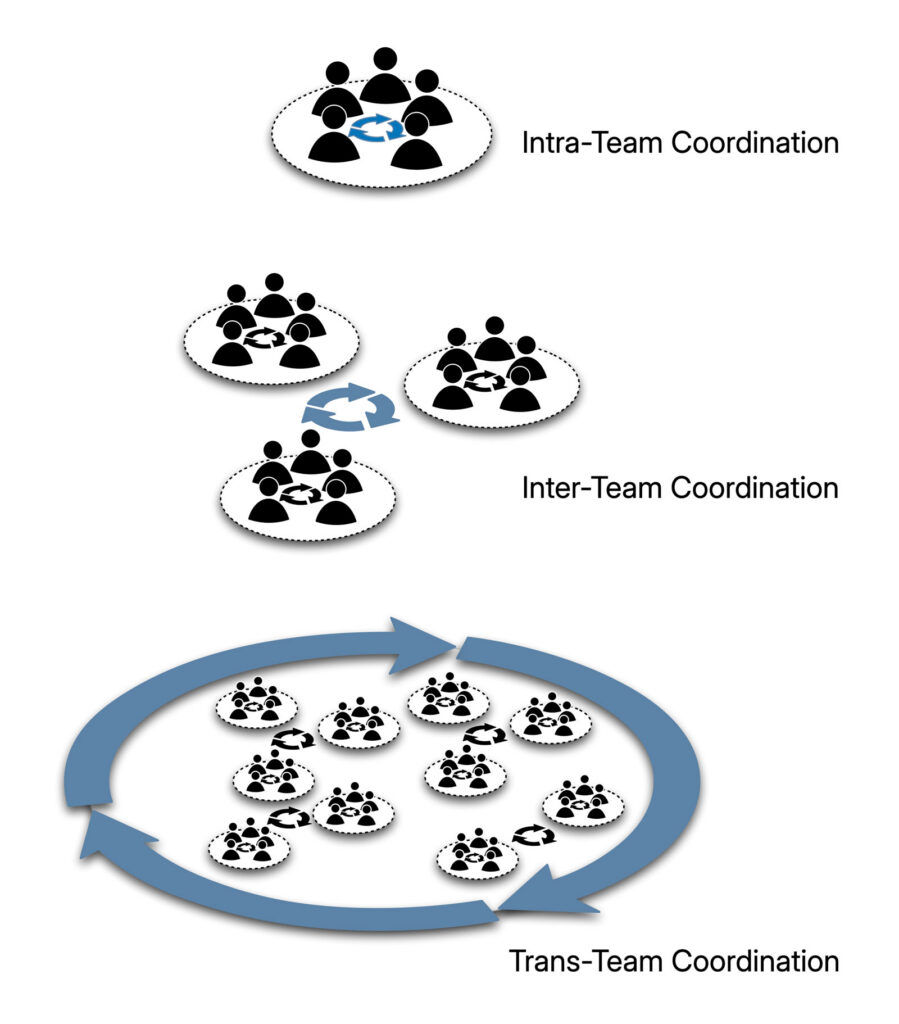
Ideally, intra-team coordination takes place within the team itself. Individuals align their activities and interact directly around shared work. Ownership is clear, and decisions can be made quickly because participants remain close to both the task and to one another. At this scale, coordination relies primarily on social mechanisms: shared understanding, trust, and frequent communication. Teams function as small adaptive systems capable of responding rapidly to local signals. This form of coordination is highly effective, but only within the limited scope of work that a single team can perform. Agile methods originated at this intra-team level, focusing on improving collaboration, adaptability, and delivery within small, cross-functional teams. Approaches such as Scrum and Extreme Programming enabled teams to become highly effective units by emphasizing fast feedback, shared ownership, and continuous improvement. At this stage, agility was largely synonymous with team-level excellence.
Inter-Team Coordination
Whenever multiple teams are required for shared value creation, coordination must extend beyond the boundaries of individual teams. Organizations therefore need mechanisms that enable inter-team collaboration: coordinate how specific teams interact, how their conflicts are resolved, and how their contributions fit together and evolve over time. The coordination task thus expands from local optimization to larger-scale productivity. Inter-team coordination aligns those teams whose contributions depend on one another. Unlike intra-team coordination, which relies primarily on direct interaction, this level increasingly depends on establishing how contributions connect through defined interfaces, agreements, and shared structures. At this point, agile methods begin to show their limitations. While they optimize feedback and alignment within teams, they provide only limited mechanisms for coordinating dependencies across multiple teams. Yet, in larger settings, such coordination is essential, as teams cannot operate independently from one another. In response, organizations introduce additional scaffolding, such as Large-Scale Scrum or the Scaled Agile Framework, to preserve short-term agile value-creation cycles across several teams. These are necessary to coordinate and synchronize the work of several teams. Ironically, it leads to the emergence of yet another caste of managers, albeit with more “agile” sounding titles. Of course, organizations need not adopt these frameworks. They can take inspiration and invent their own way of coordinating large-scale efforts. In non-agile organizations, inter-team coordination often emerges within product divisions through specific operations management and processes. Over time, most organizations develop effective solutions to handle recurring coordination tasks for fixed constellations of teams.
As organizations begin to systematically coordinate the value creation of multiple teams in this manner, the focus shifts from optimizing individual team performance to enabling recurring collaboration between teams. But this is not sufficient in a dynamic environment, where new challenges and opportunities emerge all the time. Such environments call for a more fluid structure of teams: teams need to increasingly work in dynamic constellations, not fixed ones. Coordination therefore has to extend beyond the existing constellations of teams. It must operate at the scale of the organization, establishing the conditions under which teams can connect and collaborate, regardless of prior relationships. This trans-team layer of coordination maintains coherence across the organization while allowing teams to recombine as needed. In doing so, it makes the organization more adaptable and effective.
Trans-Team Coordination
When constellations change and teams need to recombine quickly to respond to new customer needs, then coordination cannot rely on historical precedent or accumulated agreements. Teams then do not have the luxury to establish new collaboration contracts from scratch in a time-consuming process. Nor do they necessarily share the same assumptions about collaboration and alignment mechanisms. Each team may be accustomed to its own set of alignment rules, which do not easily transfer to new constellations. Establishing a new rule set for collaboration then recreates a familiar problem from intra-team coordination: who has the authority to define a new rule set for the new inter-team collaboration? If time is of the essence, leaving this to ad-hoc negotiations risks delaying or undermining the collaboration itself. This is where trans-team coordination becomes necessary. It establishes a shared and accepted basis for collaboration that applies independently of which teams are involved. The basic conditions of collaboration are shared standards that exist across the organization. These standards provide a common basis for teams to quickly connect and collaborate. In large corporations, these standards take the form of HR policies and governance practices. However, they are not designed for a dynamic environment. In a dynamic environment, these standards create barriers to collaboration because they rely on the very things that need to be overcome: assumptions of stability and fixed hierarchies for coordination.
To see how trans-team coordination operates at scale, consider Alibaba’s Singles’ Day, the world’s largest shopping event. Every year, in just 24 hours, Alibaba processes tens of billions of dollars in sales. But the real story is not the volume. It’s the way it happens. Behind the scenes, thousands of independent teams, from logistics, payments, product design, to customer service, are making live adjustments in real time. They’re responding to signals from the market as they happen, coordinating through shared data and platforms for instant cooperation. Singles’ Day has become one of the world’s most dynamic launchpads for new products. In the weeks leading up to the event, brands use Alibaba’s systems to design and test items specifically for that day. During the event itself, successful products can be rolled out and scaled rapidly. No pyramid structure could orchestrate that complexity. No alignment through control could respond that fast. It’s coherence through shared intent and live information. It works because every team knows what matters, sees the same context, and has the autonomy to act on it. They also have a common framework and mindset that facilitates connecting and collaborating in real time across thousands of dynamically forming teams.
That is what an entrepreneurial operating system looks like. One that senses, responds, launches, and learns at the speed of its environment. And that is what modern organizations might aim for when they restructure for the purpose of “decentralization.” The extent to which they can be successful depends primarily on the dynamic needs of their environment, and the interdependencies of structures they try to implement.
The three layers of coordination exist to manage these interdependencies so that the organization as a whole can create value in a dynamic environment, and evolve in sync with new challenges and opportunities. The three layers also differ in their temporal dynamics. Coordination within teams unfolds continuously around the value creation itself, coordination between teams occurs in recurring cycles of alignment, and trans-team coordination operates on longer time horizons, shaping the conditions under which the collaboration potential develops. The question, then, is how to make the three layers of coordination more effective without necessarily resorting to the old hierarchical structures.
The Coordination Challenge at Scale
A closer look at existing solutions to coordination reveals the two main dimensions of the challenge. First, the size and number of teams that are required to co-create value. Second, the stability of their inter-team cooperation needs. The number of teams largely depends on the complexity and size of their shared effort: you cannot build a spacecraft with a two-pizza team. The stability of their cooperation needs depends on the stability of demand for their product: your demand for food remains relatively stable, but your diet and the means of delivering it to you can change rapidly.
This means that for any collaboration challenge, the number of teams required for value creation and the stability of their coordination needs determine the required solution. Different combinations lead to fundamentally different coordination requirements:
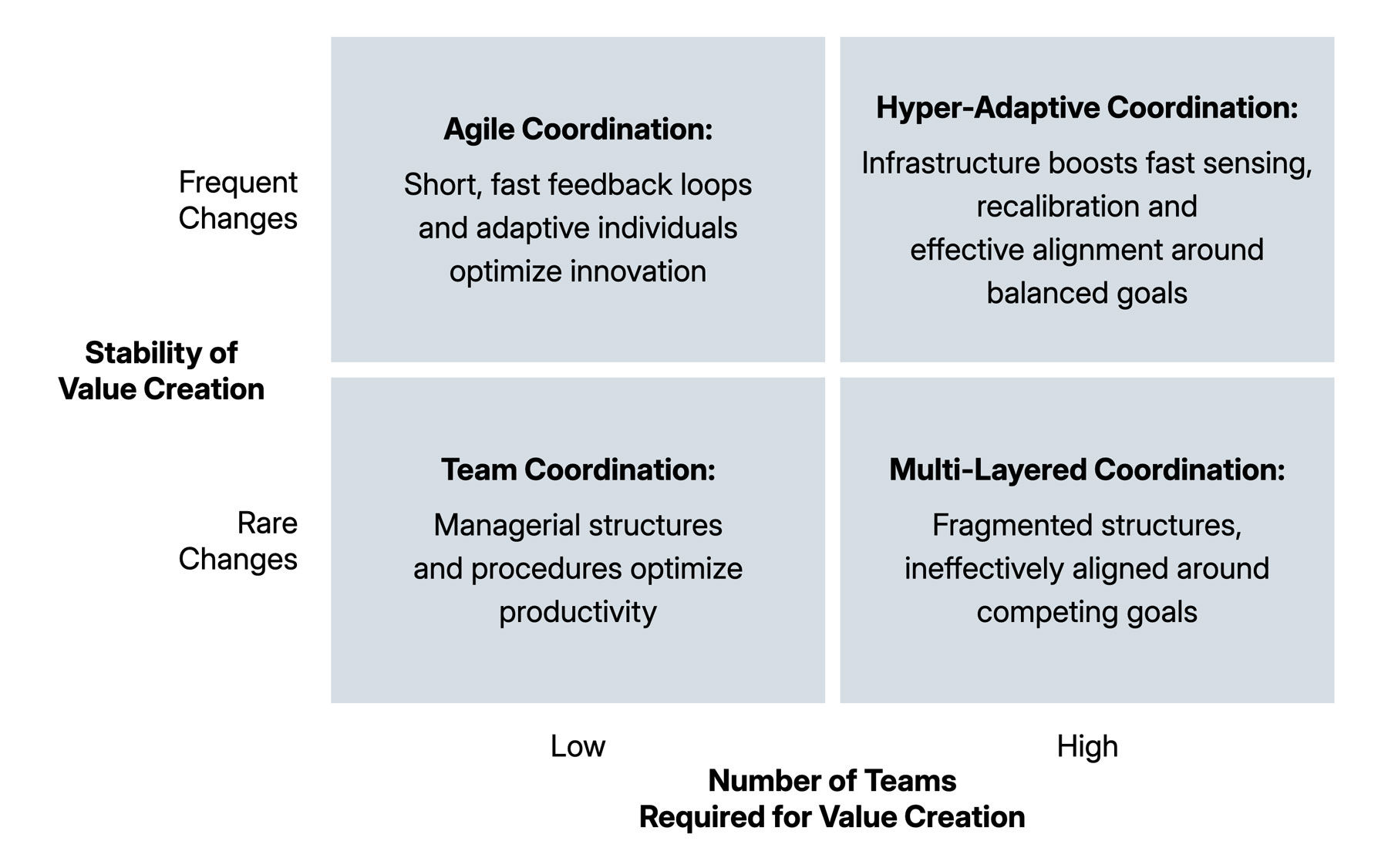
When only a few teams are involved, coordination can remain largely local, even under changing conditions. As the number of teams increases, coordination must be structured more explicitly. In stable environments, this structuring can be achieved with traditional management, fixed reporting lines and procedures that align the different contributions in the value stream. In dynamic environments, however, coordination cannot rely on these fixed arrangements to continually create value. When customers or markets demand new solutions, then the different contributions and the ways to create value need to adapt fast. This is where agile methods and self-management frameworks show their strengths and also their limitations. They begin to fail when the number of teams required for value creation passes certain thresholds. It is in this context that hierarchy emerged as a historical solution to large-scale coordination.
When Hierarchy Becomes a Constraint
Hierarchies can effectively structure and scale coordination across large numbers of contributing teams. But they mostly do it through fixed relationships: predefined roles, reporting lines, and escalation paths. In stable environments, this works well. In dynamic environments, it becomes a constraint. The fixed coordinating structures cannot adapt fast enough to changing coordination needs. As this adaptation gap grows, slowly but surely, it increasingly disconnects the governing structure from the operational needs of teams, leading to bad coordination priorities and decision lag. The governing structure then becomes a burden, not the support and enabling function it should be. It is no longer able to effectively balance short- and long-term goals. The organizational structure becomes fragmented, competing for resources and aligning on half-hearted compromises that serve neither productivity nor innovation. Many organizations respond by removing hierarchical layers. But this does not remove the underlying coordination demand. It only removes the structures that previously contained it. The operational dependencies between teams remain. What disappears are the mechanisms that made them manageable. Coordination then shifts from structured roles into the informal space between teams, where it becomes a continuous distraction: negotiating conditions for support, alignment meetings, and the intransparent forming of brittle alliances to win internal, and often personalized, power struggles. Power that was once clearly allocated becomes diffused, and harder to invoke for the long-term viability of the organization. Paradoxically, as the number of “autonomous” teams increases, so do their internal coordination costs. This is the structural challenge at the heart of decentralization.
To summarize, organizations struggle when the autonomy of teams is not matched by equally well-designed coordination mechanisms. Decentralization removes the coordination mechanisms of hierarchy, but until a replacement is found, organizations lose the ability to effectively align the contributions of large numbers of teams.
Reducing Coordination Complexity
One way to solve this challenge without relying on hierarchy is to reduce the need for inter-team coordination altogether by organizing work into self-contained value streams, as exemplified by Buurtzorg, a pioneering Dutch home healthcare organization. Teams are structured so that each unit can deliver value to customers largely independently. Most coordination occurs within the team itself, while inter-team interaction needs remain limited to a small number of topics and occasions. This approach is particularly effective when the number of teams required for value creation is small and their coordination needs are relatively stable. At Buurtzorg, small teams care for their own group of patients. Care planning, scheduling, and treatment decisions are handled within the team itself. Although interaction with central services exists, the delivery of care does not depend on continuous coordination with other teams.
A related logic appears in organizations where value creation requires multiple teams, but the number of interactions between them is deliberately kept small. Here, coordination is not eliminated but contained. W. L. Gore & Associates, for example, deliberately limits the size of its organizational units. The company’s founder, Bill Gore, observed that once groups grew beyond roughly 150 to 200 people, interpersonal communication and shared ownership began to deteriorate. To preserve effective and fast coordination, the company caps the size of individual units and establishes new ones as soon as this threshold is reached. By constraining the number of interactions, the organization limits the growth of coordination complexity while keeping its highly effective social coordination mechanisms intact.
Both approaches reduce coordination complexity by limiting either the number of teams involved or the number of dependencies between them. Both are effective as long as coordination needs remain relatively stable and bounded.
Building Coordination Infrastructure
However, not all forms of value creation can be organized this way. Many products and services require the coordinated contribution of multiple specialized teams, often under dynamically changing conditions. In these cases, coordination mechanisms need to continually evolve to fulfill their purpose, but without overburdening the operational system. This means that the total volume of coordination tasks rises, but overall coordination effort must not. Coordination efficiency needs a large boost. Only a few companies have mastered this challenge. They design their whole organizational system around ultra-efficient coordination infrastructure and highly adaptive value creation. This infrastructure defines how contributions connect: through shared interfaces, transparent commitments, and common standards for collaboration that apply across teams. Specialized tech and interaction protocols make dependencies visible, establish how value flows between teams, and act as the single source of truth for commitments, resources, and results. It allows coordination to scale across large numbers of teams and interactions. In the hyper-dynamic environment of the Chinese market, more such organizations can be found. The Chinese appliance manufacturing giant Haier provides another showcase of coordination infrastructure. Thousands of decentralized micro-enterprises operate as autonomous units responsible for specific customer solutions. A shared digital platform makes capabilities, resources, and contractual relationships visible across the organization, allowing micro-enterprises to discover partners and rapidly form collaborations as needed. Both inter-team and trans-team coordination are fully structured through shared mechanisms. In its recently announced five-year strategy for the coming years, Haier repeatedly calls for more improvements in coordination infrastructure, explicitly prioritizing cross-ecosystem collaboration, shared platforms and common standards as the foundation for autonomy and coherence. Not because Haier is lagging behind in this regard, quite the contrary: they know how much more they can gain through progress in this field.
Decentralization Does Not Eliminate Coordination
Behind the current trend towards decentralization lies the assumption that removing hierarchy and shifting to smaller autonomous teams will make organizations more adaptive or more productive. In doing so, they inadvertently also remove the mechanisms of efficient coordination. But large-scale decentralization does not eliminate the need for coordination. It shifts it. When hierarchical layers are removed, coordination has to move out of fixed roles and reporting lines and into the structures and rules that connect operational teams. The long-term viability of organizations requires that these new coordination mechanisms are made transparent, clearly governed and able to effectively balance short- and long-term needs. Without such coordination infrastructure, decentralization cannot succeed at scale and will likely be reversed. Embedding highly effective coordination routines, training and skill development into the interaction infrastructure of organizations makes large-scale decentralization viable. Without it, decentralization does not scale but collapses back into hierarchy.
 Janka Krings-Klebe and Jörg Schreiner are strategy experts, speakers and lecturers specializing in ecosystemic organizational transformation and operating models for complexity. They are co-founders of co-shift GmbH, where they work with organizations to move from hierarchical control structures toward adaptive, ecosystem-based forms of value creation. They are the authors of The Antifragile Organization: From Hierarchies to Ecosystems (2025), for which they were shortlisted for the 2025 Thinkers50 Strategy Award.