Artificial intelligence is not just reshaping technology but also how organisations create value.
IMD professor Yoshi Fujikawa argues that leaders need to move beyond traditional value chains and embrace a world of interconnected ecosystems, where customers, employees, partners, and AI all play an active role in value creation.
He explains why service is no longer simply an industry sector but a new logic for business, how AI is transforming marketing from human-to-human to human-to-AI interactions, and why competitive advantage increasingly comes from orchestrating value constellations, rather than simply selling products.
Yoshi Fujikawa is Professor of Strategy and Marketing at IMD.
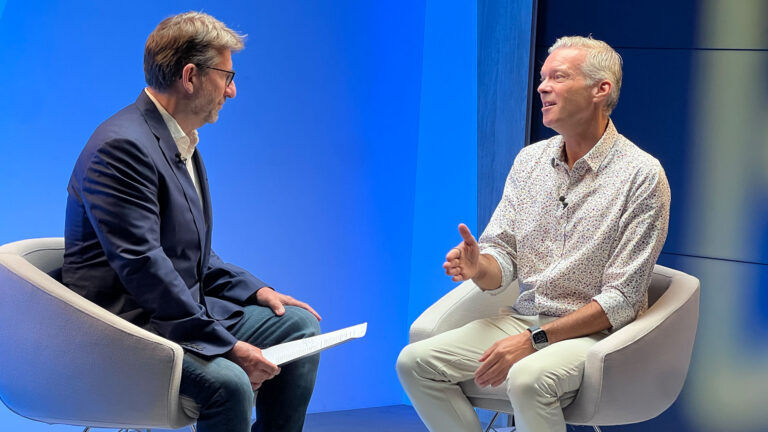
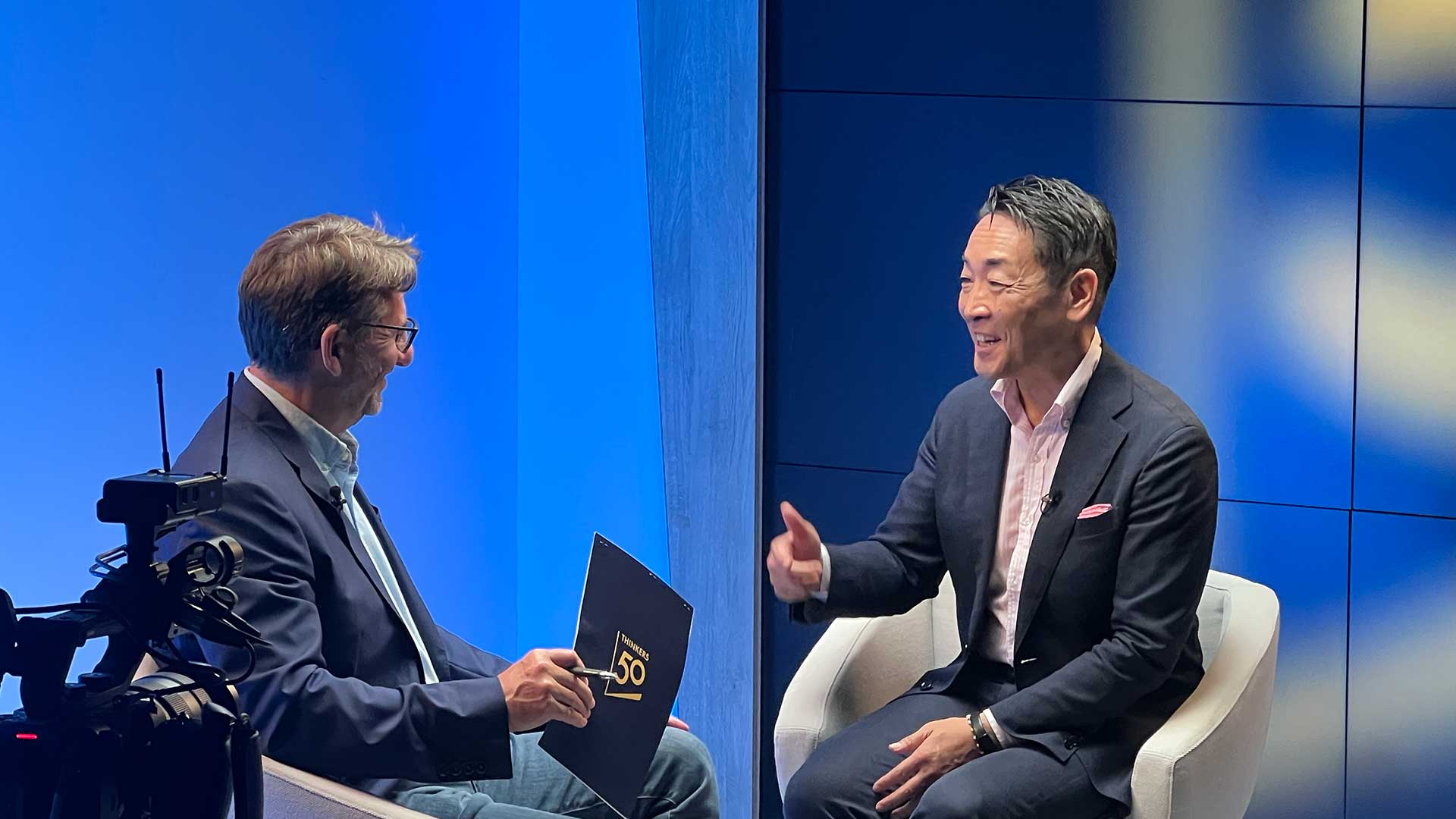
Watch the full interview or read the transcript below.
This interview took place at IMD’s signature Orchestrating Winning Performance program in Lausanne, 2026.
Transcript
Des Dearlove:
Hello, I’m Des Dearlove, co-founder of Thinkers50. My guest today is Yoshi Fujikawa, professor of strategy and marketing at IMD. His work sits at the intersection of strategy, marketing, service management, digital transformation, and executive learning. Yoshi reframes service not as a sector, but as a fundamental logic of value creation. One that increasingly depends on customers, partners, employees, platforms, and ecosystems, co-creating value together. Yoshi, welcome.
Yoshi Fujikawa:
Thank you, Des.
Des Dearlove:
I said just now, you argue that service is not simply an industry sector, but a fundamental logic of value creation, and we’re going to talk a lot about co-creation, but what are the implications for today’s leaders?
Yoshi Fujikawa:
Yes. I’m calling it a shift in lenses and there’s two ways of looking at the services. The first one, as you mentioned, the service as a sector. That’s a very traditional way of looking at the service. Look at the world saying that everything is basically physical at the core. The physical products and manufacturing, that’s always the core. But look outside and there’s also something non-goods. We have been calling it the services, like the first sector, physical goods, second sector, and whatever is leftover is the services.
That’s the lens one approach to look at the service. But if you look around the world now that everything is becoming a service, everything has a service. The manufacturing companies are becoming more and more service-based. Service companies also start handling the physical products and hardware such as Amazon Echo, Google Nest, and all of these. The tech companies are also holding the physical products for the purpose of getting connected and stay connected with the customers, see what the customers are doing and that creates the opportunities for the value co-creation.
So the implications for the leaders is that these shifting lenses opens up the opportunities for them to find, detect, and then also seize those opportunities for the value co-creation.
Des Dearlove:
So CK Prahalad, who is a great inspiration for Thinkers50 – yeah, absolutely – so whenever I hear the word co-creation, I always think of CK. But I mean, he was talking about it 10, 15 years ago, but some of the technologies we have now really make it much more feasible and much more possible. So how would you describe that sort of journey we’ve been on from what CK was describing, which at the time seemed off in the distance?
Yoshi Fujikawa:
Yes. So the co-creation is actually nothing new as you have just mentioned, but this technology and the current business environment actually opens up opportunities for all the businesses and all the companies and all the industries. That’s basically the phenomena called the “everything as a service”. And so now that you could actually reach out to the customers and technology help is always there so that you can stay connected beyond which that you have already provided the product to the customers, or you already sold the service, which the customer pays for.
That’s a traditional ending point of the value chain, traditional value chains, beyond which there has been open space, the white space right there. But now the technology actually will help you to go beyond the traditional boundary of the value chain, stay engaged with your customers and see what the customers are doing. And then also you can bring in other partners and stakeholders outside of organisations and so you can take the ecosystem approach to it. And now not just the digital technologies, now the AI.
And so now there’s what we have been calling service encounters, where providers and receivers meet and interact, that’s we call it service encounters, used to be human to human and now human with AI. And now the companies are employing AI to do their service operations, but now we as the consumers and our customers, whether that’s B2C or B2B, now we are sending our agents to plan my next trip to Singapore, for example.
And it is the AI who is actually visiting Booking.com. It is the AI visiting the airline website. It is my agentic AI that is actually comparing and then finding what’s possible and then comparing and then also deciding and suggesting what to do. And so far so good, but this also kind of challenges leaders how to think about value co-creation going forward.
Des Dearlove:
So you’re a professor of strategy and marketing. So let’s take the marketing part. And I know those two things are increasingly intertwined. It’s harder to separate, but taking the marketing, what you’re describing is a world where we’re no longer necessarily marketing to human beings. You’re sort of marketing to AI.
Yoshi Fujikawa:
Exactly.
Des Dearlove:
Yeah.
Yoshi Fujikawa:
You need to help AI to find you. You need to help the AI to evaluate you. You need to find AI to trust you. And so the way that you do the marketing is no longer one way from company to humans. It’s company and human and then AI. So you need to design that – who you want to bring in as the actors in your ecosystem and then how you’re going to orchestrate it.
And so the marketing is no longer done by the company; it has been co-creation, but now the co-creation is no longer between humans and humans, but humans and AI and then AI to AI. And so you need to design and then implement it. So that’s the opportunity right now that is emerging.
Des Dearlove:
So can you give me an example of how that sort of changes the marketing approach? I mean, what do we need to do differently to… I mean, it’s interesting language: win the trust and be discovered by AI rather than trying to appeal to human beings and trying to get their attention.
Yoshi Fujikawa:
Yeah. There’s a classic notion of customer centricity that is always there, where we have been using this concept of Jobs To Be Done, JTBD, Clay Christensen, there’s Thinkers50 terminology, I believe. And so whatever you do is basically at the end of the day is for the purpose of the jobs to be done as a north star.
And now going back to our discussion earlier, now technologies help and then everything was going on with AI. Now that you could actually get the jobs to be done, actually get done. So Jobs To Be Done as a concept from the marketing perspective is up to the point of purchase, or up to the point of sales, which is the traditional ending point of the value chain.
Des Dearlove:
Well, to some extent, that was job done!
Yoshi Fujikawa:
It’s kind of promised, right?
Des Dearlove:
Yeah, exactly.
Yoshi Fujikawa:
But when exactly the job gets done is actually through the usage stage… so that is beyond the traditional value chain. We call it “value constellation space”. And here that you need to make sure that a customer is actually using your product and that customers are using your service and that usage opens up the opportunities for you to co-create because usage generates the data with the technology and then that data help you to run the analytics and then get back to your customers and other stakeholders who may be helping the customer’s job actually get done in the value in use… so we call it a “value in exchange” and a “value in use”. Value in exchange is when the customer pays for it. That’s when the value is to be maximised through the market exchange. Again, that brings us back to the traditional ending point of the value chain. Value in use is always to be co-created through the usage stage of their customers. And so this is the opportunity now – that the value co-creation is actually taking a new shape.
Des Dearlove:
So if I’m understanding you correctly, I mean the job to be done as far as the customer is concerned could evolve over time. And if you’re tracking their changing needs at the point of purchase, they may have had one job to be done, but during the lifetime experience of using the service or the product, it could be that that changes. And if you’re tracking them and if you’ve got the analytics, you will see and be able to respond to the new job to be done.
Yoshi Fujikawa:
Right. So now the jobs to be done is kind of like dynamically evolving on both sides. I mean, the jobs to be done for the customers, the jobs to be done actually get done in the process of your operation. And so now the job to be done is not just a kind of static promise at the point of sales and a point of purchase. Now the job to be done is a kind of dynamically changing picture, kind of like a moving target of it.
But that moving target is co-created by customers and your actors – whoever that you’re bringing into your ecosystem – and then yourself. So the challenge for the leaders is now you need to orchestrate this much bigger picture of no longer just the value chain of your single entity and now you need to orchestrate the value constellation, just like, look at the night sky: connecting styles and stars, making meaning out of it. That’s a constellation. And so that’s what you are now actually tasked to do, but that’s actually a great task, an exciting task to do as a leader. And so that’s how I see it from the service innovation perspective.
Des Dearlove:
And CK would have been so excited by the possibilities now. I could just see his face lighting up. Okay. We talked a little bit about the marketing side. What does this mean for strategy? What does it mean for the nature of competitive advantage if you like? If you’re the CEO or you’re trying to direct the future of an organiaation, how does this change strategy?
Yoshi Fujikawa:
Right. So the strategy is always for long-term sustainable superior profit. And so strategy is not just for pursuing profit for the short term, it’s actually for making it sustainable, not for the environmental sense, but they are sustainable in terms of the competitive sense and then also superior, which is above the average of the industry structure. And so how this approach would help the strategy to actually make a difference is now the strategy you need to incorporate and there’s the value co-creation approach, and it’s no longer that you’re competing head-to-head through for the value in exchange, but the value co-creation in the form of the value in use is now possible.
And that’s where the differentiation is coming in. And because the AI is going to become pretty much commoditized as a tool, but the AI as an actor in an ecosystem helps you to build the trust and helps you to build the relationship with your customers and other stakeholders. That’s what’s going to stay as the source of your competitive advantage.
And so combining the service management approach in terms of the service innovation integrated into service, the strategy, will help you to make your strategy even more sustaining and your long-term profit is even more sustaining and then also superior to the industry average, which is competitors.
Des Dearlove:
I mean, obviously for a number of years now, we’ve witnessed how organisations like Apple encourage us to join the Apple ecosystem.
Yoshi Fujikawa:
Yes.
Des Dearlove:
You buy one Apple product and then there’s kind of an inbuilt logic, “Well, I might as well go all Apple, because I know that they’re going to talk to each other nicely and play nicely together.” So we’ve had this kind of ecosystem strategy for a while. We used to see it a little bit with… well, a lot with the software companies. How different is this world that you’re describing, the sort of AI enhanced and enabled work? How will that change what we as customers experience in terms of which products and ecosystems we choose to be part of?
Yoshi Fujikawa:
Yeah. So it’s an interesting world, right? Now the companies are competing… ecosystems competing with other ecosystems, and there’s some of the industries where customers are easily switching across each other, whether you’re using Uber today, or like Lyft, or like other platforms where the companies are building an ecosystem. And then none of us wants to be just confined into just one ecosystem. And because we always fear how much we are actually getting exploited, and that’s basically a trust issue of the ecosystem.
And so now the ecosystem used to be only kind of possible for like a tech firm, who operates in terms of the platform as a means to build the ecosystem. But now though, you don’t have to be the platformer to become the ecosystem builder. So for example, like Phillips, Sonicare, the toothbrush which I’ve just used this morning, and now the Sonicare toothbrush comes with the app and this app kind of evaluates in real time now, how I’m actually brushing my teeth, and most of the act of brushing the teeth is unconscious and that makes it kind of like a conscious part of what I do and then every day… and then also that stores the data and then that runs analytics and then that gives a lot of different kinds of advice.
And then this data can be shared with the service providers such as the dentists and then other product providers so that Phillips can build the ecosystem around the toothbrush. And so who thought about, like, 20, 30 years ago, like a toothbrush can become an ecosystem?
And now Nestlé just down the street, they are doing the pet food business called Purina, right? Initially Purina. Now dog food and pet food is just a product selling marketing business and B2C, and probably sometimes in a B2B, but now this dog food and a pet food can become the ecosystem as well because they’re going back to this job to be done. The reason that you are selecting Purina versus the other competitor’s product is that Purina comes with this app that basically helped me to become a better pet owner, become a better father and then a mother of the pet that I have. And because this helped me to manage what food that I’m providing to my pets, and then also that comes with a lot of different kinds of suggestions, and then the sharing knowledge and then how to become the… so there’s other pet owners also sharing their data as well.
And the same goes to Nike Run Club and many of these things are now open up for… anyone out there can become the ecosystem builder, which is very different from 20, 30 years ago where the world was only limited to those people who could actually build their tech platform such as Google and Apple and such.
Des Dearlove:
It puts me in mind of a few years ago when we were in China and we went to the factory of Haier. You know the white goods manufacturing firm?
Yoshi Fujikawa:
Yes.
Des Dearlove:
And they were very clear that they were building ecosystems around the refrigerator in the kitchen.
Yoshi Fujikawa:
Yes.
Des Dearlove:
So the refrigerator was going to be able to tell you what meals it was capable of-
Yoshi Fujikawa:
What you have in there, what’s possible.
Des Dearlove:
… and we order whatever you need there and all that. So it sounds like some of that is coming to pass. It seemed very futuristic at the time, but obviously things catch up very quickly.
Yoshi Fujikawa:
Yeah.
Des Dearlove:
There is a sense of an arms race with AI very much, the tech companies in particular, but all companies at the moment seem to be absolutely throwing money. It almost feels like, as I say, an arms race, who’s going to be first to get to the moon? And do you think that this is a window that’s going to close at some point? Because what tends to happen with ecosystems, as you say, we all like to think that we’re free to move between different ecosystems, but it feels like there’s a lot of competing AI tools at the moment, but it will consolidate.
We saw it with the motorcar back in the beginning of the 20th century. There were lots and lots of car companies and then gradually it winnows down to a few giants. Is this window, particularly with AI, is that going to stay permanently open or will we see this… are we in a kind of a special moment where it’s winner takes all?
Yoshi Fujikawa:
For the user side of the technology?
Des Dearlove:
From a strategy point of view, I mean, there does seem to be a great deal of almost panic in the marketplace in terms of the investment in AI as if a more measured approach isn’t going to serve. So we’ve got to do it now and we’ve got to be first.
Yoshi Fujikawa:
So I think in terms of the companies who are employing AI for their strategy – not the AI companies propagating the AI solutions to their clients – in terms of the companies who are employing AI for their strategy, I think the more important thing is not just to rush into the AI investment for the sake of the AI investment. You need to design, going back to what we discussed earlier, you need to decide what role that AI plays as an actor in the ecosystem, what role that they’re actually going to play, and then how you’re going to do the resource integration as we call it.
The AI may then have access to the resource so that they can find what’s available out there, whereas the humans can also have access to their resources and then our time, our knowledge, our skills… and then also other stakeholders that you invite in an ecosystem have their access to their resources.
And so it’s basically value consolidation, it’s resource integration across different actors, including you. And so when it comes to your question, going back to your question, that what role that you want to assign the AI to play in this ecosystem is far more important to comparing rushing into the AI investment for the sake of just expanding an investment and for that. So I think what we need to really worry about is more about the ecosystem design too, from my perspective, rather than just how to invest AI for the future.
Des Dearlove:
This is fascinating stuff and I could happily sit here and talk to you for hours, but we are running out of time. And I do want to ask you a final question. The 2026 Thinkers50 London Summit is taking place, I mean, as we’ve sort of hinted at, obviously at a moment of technological disruption and institutional uncertainty, what kind of leadership mindset is needed now and what would be your advice to…
We’re bringing together some of the world’s leading management thinkers, but also our new Leaders50 list is coming and they’re going to convene together for the first time at the 2026 Thinkers50 event. So there’ll be leaders in the room and there’ll be thinkers in the room. What would your advice be to the leaders and how should they approach this brave new world? What sort of mindset is needed to really take advantage of these opportunities?
Yoshi Fujikawa:
I will start with a very, very classic mindset, which is customer centricity again. So the customers’ jobs to be done is always north star, that is not what you want to be changing. And that’s from my perspective, that’s how the world actually operates. And so the customer job to be done, although it could be dynamically changing as we discussed earlier, is always a north star.
And now how to get there, by redesigning orchestration of the value co-creation in a multiple actor ecosystem. But in order to do that, you need to make sure by deciding or reconfiguring three, four things. And one is who are the actors that you want to invite and what role that you want to assign them to play and which resources that you want them to have then access to. And then how you want to change the rules of resource integration.
And so that’s the kind of like, the mindset that we should all have in order for us to kind of detect and grasp those opportunities that are actually emerging right now. And so that is the thinking underneath what’s actually happening on the surface. And so that’s how I see it.
Des Dearlove:
And finally, if you were talking to a leader today, should they be optimistic? Is this a time of opportunity or a time of threat?
Yoshi Fujikawa:
I’m super optimistic about it and this is actually the most exciting time in terms of value co-creation. And so the world is actually helping every single one of us to see the world in this way, which used to be limited to only those organisations and individuals who have that access to… and that, but now it is open up for everybody to see that.
Des Dearlove:
And you use AI all the time?
Yoshi Fujikawa:
I do.
Des Dearlove:
What do you use it for?
Yoshi Fujikawa:
I do. I just brushed my teeth right there with the Sonicare, just right before I rushed into this interview!
Des Dearlove:
Yoshi, thank you very much.
Yoshi Fujikawa:
Thank you.