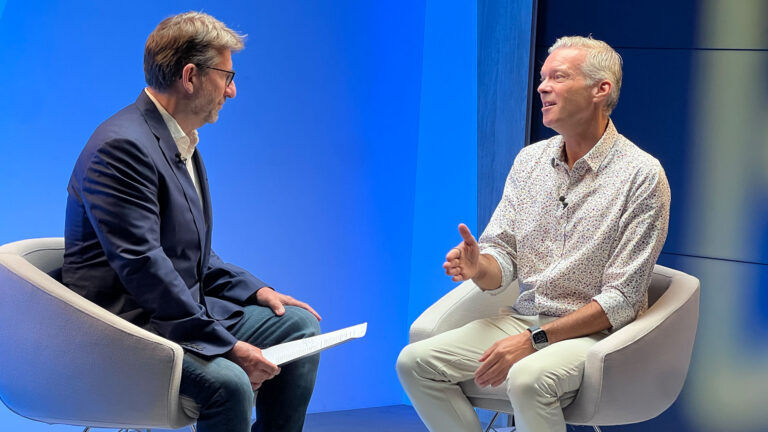
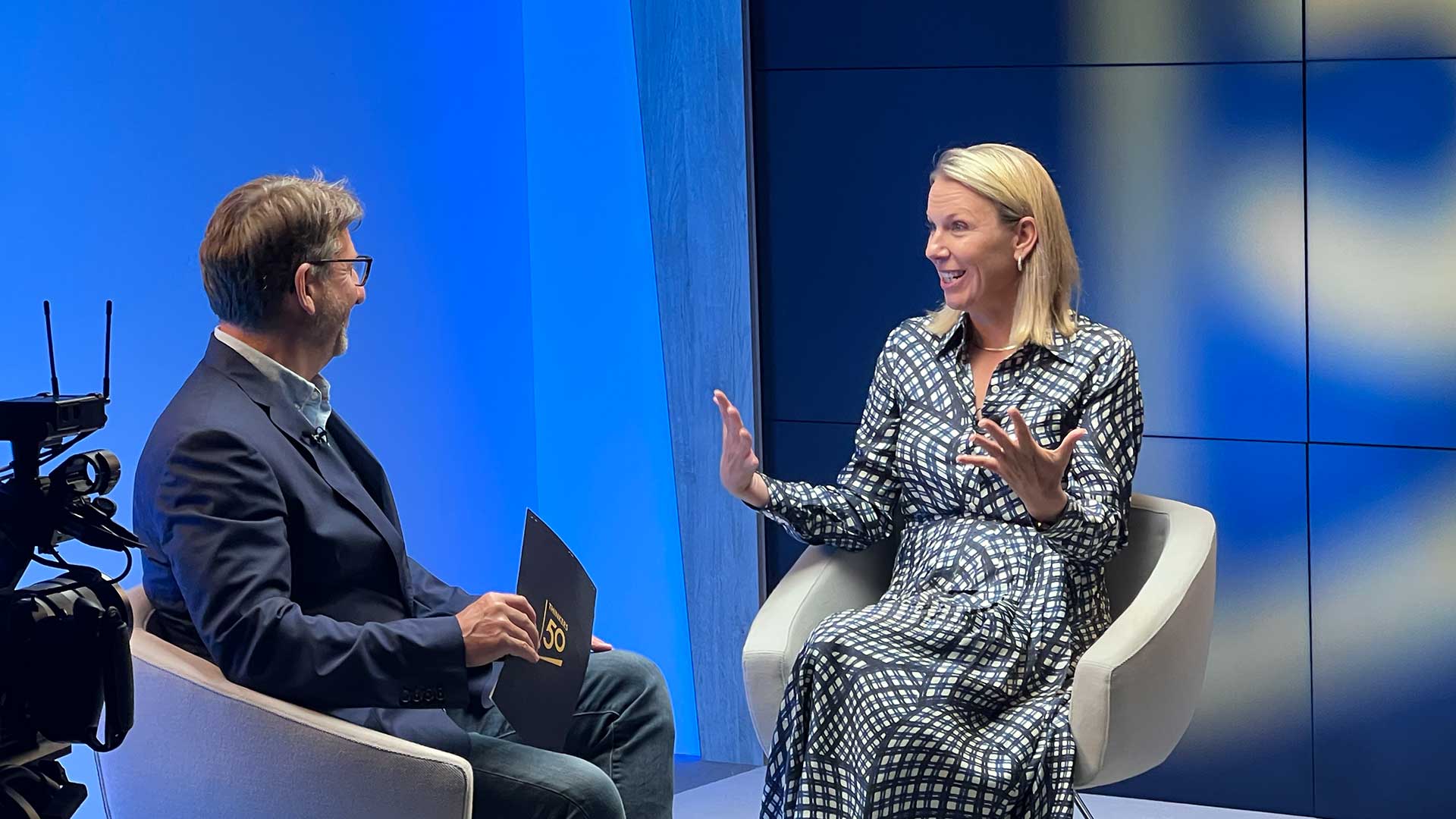
Human connection has never mattered more. As organisations grapple with uncertainty, polarisation, and unprecedented technological change, IMD professor Marissa King, argues that leaders need to think differently about the relationships that underpin performance.
In this interview with Thinkers50 co-founder Des Dearlove, she explains why the structure of our networks – not simply the number of people we know – shapes innovation, resilience, collaboration, and trust. She also explores how leaders can intentionally design stronger connections within organisations, what AI means for the future of human interaction, and why bridging divides may be one of the defining leadership challenges of our time.
Marissa is Professor of Leadership and Management at IMD and author of Social Chemistry: Decoding the Elements of Human Connection.
Watch the full interview or read the transcript below.
This interview took place at IMD’s signature Orchestrating Winning Performance program in Lausanne, 2026.
Transcript
Des Dearlove:
Hello, I’m Des Dearlove, co-founder of Thinkers50. My guest today is Marissa King, professor of leadership and management at IMD. A sociologist and network scientist by training, Marissa’s work explores how the patterns of human connection shape performance, resilience, collaboration, and change. Her book, Social Chemistry: Decoding the Elements of Human Connection challenges the traditional idea of networking, showing that our relationships are not random, but follow patterns that can be understood, measured, and changed. Marissa, welcome.
Marissa King:
It’s a pleasure to be here with you.
Des Dearlove:
The book Social Chemistry argues that relationships are not random. What do leaders most often misunderstand about our network relationships?
Marissa King:
Oftentimes when people are thinking about networks, their mind immediately shifts to thinking about networking. And when that happens, they start to really focus on the number of the people that they know. But instead of the number of people that someone knows, it’s actually the architecture or the form that those relationships take that are at the key to understanding human thriving, how organisations work, and how to make society more cohesive.
Des Dearlove:
And you identified three kind of broad network styles or types. Can you explain what the three are?
Marissa King:
Absolutely. If you look at more than 50 years of research in the social sciences, we know that most relationships can be described as either expanding, brokering, or convening. So expanding networks are just large networks. They help with influence and visibility. Brokering networks, on the other hand, tend to straddle different social worlds. And in straddling those different domains, they tend to promote innovation. And then finally, we can think about convening networks where your contacts are closely related to everyone else within your network. That tends to promote trust and resilience and bandwidth. So across these three types, there are various different benefits, but each of those different structures have an important place in making organisations, social relationships, and even your personal relationships work together well.
Des Dearlove:
So I appreciate they all have their value, but is one more important for leaders and leadership now at this moment in history?
Marissa King:
I think that’s a really great question. So each of these have different benefits. They also have different drawbacks. And the key piece is that we’re constantly creating and recreating these relationships and they need to change in response to what’s changing in the environment. So if you think about what’s happening in this moment now where we’re facing increasing fragmentation, increasing polarisation, and immense uncertainty, it turns out that brokering type networks, which are really focused on adaptability, combined with these convening networks which provide resilience are sort of the magic ingredients for really thriving right now.
Des Dearlove:
Okay. So what does that sort of look like if you are in a leadership position? We’ll get onto how you cultivate those relationships, but looking in from the outside or from the inside looking outside indeed, what does that look like?
Marissa King:
If I were a leader today or being a leader today, as I’m thinking about how do I manage these competing priorities, if you think about the challenge with most existing organisations to restructure an organisation, it’s immensely costly. It’s really difficult and it comes with a lot of pain. But instead, if I start to think from a network perspective and think about how can I redesign these types of interactions, we can do this. We could go out this afternoon and think about how to do this. So there are a couple different levers to pull from an organisational design or team design perspective. So we can think about the way that we structure teams. I spend a lot of time working in emergency departments where teams are on a day-to-day basis being designed and redesigned. So if you create stable, repeated interactions, you’re going to get a convening network.
If you have more diversity in terms of rotating people in and out of a team, you’re going to get a brokering network. The same goes with physical space. So how we’re designing offices and layouts or thinking about how we construct virtual work, all of those work together and are levers that we can pull to think about how do we get both of these properties. And what’s amazing is that if you think about social life in general, we don’t get to choose who our neighbours are or who our kids are friends with. So there are many aspects of our lives that we don’t get to design. But what’s powerful about the workplace is the workplace is one of the only places that we can consciously design social interaction. So these design levers that we can pull in the workplace are incredibly important.
Des Dearlove:
Okay. I have to say though, I do know some parents who try to choose who their kids’ friends are.
Marissa King:
Does it work out?
Des Dearlove:
Yeah, it doesn’t usually work out.
Marissa King:
No, it doesn’t usually work out.
Des Dearlove:
But they think they can. No, coming back to, I mean, I’m always fascinated by we’ve all seen the organisational charts, which is the kind of the formal network for an organisation. But I think we all sense that really organisations run on informal networks. How does that play out and how is that changing the nature of work, particularly now that we’re not necessarily under the same roof? As you talked about, you mentioned hybrid work, people are scattered all over the world. How do the formal and the informal play together?
Marissa King:
I love that question. If we think about this question, how we think about how these play together, really a network perspective or network lens is mapping this informal architecture. And some of that does directly map onto formal positions. So who I put in a role, how I construct a team, those formal assignments impact and influence informal relationships. But there’s a whole world that’s operating behind that, as many of us know, and starting to surface that, and conscious that, is really critical because that’s where much of this work gets done. And it’s also a tool that we can play with and redesign in a much more rapid and adaptive way to meet these changing demands of uncertainty and the rapid speed at which things are changing now. This informal architecture is much easier to design and redesign both through formal positions, but that’s costly. We can think about other ways that we can play with time and space, which has a huge imprint on what these informal interactions look like.
Des Dearlove:
As you say, restructuring, when you kind of re-engineer, re-architect an organisation is very time-consuming, very expensive, particularly if you can do it in other ways and informal ways. But what should be… I mean, I’m imagining a leader who wants to make change in an organisation. How can you engineer these sorts of networks? You mentioned leaders, but is that a mindset thing where you think, “Actually, I’m not going to think about the organisation almost as a physical thing. I’m going to think about it as a system of networks or one big network or an ecosystem,” or is there a different way of thinking?
Marissa King:
I love that, thinking about it as a mindset shift. And in many ways when I’m thinking about this, I’m trying to do two things simultaneously. One, I’m trying to allow someone to visualize what this network structure looks like. So first is giving the vocabulary – or the mindset in your words. So when I walk around a room or an organisation, I just see these maps in my head. But without that visual ability to understand these are the fundamental elements or fundamental building blocks of social systems, without that architecture, we can’t play with the building blocks. So the first piece is giving this mindset shift to understanding what the architecture looks like. And from there you can start to understand each of these different architectures or types has behaviours underlying it. So if I want to create a larger network or a more expansive influence network, onboarding is key. So how I’m bringing someone into the organisation, or you can think about individual behaviours.
So both of these are in play, but the first piece is being able to see the system and then thinking about the behaviours, either individual behaviours that you’re trying to promote or encourage, or system or team level dynamics that can also promote these same benefits.
Des Dearlove:
I think even now, a lot of leaders, when you talk about networks, probably see it as a sort of soft side of management, but what does the science tell us in terms of the actual impact of networks on performance? Which, at the end of the day, is what CEOs are concerned with.
Marissa King:
Yeah. I think it boils down to this idea. We oftentimes think about relationships as being soft skills, but where we started, relationships aren’t random. They can be mapped and measured. And once you take that shift to thinking about relationships being mapped and measured, those maps have extraordinary implications that we can tie to performance. So the form a network takes impacts everything from an individual perspective, pay, promotion, performance within side organisations, innovation, creativity, resilience, even health and wellbeing. So how the form that your network takes has an impact on premature mortality or early death that increases or reduces, if you have a good network, by about 50%. So in every dimension of both human and organisational thriving, the form and the quality of our relationships has an extraordinary and measurable impact.
Des Dearlove:
Okay. No, that’s important. The mortality one is I think at any measure that’s an important performance measure. Is there a danger that we overthink this and we take the, dare I say it, the fun out of the sort of social side of work that we’re… I mean, we’ve all met people at networking occasions where you start talking to someone and you can see them looking over your shoulder and thinking, “My next mission is to talk to that person.” I mean, is there something to be said still for the spontaneity or are we moving away from that and being more deliberate?
Marissa King:
I love that. So certainly the most important thing I believe is just in the joy of human connection, the spontaneity. And the spontaneity is actually what makes networks work. So that calculated approach of, “If I just meet this person, then my life’s going to…” One, it doesn’t work. But two, you’re right that it can diminish that sense of joy. And there’s really important research that shows that this type of interaction typically is associated with one specific type of interaction, which is an instrumental professional interaction. So I’m going into a professional relationship with this idea I’m going to get something out of it. But we know that we can overcome that by thinking about entering that interaction with a sense of giving instead of, “What am I going to get out of it?” And then you overcome this instrumental component. And I would say that’s my biggest worry in this profession is that people think I study networking, not networks.
And the network piece is so key because if we don’t think intentionally about our relationships, our networks, which are one of our most valuable assets, end up being accidents. And we all have relationships. Our decision to sit down and have a conversation today is going to have an impact on our relationships or our network. But the problem is that most of the time that’s done unconsciously. But by thinking more consciously about those connections, it benefits not just you as an individual, but also organisations and everyone else around you. And as you mentioned and where we started, there’s just joy in that connection and keeping that alive is so, so critical.
Des Dearlove:
We emphasize this or I mean, I’ve witnessed it many times at Thinkers50 events, particularly our big event in November, is that people come into the room and there’s a serendipitous bumping into people. And it’s always so heartening afterwards to hear that a professor from Harvard is suddenly collaborating with someone that they hadn’t met and they met them at our event and they wouldn’t have spoken to each other. That’s the great joy of physical events in a world that we feel that we still get many benefits from the virtual connections, but actually sometimes the fact of being put into a space and bumping into people can still be very valuable. You see that as well?
Marissa King:
Absolutely. I mean, one, there’s spontaneity and joy and connection. That’s where new ideas and innovation comes from, this recombination. But there is a component of that that I believe, and I think most of the research suggests, has to happen in coming together face-to-face. So there are human needs that we absolutely have to have that really can’t be met without the physical component. So making eye contact, touch, and just simply the presence that exists when you’re face-to-face. And that’s not really repeatable if we think about other domains and formats. So there’s something just profoundly human about connecting through our human senses in particular.
Des Dearlove:
And we are more attuned. I mean, I think when there’s even a little bit of separation in time, it’s much harder to read body language… it’s a different experience. Adam Grant, who’s one of the people whose work we’ve promoted over the years, he wrote a book, Give and Take. And one of the very satisfying conclusions of that was he talked about givers and takers and matchers. And in the big scheme of things, I think he came out with saying that actually givers, people who give generously, come out on top. Not always because takers can sometimes obviously take advantage. But it was pleasing to hear that those people that give the most also tend to do well and even best in career terms.
Marissa King:
Yeah. And it makes perfect sense if you think about just how relationships work, that idea that the norm of reciprocity is critical to human functioning. And so the idea of thinking about what can I give, it opens up a whole different world. And I think what’s particularly interesting about Adam’s work and work that’s built on it is it’s not also just one-to-one giving that matters, but if we think about giving one to many. That is where I think the immense power comes. And networks are amazing in the sense that they really work on a collectivity. So everything we all collectively put in, it just amplifies far beyond anything that our one-to-one exchange could ever create. And that’s where I think this power of the collectivity coming together through generosity is really, really key.
Des Dearlove:
Sort of a network effect.
Marissa King:
A network effect.
Des Dearlove:
I have to ask you, we’ve talked and I’m delighted that we’ve talked so much about the human side. I have to ask you about AI and how that’s going to change how we network and how deliberate we are in terms of selecting and navigating our social connections. Where do you see the impact? And is it a good impact or not-so-good impact?
Marissa King:
I think it’s transformative, there’s no doubt about it. And there are a couple ways that I’m seeing this play out now. And what is different about AI than anything that’s come before I would say technology-wise is that it’s relational so that it is actually an agent interacting with you. And so what is… the question becomes, what happens when you put this agent that has real human-like tendencies within an ecosystem? I think one of the things that I’m noticing that first happens that I would say is more on the worrisome side is that people sort of forget the basics of human interaction. You put AI in a conversation with a team and everyone just starts defaulting to talking toward the agent. And I think the antidote to that is we need to think very, very carefully about how we’re designing these systems, how we’re designing these network architectures and thinking about what is AI’s role in it. So it’s an active agent. So where in this structure does it fit?
And what we know from early research is that when this is being deployed in organisations, it’s actually creating more of this convening-like structure. So everyone is interacting with everyone else, which kind of goes contrary to what you would expect. So I think people often are worried about, “Oh, there’s going to be an increased sense of alienation,” but actually it seems like that when you introduce AI, it’s creating a greater sense of this convening network. Which you could be like, “Okay, that’s great. That could promote trust, that could promote more communication.” But the downside is if that’s happening on a single platform. So the AI has been trained with one mental model in mind, then everyone is actually… the downside to that network type is that it promotes group think. So everyone’s actually converging on a dominant model of thinking so that all these side conversations we’re having with AI before we go into the meeting means that the discussion we have in the room is lacking that diversity, lacking that innovation, and also maybe lacking in just the basics of human communication that we still fundamentally need.
Des Dearlove:
I can see how it could be detrimental to the spontaneity, in particular. I mean, I guess we’re training AI agents to… as you say, we’re uploading a mindset before we go in, which doesn’t allow us then to, or potentially could narrow the lens that we’re looking at. “This person is irrelevant to what I’m here for according to what I’ve been programmed for,” rather than that human thing when we just think, “That’s interesting.”
Marissa King:
Exactly.
Des Dearlove:
Yeah. Okay. So the Thinkers50 London Summit this year is all about leading in the fragmented world. How does networking impact on how leaders view their role and what they should be doing? I think we all are experiencing the fragmentation, but what does it mean in terms of social networks?
Marissa King:
So if you think about from a network perspective, what fragmentation looks like, it looks like that there are a lot of disjoined groups, oftentimes with polarised opinions and different viewpoints or different experiences that are disconnected. So in my world, this is right for what I would call brokering types of behaviours. So we need to create a sense of connection across these disjoined or fragmented groups. And I think many of the discussions now are focused on, all right, we need culture change or we need to have courageous conversations to address what’s underlying it. But that is very, very difficult. Changing culture arguably is one of the hardest things to do. And how do you facilitate these courageous conversations when you need them happening across multiple dimensions?
And the solution to that is really thinking about how can we create ties across these groups that are based on fundamental human experience? So we may have very different viewpoints or very different experiences, but at the end of the day, even through our own conversation thus far, family is likely deeply important. Most people love to laugh. How do we create these connections and start by seeing each other eye to eye, human to human, to start bridging across these groups? And so in this moment right now, this brokering type of network is really critical to starting to overcome fragmentation.
Des Dearlove:
Just imagine if you were organising an event and you had a bunch of really interesting people and the event organisers, in this case, are trying really hard to bring together business leaders and management thinkers in the same room and to really foster these courageous… I’m only asking this for a friend.
Marissa King:
Yeah.
Des Dearlove:
What would you advise that event organiser to do and how can we amplify some of those effects?
Marissa King:
I would start by not trying to encourage courageous conversation. I would start by trying to encourage deeply human conversation. So the conversation I would want to have is what is one of your moments of greatest joy? What matters to you most? And in those conversations, what we’re going to realise is people just by being humans share our most deepest values. And from that point of shared experience and shared values, then you start to just say, “Okay, we’re all human here. We all want to achieve the same thing.” And that’s starting to lay the foundation for this broader structural approach where we need to start connecting across points of difference.
Des Dearlove:
Okay. Fascinating subject.
Marissa King:
Yep.
Des Dearlove:
We’re running out of time. We’re going to have a bunch of business leaders in the room. What would be your advice, if you were speaking directly to them in terms of your research and what they can take away from our conversation, what would be the takeaway? What would you like them to remember from this conversation and how could they put that into action?
Marissa King:
That relationships aren’t random, they’re arguably the most valuable asset we have. Both as organisational leaders and as human leaders, we need to think about how we can promote relationship thriving and create leadership through connection.
Des Dearlove:
And what will distinguish the leaders that do best in the future in terms of some of these skills?
Marissa King:
In this day of age where there’s so much uncertainty and so much unpredictability, the only way that you’re going to get simultaneously adaptability and resilience is by thinking about human connection. So in this moment, human connection is more important than ever, and we deeply need to lean into it, and it’ll also bring more joy, I think, into the world as a whole.
Des Dearlove:
Marissa, thank you very much.
Marissa King:
It was a pleasure.