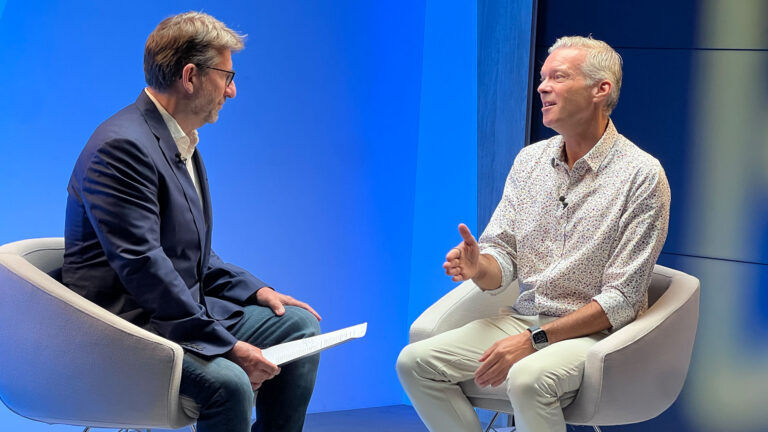
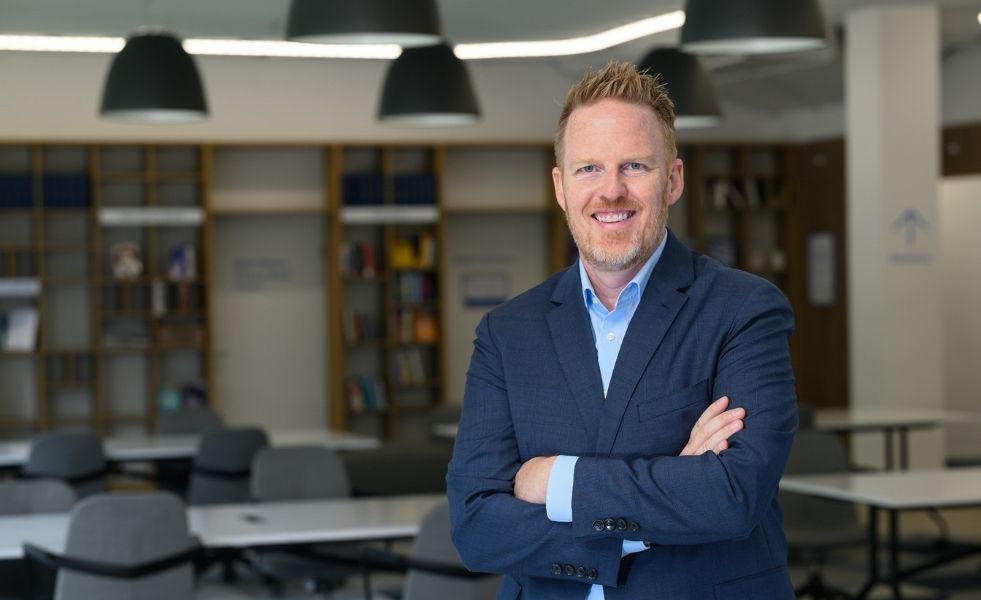
David Bach is the president of IMD, Nestle Professor of Strategy and Political Economy, and a globally recognised innovator and expert on management education. In this conversation with Thinkers50 co-founder Des Dearlove, he explores what leadership demands in an era defined by geopolitical uncertainty, rapid technological change, and declining trust in institutions.
Drawing on insights from his Leaders Unplugged podcast, David argues that values – not formulas or playbooks – provide the compass leaders need when the future is impossible to predict. He discusses why business must become more comfortable with collaboration, how AI is reshaping management education, and why leaders should have the confidence to admit they don’t have all the answers.
Watch the full interview or read the transcript below.
This interview took place at IMD’s signature Orchestrating Winning Performance program in Lausanne, 2026.
Transcript
Des Dearlove:
Hello, I’m Des Dearlove. I’m co-founder of Thinkers50. My guest today is David Bach. David is the president of IMD and Nestle Professor of Strategy and Political Economy. A globally recognised innovator and expert on management education, he leads IMD at a time when executives face geopolitical turbulence, technological disruption, and profound questions about trust and purpose. Through his Leaders Unplugged podcast, David speaks candidly with CEOs, change makers, and thought leaders about what leadership really demands now.
David, welcome. It’s great to see you again.
David Bach:
Thank you for having me.
Des Dearlove:
Leaders Unplugged, the podcast, you really try to have deep conversations with leaders in the modern age. What have you learned from those conversations?
David Bach:
So you’re absolutely right. Leaders from across the spectrum in the corporate world, in government, in academia, and not necessarily people at the very top of organisations. We very much believe at IMD that leadership happens across organisations. I think what I’ve learned is yes, there are techniques, there are certain things that good leaders tend to do, but at the end of the day, there’s no substitute for values. I think if you have these deeper conversations, you’ll realise at the core when you have to make a decision, you fall back on your values. And that’s what struck me the most actually about this.
Des Dearlove:
And that sense of the North Star, as it were, pole star, that helps people navigate through especially the sort of turbulent times that we’re seeing at the moment.
David Bach:
I think so, because there are often no answers. There is no playbook that you can fall back on. The uncertainty, the volatility is built in. And so what is it that you rely on in the end? It’s the values of your organisations, the values of your profession, and at the end of the day, your personal values.
Des Dearlove:
And they’re very much conversations. I mean, they’re not lectures.
David Bach:
Correct.
Des Dearlove:
They’re not seminars. And then obviously that’s deliberate and presumably you get a more kind of human response from people.
David Bach:
Yeah. And it’s something that I think I’ve experienced since taking over IMD. You can have all the credentials, you can be well-prepared, you can have your strategy document, but leadership is interpersonal. It’s the human connection, how you relate to individuals, how you relate to groups, how you motivate people, how you mobilize them. And so I find these conversations to be much more revealing about who somebody really is as a leader, what makes them tick than something that would be a little bit more canned and prepared.
Des Dearlove:
So who stands out among your guests? Who are the memorable ones or what are the memorable moments?
David Bach:
I mean, there’s so many. So I’ll give you three examples. So I had Gideon Rachman on from the Financial Times. And that was great because Gideon is one of the people I look up to, I think about when I think about the podcast. He has this great podcast with the Financial Times, The Rachman Review. And having him on the other side was really great because I really got a sense of how he feels about current affairs and how concerned he is about the challenges that democracy is facing, for example. So that was really great.
But also I’ve had the new president of the International Olympic Committee, a former gold medallist swimmer, Kirstie Coventry, former national security advisor to President Biden. So it’s a very eclectic group of people, of course, CEOs as well. So I’m enjoying all of these conversations.
Des Dearlove:
So apart from the laser focus on values, are there other commonalities? Because obviously they’re quite disparate backgrounds and different roles.
David Bach:
Yeah, I think you can’t escape it, everybody one way or another is talking about uncertainty and change. They all feel, whether they’re in government, in academia, in business, in civil society, they’re all grappling with a lot of change in the world, mistrust in institutions, rapid technological change, geopolitical conflicts that seemed like we had left behind. And they’re all sort of figuring out what it means for them, what it means for their organisation, what it means for their profession.
Des Dearlove:
And geopolitics is sort of your area of expertise. So what advice have you got for leaders trying to navigate their way through very confusing and difficult times? I mean, there was a time too when business leaders in particular tried to sidestep and really not get too involved in the political side of things.
David Bach:
Yeah. So there are three pieces of advice that I give, but before I do that, let me actually pick up on the last point that you mentioned. I think business education, and I’m generalizing, has contributed to the problem that we face right now, in that for decades we’ve basically said to leaders, look, focus on your customer, focus on your shareholder, forget about the rest. And businesses exist in society. They’re collections of people. You cannot disconnect them from society.
So I think we need to sort of relearn this. And so there are three things that I say. First of all, leaders have to understand the old era is gone. It’s not coming back. This is not a temporary departure from the mean. This is what we have right now. Number two, everybody is dealing with the same set of challenges. So there’s no point going into a foetal position and being sad and upset about how hard it is. Everybody’s dealing with the same thing.
And the third, you can learn this. You can get good at navigating this environment. In fact, the folks who led organisations in the ’50s, ’60s, and ’70s, people who have been growing up in emerging markets, they’re all very familiar with volatility, with weak institutions. And so it’s really this group of Western leaders who’ve had the good fortune of developing their careers in relative stability who are struggling with this.
So we’re not going back. Everybody is dealing with this and you can learn how to manage it and get better at it.
Des Dearlove:
When I first met you, which was at least a decade ago, let’s leave it at that…
David Bach:
We look the same, both of us.
Des Dearlove:
Yeah. As we did there, I’m sure. Completely untouched by time. But your kind of area of expertise and research at that time was very much non-market strategies, which seemed it was a coming topic, but I mean it’s very much sort of landed. I always think for business leaders, the hard bit is knowing when to engage and when to say that one actually doesn’t concern us too much, because you don’t want to get involved in every single issue that comes up. So how do you navigate that? How do businesses decide when they need to engage because it is core to the business and the people that work for them and the communities they’re in and all those things? And when do you say, well, that one’s for somebody else to…?
David Bach:
Yeah, I think it’s really important to distinguish between business leaders weighing in on important questions about trade policy or fiscal policy or investments in infrastructure or education, or just picking whatever the topic du jour is that some reporter might be asking them about or they might feel compelled to post about on social media. So I don’t think we want CEOs who weigh in on every particular issue, but businesses play really important roles in society.
Take the competitiveness of Europe, for example, right now. Europe needs to grow faster. It needs reforms. It needs capital market union. And I think business has a really, really important voice. You have the European round table that is basically organising a set of CEOs who are working with policymakers and are helping them think through how to accelerate reforms.
And I think this is really important that often this is not a sort of solitary CEO doing something on their own. It’s business leaders working together, working with governments. So one of the things that I try to emphasize is that competition is great. We love competition. It incentivizes innovation and risk-taking and all of that. But as a leader, you also have to know when you have to shift into collaboration mode. When you pick up the phone, you call a competitor and you say, look, let’s put that aside for a moment. We have a shared interest here in moving an agenda forward. Making sure that we deliver more value for society, for stakeholders. And so that ability to shift in and out of competition and collaboration I think is going to be really important.
Des Dearlove:
We have at the Thinkers50 London Summit this year, we have Paul Polman as one of the speakers, former CEO.
David Bach:
Who knows this very well, of course.
Des Dearlove:
Exactly. And in the book that he wrote with Andrew Winston, Net Positive, they talk about the fact that most organisations… you can’t solve the world’s problems in isolation. You really do need to collaborate. So collaboration is kind of in business terms after decades of being told compete, compete, compete. It’s a change of gear I think for a lot of organisations. And it’s difficult because it doesn’t come as naturally to people, dare I say it, people who are trained in MBA programs.
David Bach:
100%. I mean, that’s why I do think we have part of the responsibility as an industry for this. And again, I would say that people who build businesses in a previous era, people who work in emerging markets, they get this.
I remember I was in Nigeria a few years ago and I met a young entrepreneur at an event and he was describing the business that he was building. And I said to him, “So is that a traditional venture or is that more of a social entrepreneurship project?” And he looked at me and he said, “David, in Africa, all entrepreneurship is social entrepreneurship.” So some of these are Western categories that we have created. Leaders elsewhere understand that their job isn’t just to think about the customer, they’re part of society.
And so we’re rediscovering some of that. And I think Paul deserves a lot of credit for doing that at Unilever, but also of course he chaired the World Business Council for Sustainable Development, a group of 170 or 200 CEOs that recognise that when it comes to sustainability in the planet, there’s so much that we can and must do together.
Des Dearlove:
You’ve put your hand up and said that business schools and business education has to take some responsibility for some of the things that perhaps need to change. I mean, this feels like a time when business schools have a need to really demonstrate that they’re still relevant. Now we’re sitting here at IMD. IMD, I’ve known IMD for many years and the school has always had a reputation for being an innovator in business education. Your personal brand is kind of built around being an innovator in business education. So what are the kind of innovations that are needed and that you are putting in place at IMD?
David Bach:
Yeah, so I mean, we were very quick to embrace technology, particularly AI, using AI to make learning more personalized and more interactive. We’re building games and simulations in new ways. So these are pedagogical innovations.
But I think the biggest shift really is how do we show the impact of what we’re doing? How do we even show the return on investment that we are creating? And some of my colleagues are uncomfortable with this idea. Education shouldn’t really be about ROI. But particularly when you look at executive education, which is where so much of IMD’s work is, people are spending a week with us, senior leaders. It’s an enormous investment by their companies to send them here. We owe it to them to generate tangible impact from that time.
And so we’re working very hard on how do we measure impact? What are the business objectives that a company is pursuing when they’re sending their leaders to an IMD program? How can we show that there is a clear before and after as a result of that intervention? So I do think management education will need to be comfortable with the idea of being held accountable for the difference it actually makes.
Des Dearlove:
We are here in the week of one of your flagship program, Orchestrating Winning Performance. And I’ve sat in on a couple of sessions. I’m amazed by how international the participants are. I think there’s 60 different nationalities here this week?
David Bach:
Yeah.
Des Dearlove:
And clearly they’re still getting something from it, but you talk about measuring impact, what do the metrics look like? What’s that?
David Bach:
Well, I mean the metrics vary across participants. I mean, we’ll ask people on Friday afternoon and in the coming days what was most impactful about the program for themselves, for their organisation. But we’ll go back to them in four months time and we’ll ask them what’s still sticks? How is it transforming you? What challenges did you encounter? And we’ll ask them a year from now again, what the impact of the program has been. And so we use some of that information then to fine-tune. We get that information for every single session that people attended.
But increasingly with our corporate partners, we say, “All right, in order for this program to be successful, what is it that needs to happen in your organisation?” We essentially contract around that, design against it, go back to measuring it and try to be held accountable for it. And all of that against the backdrop of a faculty that is super entrepreneurial, that likes innovation. This week is like a festival for us. There’s only one rule at OWP, it’s got to be new. And so people design new sessions, they try things out, but it’s all about making a tangible difference for each learner and each organisation.
Des Dearlove:
What are the big innovations that you can point to in the last couple of years that people outside or people watching this would say, “Oh yeah, that does sound like progress…” rather than sort of tinkering.
David Bach:
Sure. For me… in management education you mean?
Des Dearlove:
Yeah.
David Bach:
I think for me, one of the really important areas, and we’re very much focused on this, is to perforate and perhaps over time eliminate the distinction between degree programs and executive education. Again, this is sort of a distinction in our head. I mean, at the end of the day, you have classrooms, physical or virtual, you have faculty, you have participants or students, you’re learning. So it’s just us who have designed…if it’s enough of it, we call it a degree. And if it isn’t, then well, it’s non-degree.
And so I think stackability is the easiest way in which you perceive this. How do you actually build a learning journey around your individual needs? How do you spread it out so you can accelerate when you want to slow down a little bit when it makes sense in your life?
Once you start talking about stackable certificates where the building blocks are non-degree programs, but they stack up into a degree, then you start thinking about, do they all have to come from the same school? You and I grew up in a world where we bought music on compact discs and we got 15 songs from the same artist, whether we wanted to or not. And maybe your playlist has five songs from one artist and three from another and two from a third.
And so I think perforating that boundary, enabling stackability, and then really thinking about assembling across the institution is a real innovation. We’re working in that direction. Others are too.
Des Dearlove:
Fascinating really. I mean, do you feel that the history of IMD, which is very different to some of the other business schools, which a lot of business schools sort of grew out of universities and have this very heavy academic weight on their shoulders; do you feel that you are freer here, that you’re more able to… I mean, because that’s sort of anathema to talk about degree and non-degree as though they could be interchangeable, almost modular.
David Bach:
Yeah, this is a very different institution. We were set up by business to do this. About 80% of what we do is executive education. The faculty we recruit are people who want to be here. The best way to think about this is if you think of a distribution of faculty, in every school in the tail, in one tail, there are a couple of people who are the innovators who like being with executives, who keep pushing themselves. Those are the people we try to recruit. Very often in their institutions they were the only person like this or they were the oddball out and they come here and they realise, “Man, everybody here is just like this.” And so we’ve created a platform where really impact-focused faculty can come together. They’re supported by an extraordinary community of staff to innovate, to push the boundary, to work with leaders.
But it’s a very unique place. It makes for a pretty volatile environment. Executive education is the most volatile part of management education. Not nearly as… I’m jealous sometimes when I look at my colleagues who have these steady undergraduate or master’s revenues, even though they’re a little bit concerned about those now, but it’s very steady. We are the most volatile part of management education, but in many ways also the most exciting and innovative part.
Des Dearlove:
Probably the closest to the coalface, to having that impact that you’re talking about, that global impact you’re talking about. Okay, so what does AI mean for business education, management education in particular? Is it good news or bad news?
David Bach:
I think it’s good news. I think overall, it is good news. So certainly it means what we teach has to change. So AI is changing work incredibly fast. This is the fastest diffusing technology. It took the telephone 75 years to reach 100 million people. It took ChatGPT two months. And at this point, you have almost a billion active users just on ChatGPT. And the models are getting faster at breathtaking speed. So this is transforming everything. And so because it’s transforming work, we need to prepare leaders for it. We’re working with board members and what that means for them and how they can guide AI investments. We’re working with senior executives where it’s not so much about how to use technology, but how do you create the environment for people to experiment and then to scale? And we’re working with organisations developing skills at scale.
So that’s the what. I’m really excited about the how. And if you think about it, the magic of a place like IMD is that in our fairly small physical settings, we can create interactive personalized learning, and that’s the most impactful learning. And when you scale up, you either lose the interactivity, you just get one-directional video, or you sort of lose the personalization and sometimes you lose both. What AI enables is to actually do interactive personalized learning at scale. So we’re sharing some videos with participants and you can use AI to actually then apply it to your setting, get feedback on it and so on. So we’re at the beginning of this, but we’re really excited about what it can do.
Des Dearlove:
So this personalization thing, business schools have been talking about, forgive me, but for a long time, but it seems like the technology might finally have caught up. It might actually be feasible. We’re big champions and promoters of the work of C.K. Prahalad, the management thinker. And of course he talked about co-creation and he talked about N equals one to the personalization to the individual. I mean, my question is to what extent is it still just talk and to what extent is it a realizable, touchable two years from now, five years from now?
David Bach:
No, right now. Right now already. So I’ll give you the example. We’re here at Orchestrating Winning Performance. About half of our sessions, we basically record the session that takes place. We generate a transcript, we strip out the personally identifiable information, and then we make it accessible via an AI tool to all of the participants. So if 15 minutes or an hour or two days after the session you’re like, “What was that framework again that this professor talked about? Or what was the example from the pharmaceutical industry that they used?” They can chat with the class.
Now here’s the cool thing. If the example that was used was about pharma but you’re working in telecoms, you could say, “How would that apply to me?” And it will tell you, give you some ideas and recommend some readings, some of them from IMD, some of them from others based on that. And if you want to do that in French or in Albanian or in Japanese, you can. So it’s a way of deepening, lengthening, personalizing the interaction with an in-person learning experience taking place here enabled by AI.
Des Dearlove:
Okay. Final question. In November, we are celebrating 25 years of Thinkers50. We’ve got our new Leaders50 list. So for the first time, what we’re trying to do with the London Summit and Awards Gala is bring together not just the world’s great management thinkers, but also the most inspiring business leaders. So there’s going to be 700 people in the room of which a large proportion will be practicing business leaders. What’s your kind of advice to those people? What should they be thinking about at this point in history? What are the big concerns and what can they do when they walk out of that room? Because we’re also all about impact. So our mantra now is thinkers plus doers equals impact.
David Bach:
Yeah, absolutely.
Des Dearlove:
And the doers haven’t always been in the room, but they’re very much going to be in the room this time. So what’s the advice to the doers?
David Bach:
I think leaders really have to role model behaviour and there’s a lot of pressure on them in a world of uncertainty and change. There’s a lot of pressure for them to say, look, this is how the world is going to be and that’s how we’re going to organise ourselves around it. And of course we don’t know what the world is going to look like. The UK is about to have its seventh prime minister in 10 years. Let’s hope this one lasts a little bit longer, but the volatility is built in at this point.
And so leaders who pretend they know all the answers are not sincere. And so we need leaders who say, look, I don’t have all the answers. We don’t have all the answers, but here’s what we’re going to do. Here’s what we can rely on. These are our values. These are our capabilities. These are the relationships that we have with our clients that are going to take us forward.
So how do you give sense and meaning and direction to folks in a volatile world? And I do think part of that is going to be to admit that there’s certain things that we just don’t know and it’s okay.
Des Dearlove:
David Bach, thank you very much.
David Bach:
Thank you.