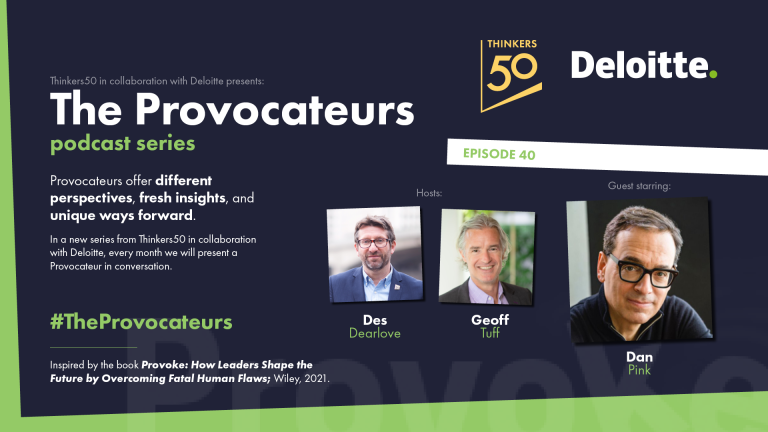
Thinkers50 in collaboration with Deloitte presents:
Daniel Pink is one of the world’s foremost authorities on work motivation and human behavior. His seven best-selling books include Drive, To Sell Is Human, When, The Power of Regret, and A Whole New Mind.
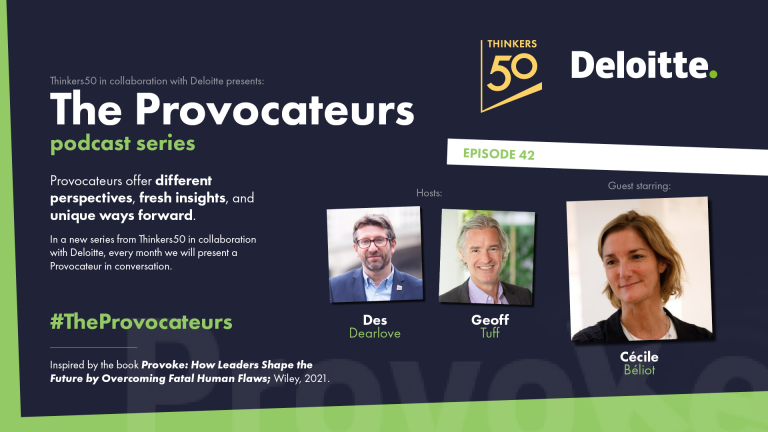
Recorded in London’s historic Guildhall during the Thinkers50 London Summit & Awards Gala in November 2025, this conversation features Dan in dialogue with Provocateurs hosts Des Dearlove, Thinkers50 co-founder, and Geoff Tuff, Deloitte’s Global and US Sustainability Leader for Energy, Resources, and Industrials.
In this episode we discover:
Dan also challenges the tendency towards dehumanization in leadership and reveals how the emotion of regret, when properly harnessed, can transform leaders into better negotiators, problem solvers, and strategists. He leaves us with one provocative question every executive should ask before making major decisions: What will the you of ten years from now think about what you’re about to do?
This podcast is part of an ongoing series of interviews with executives. The executives’ participation in this podcast are solely for educational purposes based on their knowledge of the subject and the views expressed by them are solely their own. This podcast should not be deemed or construed to be for the purpose of soliciting business for any of the companies mentioned, nor does Deloitte advocate or endorse the services or products provided by these companies.

Author of several bestselling books on science, business, and creativity.










Inspired by the book Provoke: How Leaders Shape the Future by Overcoming Fatal Human Flaws; Wiley, 2021.
Des Dearlove:
Hello, and welcome to the Provocateurs Podcast. Our aim with these podcasts is to provoke you to think and act differently through conversations with insightful leaders who offer a new perspective on traditional business thinking. I’m Des Dearlove, co-founder of Thinkers50. And today we’re coming to you from the Thinkers50 London Summit and Awards Gala at London’s historic Guildhall.
This is a collaboration between Thinkers50 and Deloitte, and my co-host today is Geoff Tuff. Geoff leads Deloitte’s sustainability work globally in the energy and industrial sectors. He’s also the author, along with Steve Goldbach, of three books, Detonate, Provoke, which inspired this podcast series, and now the final book in the trilogy, Hone: How Purposeful Leaders Defy Drift. Geoff, it’s great to see you.
Geoff Tuff:
Des, it’s great to be back and I’m excited to talk to today’s guest, and it hasn’t been that long since you and I did one of these together at New York Climate Week. But today we have Dan Pink. Daniel Pink is one of the world’s leading thinkers on work motivation and human behavior. He’s the author of seven best-selling nonfiction books on a range of topics from human motivation to the science of timing to a graphic novel career guide. His books include The New York Times Bestsellers The Power of Regret, A Whole New Mind, and When, as well as the number one New York Times Bestsellers Drive and To Sell Is Human. His deeply researched works have been translated into 46 languages and have sold more than 5 million copies around the world. Daniel, welcome.
Dan Pink:
Thank you. Thank you. It’s good to be here. Am I the provocateur or am I the person being provoked?
Geoff Tuff:
You are the provocateur.
Dan Pink:
Or am I the person apparently being honed now?
Geoff Tuff:
Well, no honing just yet, but you are the provocateur. And I know we’re going to spend time about all your research over the years studying motivating people. But if I might, what motivates you? What has led you into this career and through all the amazing accomplishments you’ve done with your works?
Dan Pink:
Yeah, I mean, it’s a question that I’ve asked myself and I think that the answer is really that I like to find stuff out, figure stuff out. I like to discover new things or make sense of a messy world. That to me is the highest motivation. So when I look at something, it’s like, what is going on there? Being able to figure that out and being able to give a name to it and being able to describe it for other people to sort of implant this idea in their heads. And if I can get paid for doing it, that’s a huge win.
Geoff Tuff:
And it seems like most of the time you do a pretty good job of figuring it out.
Dan Pink:
I mean, I try to. I mean, I work really hard, but I do that … For me, that kind of work, the work of actually figuring stuff out is really joyful. It’s really just fascinating. It’s like being a detective when it comes to actually writing 300 pages and doing that every single day, that can be challenging. But the idea of starting with a tangle, untangling it, making sense of it and explaining it, that’s why I get up in the morning.
Geoff Tuff:
Fantastic.
Des Dearlove:
And that sense of curiosity, I think that feels like it’s an innate human sort of characteristic. And yet so many organizations … I mean, you’ve studied motivation – so many organizations still seem to use the old sort of carrot and stick approach.
Dan Pink:
Yes.
Geoff Tuff:
How do you feel about that?
Des Dearlove:
And why is that? Why haven’t they moved beyond that?
Dan Pink:
Okay. I think it’s a really important question. Why haven’t they moved beyond that? And I think that that’s explicable in a relatively simple way. Let me just give a very quick summary of why those kinds of traditional motivators don’t work. We have now nearly 70 years of evidence showing that these, “if, then” motivators, not all motivators, but controlling contingent motivators – if you do this, then you get that – they’re actually quite effective for simple tasks with short time horizons. They work really well. They’re far less effective for complex tasks with long time horizons. And in a world now, especially with AI, simple tasks with short time horizons are basically being entirely automated. And most organizations are doing complex tasks with long time horizons.
Okay, so why do these old motivators persist? To answer your question directly. Okay, so a few things. Number one is that these, “if, then” motivators get people moving. It’s not like the research doesn’t say … I mean, I wrote a book about intrinsic motivation and sometimes people will say, “Oh, well, so people don’t care about money.” That’s bullshit. People do care about money. All right, so here’s the thing.
We are talking now in November, and let’s say that you’re running a sales force and your only goal is to get your sales force to hit their quota by December 31st. Des, give them a big stinking bonus right now. They will get their numbers. They might screw their customers, they might pull orders in from 2026, but they will respond to that. So these “if, then” motivators get us action. That’s one thing. They have all kinds of collateral damage potentially, but they get us action. So that’s one thing. The other thing I think is connected is that many organizations, particularly publicly held companies, are very short-term. All right? Remember, they work well for short-term tasks. If you’re so myopic that all you care about is the next quarter, yeah, I can understand why you would do it. Makes perfect sense.
And then the third one I think is in some ways the most insidious in that it’s easy. I don’t have to figure … Let’s say in an alternative universe. This would never happen. I’m managing you. It’s so much easier for me to dangle some reward in front of you than to say, “Hey, what makes you tick? How can I give you the right level of autonomy? How can I help you see progress every day? How can I connect your individual job to the larger mission?” That’s hard. So all these things together, I think conspire to make them more persistent than we might want. Certainly than what the signs would tell us we should be doing.
Geoff Tuff:
And hearing you describe it that way, it almost sounds ridiculous how short-termist every single one of those reasons are. So-
Dan Pink:
I mean, you’re the consultant, you can do something about this.
Geoff Tuff:
I’d like to think so.
Dan Pink:
I mean, you’re working on climate, that’s like the antithesis of short-term.
Geoff Tuff:
It is definitely the antithesis. And actually I think without diverting onto that topic, I think a lot of the solutions to what you’re talking about are the types of solutions we need in big system-oriented challenges, like climate.
Dan Pink:
Yeah. Exactly. Yeah.
Geoff Tuff:
So you’ve studied the science of motivation and you’ve really been emphasizing in your work three key forces: purpose, autonomy, and mastery. So I assume that those are the antidote to a lot of the short-termism that we talked about before. But what are the biggest blind spots that executives have when they’re trying to bring those forces into their organizations and use them as a better source of motivation?
Dan Pink:
So the blind spots that executives have for doing it, because I think we have pretty good evidence that people perform at their best for complex tasks over the long term when they have autonomy, which is some sovereignty, some control over what they do, how they do it, when they do it. When they have a sense of mastery, which is are they making progress? Are they getting better at something that matters? And purpose. They don’t have to be making a difference in sense of reducing the climate crisis, but it could be simply, do they know why they’re doing it? Are they making even a contribution?
And so what are the blind spots? I think that there probably are blind spots for each of them. Let’s take autonomy. A lot of leaders don’t like it. A lot of leaders prefer control. Plain and simple. They have been … in some ways, their muscle memory of what it is to be a leader sometimes is that leaders are controlling. Leaders are not liberating. I think that’s a colossal mistake. And at some level, control is easier because I know if I say to you, “You need to be in this office from this point to this point. You need to be in view all the time.” That might relieve some discomfort I have. It’s not going to lead to better performance. But I think that’s the blind spot on autonomy.
On mastery, I think the blind spot is that leaders underestimate how much people actually want to learn and grow on the job. That they underestimate how much simply learning and growing and developing is inherently important to people. And then the third one is the blind spot is that they might not think that purpose matters and they might not know how to do it. But I think that there’s a … if you forgive this because making this up on the spot … kind of a meta blind spot, because I think it’s an interesting way to think about this. There’s a meta blind spot among leaders is that they think that the people they’re leading are different from them and they’re not. All right.
So if I were to say to leader, “Do you want autonomy on the job?” “Hell, yeah, I want autonomy on the job.” “Do you want to get better at something that matters?” “Hell, yes.” “Do you want to connect to a purpose?” “Yeah. But these great unwashed who I’m leading, they don’t care about that stuff.” And I think that’s the meta blind spot people. They don’t realize that the people they’re leading are similar to them.
Geoff Tuff:
It is fascinating. It sounds like you’re actually talking about a tendency towards dehumanization amongst leaders.
Dan Pink:
Yeah.
Geoff Tuff:
But that’s not the way most people like to think of themselves or actually-
Dan Pink:
That’s a great … Well, to put it mildly. I mean, go on the street here and say, “Do you enjoy being dehumanized?” And see if you get a yes. You’re not going to have people who want to be dehumanized. But I think that’s a really nice way to put it. I think it’s a really smart way to put it and that they don’t realize that the people who they’re leading are not inputs in a system. They are human beings and they’re human beings who are very, very much like them.
Des Dearlove:
Do you think, though, there’s an element of wanting to create an otherness? Otherwise to separate these people from … otherwise they could be just like me, they could do my job.
Dan Pink:
I think it’s a really astute argument. That is probably somewhere beneath that part of it. That people want to maintain their own sense of power. They have a view of a hierarchy, and they want to maintain their place in the hierarchy.
It’s probably a bad strategy for that though. Okay. And I’ll tell you why. Let’s go back to autonomy here for a second. All right. Let’s go back to autonomy and let’s go back to humans just … alright. The opposite of autonomy is control. And human beings have only two reactions to control. They comply or they defy. Period. And so in that case, the thing that you’re … the otherness that you’re talking about, othering people, is a form of control. You’re going to get compliance or you’re going to get defiance. I don’t think you want either one of those things. I really don’t. And in some ways the history of human civilization is the history that you’re describing there, Des, of one set of human beings trying to control another set of human beings, and that other set of human beings sometimes being compliant, but often being defiant. I mean, it’s easier for an American to see in Europe, but it’s actually very easy for an American to see in his own country right now.
Des Dearlove:
Yeah, for sure. You mentioned AI earlier because to some extent it’s filling in … it’s going to perform some of the tasks that the old carrot and stick system may have been effective in performing. Is there a role for AI in creating a better way to motivate people? Is that-
Dan Pink:
A better way to motivate people?
Des Dearlove:
Yeah.
Dan Pink:
Probably. I mean, I think that you can use … I mean, another way to look at that is to go one level more concrete and say, “Can AI enhance autonomy?” And I think it can. It gives people another tool that they can use to do their jobs better, do their jobs in different ways. Mastery? Yeah, absolutely. I think that AI can enhance mastery in some cases and erode mastery in other cases.
But to me, one of the best uses of AI at an individual level is having AI quiz you or test you on your mastery of things. So I will do things like … if I have a complicated article that I really need to make sure that I understand, I’ll feed into AI and say, “Test my understanding of this. Ask me a series of open-ended questions and then critique my answers.” And we know from the research that quizzing yourself is one of the best ways to learn. There’s no question about it. And now you have this tool, this tool that’s like I could have people … I could find friends or family to quiz me. They would get tired of that pretty quickly. But AI, it’s inexhaustible how often it can quiz you to lead toward mastery. And then purpose, I think, it’s a little harder on AI to enhance purpose. Or maybe I haven’t thought it through enough.
Geoff Tuff:
Or perhaps there’s a way to actually explore what your individual purpose is and to broaden the topics that you may consider to be central to purpose?
Dan Pink:
Could be. One of the things that I’ve done on AI. And I don’t want to turn this into an AI tutorial. I mean, I sort of do-
Geoff Tuff:
We all need that!-
Dan Pink:
I sort of do, but I know that’s not your mission, is on blind spots. So just on your question, Geoff, I asked AI questions like, “Tell me about my blind spots. Use the queries that I’ve made over the last X amount of time,” whatever it is, “And any publicly available information and tell me what are my blind spots?”
Geoff Tuff:
That’s fascinating.
Dan Pink:
And it’s a good question to ask. Now the thing is about all this AI thing is that to me you have to have … I like to call it taste. You have to have taste. You have to know what is good and what is not. And so it’s possible that AI could give me a list of my five blind spots and they’re wrong about them. And then I started to start filing that advice and now I’m in worse shape. Or someone says, “Give me 25 interesting headlines for this article that I’m writing,” and I have to look at them and I have to have enough taste to know that 23 of them stink. But if I say, “Give me one headline,” and they give me a bad headline and I use it, I’m in worse shape.
Geoff Tuff:
So I hate to continue the AI tutorial, but-
Dan Pink:
No, you don’t. You want to keep going.
Geoff Tuff:
Well, I do actually need … I, of anyone, need to learn more about this, but let’s go back to the point about dehumanization before. I think a lot of what we’re talking about here beyond broadening the definition of motivation and thinking about the way that we can pull those levers is actually enhancing human-to-human communication between leaders and employees. How can AI best be used for that, beyond just the day-to-day communication … smoothing out communication norms?
Dan Pink:
How could it be used to … Well, I mean it might be possible that AI can enhance certain kinds of routine communication or at least automate certain kinds of routine communication, leaving you more time. So if you think about the number of … if you’re a leader in an organization, think about the number of essentially routine emails that you have to deal with where you know the answer in your head, and it doesn’t require a lot of cognitive firepower. It’s possible to have, at some point, to have a Geoff agent answering those kinds of things. And then that would free Geoff the human to have human to human …
Geoff Tuff:
To do your human-
Dan Pink:
Yeah, yeah, theoretically. Yeah.
Geoff Tuff:
That’s great.
Des Dearlove:
In The Power of Regret, you call regret a transformative-
Dan Pink:
Yes.
Des Dearlove:
… emotion. How can leaders use regret to make smarter choices or build stronger teams?
Dan Pink:
Well, so, again, just to take one step back, regret is this emotion that we all have, all human beings have where we look back and we wish we had done something differently or wish we had done a different thing or wish we hadn’t done something differently. That process of looking backward and feeling bad about that brings us down. It’s a negative emotion, but it’s ubiquitous in the human experience. Everybody has regrets.
And so at a high level, you have to ask yourself, “Is there something wrong with us? Why would something so unpleasant be so ubiquitous?” And the answer is because it’s useful. It’s adaptive. And the question is we haven’t been treating it right. And here we have basically people go in two different directions. So one of them is this very American “you should be positive all the time and never be negative.” “You should always look forward and never look back.” That the path to a good life is endless, unrelenting, positivity and always forward-looking. And that is bad advice. That is unscientific advice.
The other side is that when people feel regret, they feel shame, they get brought down, they ruminate. That’s really bad too. What we should be doing, to answer your question more directly, is what leaders should be doing is looking at their regrets as information, as data, as signal. And when we do that, when we think about our regrets, when we scrutinize them in the way that we would a quarterly sales report or whatever, we have decades of evidence that it’s a transformative emotion in the sense that it improves our performance, especially for leaders. There’s evidence that reckoning with your regrets directly can help you become a better negotiator. Reckoning with your regrets directly can help you become a better problem solver. Reckoning with your regrets directly can help you avoid cognitive biases. Reckoning with your regrets directly can help you become a better strategist. I mean, over and over and over again that if we use this emotion as a learning tool, it’s powerful. The problem is we haven’t been doing that and we haven’t been taught how to do it.
Des Dearlove:
And does the way we react to regret, is that different across cultures? I mean, you mentioned also obviously-
Dan Pink:
Interesting question.
Des Dearlove:
… the American positivity.
Dan Pink:
Yeah. Yeah. It’s an interesting question and I’m not sure about that. I did a very big survey where I collected regrets from all over the world, from 134 countries. And what I found is that the substance of regret is very similar around the world. Very similar to my surprise. In terms of how people react to it, I’m not entirely sure. One thing though that I think is adjacent to that is that I think the secular world does a poor job of dealing with regret and worlds of faith always have mechanisms to help people deal with this.
So Catholicism has confession. It’s so scientifically sound. You think about your regret, you disclose it, you have a plan of action. Jews have a day of atonement where you set out aside and you atone for your sins. There’s other kinds of … there’s another practice in Judaism, I can’t think of the name of it, where you write a regret on a piece of paper and you light it on fire and put it in the river. That is like … religious traditions have processes and rituals and things to do to deal with this emotion. Whereas secular tradition does not. I mean, it’s true for all … Religious traditions are in part designed to help people deal with negative emotions. How do you deal with grief? Religious traditions have a way to deal … have a plan for that. How do you deal with fear? We got a plan for that too! Whereas secular traditions are like, “Hey, just be positive all the time.” And people are like, “Whoa, wait a second. This is not working for me.”
Geoff Tuff:
So that actually is fascinating because there’s nothing stopping us from transferring those actions, those behaviors, in the religious world into the secular world. We don’t have-
Dan Pink:
Exactly right!
Geoff Tuff:
… we don’t have the sacraments, we don’t have the situational ability to do that easily. But before you started giving that answer, I wanted to ask you what it looks like to ruminate on regrets. Because I’m someone who can think conceptually about the act of thinking, but then when I’m in the middle of it’s not nearly as organized as I believe it is, and boiling it down to behaviors we can go-
Dan Pink:
When you ruminate on a regret, what it does is that it stalls you from action. It stalls you from the action of making sense of that regret. And it also stalls you from moving beyond it. And essentially it’s a trap. It’s like getting stuck in quicksand. Now, the thing is it’s not permanent. Exactly to your point, there are specific things that we know from many bodies of science that end up being actually similar to what religions have figured out. Many steps that we can take to help people overcome that kind of rumination and enlist the regret as a positive force going forward.
Geoff Tuff:
So I wonder if there’s some way … and you may have thought about this extensively, but I wonder if there’s some way to take all of that into the corporate world, into the business world-
Dan Pink:
Totally.
Geoff Tuff:
… or the things that leaders can be doing in their organizations to create the types of behaviors that allow you to break beyond that rumination.
Dan Pink:
I think so. I mean, I think you can … There are two ways at that. One of them is what do leaders do themselves? And so if you have a leader who’s ruminating over her past regrets, that leader is probably going to be less effective. So what do we do to help her overcome those regrets?
And, again, the process is relatively simple and straightforward. What you want to do at an individual level, whether you’re a leader or not, is number one is … you can think of it as inward, outward, forward. So inward is what do you say to yourself, basically? And a lot of times, especially high-achieving people who are often in leadership positions, when they make a mistake, when they have a setback, when they screw up, their self-talk is brutal. It’s lacerating. It’s vicious. And what the research tells us is that’s a really bad idea. There is zero evidence that lacerating self-talk is a performance enhancer. Zero. Self-esteem, boosting your self-esteem, barely anything.
What really works is what’s called self-compassion, which is treating yourself with kindness rather than contempt. Not treating yourself better than anybody else, but not treating yourself worse than anybody else. So think about when you have your lacerating self-talk, would you direct that to somebody else in your organization? Say those exact words. No way.
Geoff Tuff:
No. Yeah.
Dan Pink:
Of course not. So don’t do it to yourself. Don’t treat yourself better than anybody else. Don’t treat yourself worse than anybody else. Recognize that everybody has regrets. Recognize that the mistake that you’re looking back on is a moment in your life, not a full measure of your life. That’s step one.
Step two is outward. There’s a very strong argument for disclosing regrets, for writing about them, or talking about them. When we write about things, when we talk about things, when take something that is abstract and make it more concrete. There is evidence of … I mean, you see it in some of the more validated therapeutic techniques where if we name an emotion, it becomes less menacing. When we name things, we have some dominion over it.
And so writing about things and talking about our regrets is a form of getting dominion over it, making sense of it. There’s also an argument on the leaders for … and we know this from some of the research on vulnerability that’s come out in the last 10 years. We think that if we admit our mistake or acknowledge our mistake or admit our regret, people will think less of us. Many cases, not all, but in many cases, people think more of us.
And then what’s really important is outward, which is basically look at your regret and say, “What did I learn from that?” Extract the lesson and say, “How can I apply that lesson next time?” And when we do that, it’s a transformative emotion. And I think that if leaders have a meeting and say, “Hey …” It’s true for parents too. I mean, if leaders say, “Hey, guys. Let me tell you about a big regret that I have, but don’t stop there. Let me tell you what I learned from it and let me tell you what I’m going to do for it.” We need a guest appearance from Amy Edmondson now, because it’s like that establishes psychological safety and it also sort of role models how you deal with these kinds of things.
Geoff Tuff:
Yeah, creating that environment of safety sounds absolutely central to that. I thought we were going to hear about corporate confessional booths, but we didn’t.
Dan Pink:
That’s interesting. I mean, actually, that’s a super interesting idea. It’s sort of like … it’s those whistleblower lines, but on yourself.
Geoff Tuff:
Yeah.
Des Dearlove:
Brilliant. Listen, we’ve bounced you around between all your books.
Dan Pink:
That’s all right.
Des Dearlove:
But we’re going to bounce you some more.
Dan Pink:
Bounce.
Des Dearlove:
Your book When goes into the science of timing.
Dan Pink:
Yes. It does.
Des Dearlove:
What do great leaders get right or wrong about When?
Dan Pink:
What do they get wrong? Let’s go for what they get wrong. So, at both kind of a human level and at a tactical level, what we get wrong is that we … I almost need a two-by-two matrix here. But so what we get wrong at a daily level is that we think that all times of day are created equal, and they’re not. This is not even a close call. There are differences in brain power based on different times of day. There are material differences in how people perform based on time of day.
Des Dearlove:
And does that vary from individual to individual or is that just a kind of … we all got the same-
Dan Pink:
It does vary from individual to individual, but there are broader patterns. But there’s definitely individual variation. One level down based on chronotypes. Are you naturally wake up early and go to sleep early? Or naturally wake up late and go to sleep late. But we think that all times of day are created equal. They’re not. There are differences in performance.
My favorite corporate study is a study showing that companies that reported earnings later in the day had … they took the transcripts of all these corporate earnings calls, then they went and looked at sentiment analysis and showing are they using more negative words or more positive words? And companies were using more negative words in afternoon earnings calls, and then they corrected for what the numbers they were reporting. So you adjust for that. Maybe companies with terrible numbers are reporting in the afternoon. That turned out not to be the case. And it turned out that earnings calls in the afternoon had more negative sentiment in them than earnings calls in the morning, even for the same kinds of results. To the point where it actually had temporarily depressed the stock price. And so it’s like there are all these things like this.
Geoff Tuff:
I hope the world knows that by now, by the way, that seems like a pretty easy fix.
Dan Pink:
There are all kinds of easy fixes, but I don’t know if the world knows that because I don’t think the world knows that if you can avoid it, don’t go into the hospital in the afternoon for elective surgery because anesthesia errors are much more-
Geoff Tuff:
Another note to self.
Dan Pink:
… much more likely. I’ll give you another one, Geoff. Anesthesia errors are, what, four times more likely at 3:00 PM than at 9:00 AM. I’ll give you another one. This is not to all your listeners out there. This does not qualify as medical advice. I’m not a doctor, much to my parents’ chagrin. Colonoscopies. Doctors find fewer polyps in afternoon exams versus morning exams for the exact same population. There’s a decline in general in people, not every single person, but there’s a decline in vigilance in the afternoon. There’s a decline in positivity in the afternoon. Now, there ends up being a general pattern of a recovery later in the day, like four o’clock, five o’clock, six o’clock. So I think there could be an argument for earnings calls at 7:00 PM, maybe.
Geoff Tuff:
So you’ve been doing this work, studying management, how companies operate for over two decades at this point.
Dan Pink:
Good lord. Yeah.
Geoff Tuff:
I hate to be the bearer of that news, but a lot has changed in that time. I’d love to hear what are the things you think have changed the most since you started in this work and what have been the eras of most accelerated change? Are we living in one of them right now?
Dan Pink:
What has changed? I do think that there has been a … at some level, and I think it’s a positive change. I speak to the American experience. There has been a loosening of sorts culturally in terms of practices and things like that for all of the complaints that I had before. I mean, I’m old enough to remember the time that there was something called Casual Friday, and here we are on a Monday and we’re dressed that way. So I think there has been a loosening in there. I think there’s been a loosening in the kind of communication. I think that’s partly tech enabled. It wasn’t that long ago when you … if you’re working in a large organization, you might never see the CEO or have any opportunity to communicate with them, and now you can send them an email. Like 20 years ago, you could start sending them an email. So I think there’s a kind of loosening that I’ve seen.
I think there is a slow reckoning with the humanness of it. I don’t think we’re fully there yet, but I think there’s a greater reckoning with some of the humanness of it. Again, it’s slow, but if you look at even things like women or people of color in leadership, very different from the way it was two decades ago. So I think there’ve been a lot of positive trends in there. The negative trends would be that I think many leaders are still hung up on control. And at a sort of macroeconomic level … this is more political, I think there is a danger in having such a small number of very, very, very, very, very large companies that control the most important platforms. I think there is a danger there. I think we’re seeing glimmers of it right now. I don’t think it’s a calamity right now.
I do think that the world of work, the world of companies and so forth 20 years ago was somewhat winner take all. Now I think it’s super-duper winner take all, and that’s dangerous. You see that in differences in wealth. You see that in the fact that we have companies now worth trillions of dollars. I mean, that’s incredible. Last week for something I was working on, I wrote out a trillion. That’s-
Geoff Tuff:
That’s a lot of zeros.
Dan Pink:
That’s a hell … it’s 12. It’s 12 zeros. It seems like a fake number. And yet we have these companies … It’s like we had … in 2018, Apple becomes a trillion-dollar company. Now we have these trillion-dollar companies all over the place. And so you have seven companies responsible for something like a third of the S&P 500 index. I mean, there’s some dangers in that consolidation. There’s some dangers in labor markets that feel winner takes all to people. So I think that’s a possibly dangerous trend there.
Geoff Tuff:
And is that accelerating now? That type of concentration and change, or is it just easy to believe that because everything we’re hearing about AI and-
Dan Pink:
I don’t know. I mean, I think it’s plausible when you look at the … I think there’s little question that the labor market has become winner take all. So, at the same time, you have stagnation in the middle in terms of wages. In fact, a slight decline of wages in the middle just for inflation. You have at the super-duper top … and I’m not talking about 10%, I’m talking about 1%. I’m talking about the other. You have incredible consolidation there. That could be dangerous. I don’t know. And then certainly in terms of the most important platforms for communication are controlled by companies that don’t necessarily have the best civic interest in mind.
Des Dearlove:
Fascinating. We are running out of time and we’re going to ask you the question we always ask our guests, which is, if you could provoke one big rethink among today’s business leaders, what would it be and why?
Dan Pink:
One big rethink.
Des Dearlove:
Or one big provocation.
Dan Pink:
I’m going to go with a facet of regret, sort of adjacent to regret, that uses our … The reason we have regret is that our brains are amazing. Our brains can travel in time. And so the provocation that I would give to leaders is when you’re thinking about a decision you’re going to make this year, before you make that decision, think about having a conversation about the decision with the you of 10 years from now.
Does the you of 10 years from now want you to do this thing? Is you of 10 years from now going to feel good about that? And I think intuitively people would make some different decisions. I think they would be more likely to take the high road. I think they’d be more likely to be bolder. I think they’d be more likely to do more difficult things rather than take the easy … what we were talking about at the top of the interview, easy short-term situations. Think about … because you will have to reckon with that. That’s what regret is. We have regret because the you of today looks back on the you of 10 years ago, 20 years ago and says, “What the hell were you doing?” And so use that power and go forward 10 years or 20 years and say, “What does the you of 2036 or 2046 going to think about what you’re about to do?”
Geoff Tuff:
And magically you’ve brought us full circle. We started at the beginning and talking about short-termism. Now you’re talking about longer-termism. And I will say, it has been a very positive podcast, even though ironically, I think it’s exactly three o’clock in the afternoon.
Dan Pink:
Oh, okay.
Des Dearlove:
Sadly, three o’clock or not, it’s not quite time for a gin and tonic. Sadly, we’re out of time. Huge thanks to our guest, Daniel Pink and to you for listening. This is the Provocateurs Podcast coming to you from the Thinkers50 London Summit and Awards Gala in London’s historic Guildhall.
We’ve been Geoff Tuff and Des Dearlove. If you’ve enjoyed the show, please check out the other episodes of the podcast. We’ve had some great guests, along with Dan. We’ve had Paul Polman, Andrew Winston, Amy Chang, Chip Bergh to name but a few. So please do check out previous episodes, and we’ll see you next time.
This podcast is part of an ongoing series of interviews with executives. The executives’ participation in this podcast are solely for educational purposes based on their knowledge of the subject and the views expressed by them are solely their own. This podcast should not be deemed or construed to be for the purpose of soliciting business for any of the companies mentioned, nor does Deloitte advocate or endorse the services or products provided by these companies.

Thinkers50 Limited
The Studio
Highfield Lane
Wargrave RG10 8PZ
United Kingdom
Contact us at:
enquiries@thinkers50.com

Thinkers50 Limited
The Studio
Highfield Lane
Wargrave RG10 8PZ
United Kingdom
Contact us at:
enquiries@thinkers50.com

Thinkers50 Limited
The Studio
Highfield Lane
Wargrave RG10 8PZ
United Kingdom
Contact us at:
enquiries@thinkers50.com
| Cookie | Duration | Description |
|---|---|---|
| LANG | 9 hours | Linkedin set this cookie to set user's preferred language. |
| nsid | session | This cookie is set by the provider PayPal to enable the PayPal payment service in the website. |
| sp_landing | 1 day | The sp_landing is set by Spotify to implement audio content from Spotify on the website and also registers information on user interaction related to the audio content. |
| sp_t | 1 year | The sp_t cookie is set by Spotify to implement audio content from Spotify on the website and also registers information on user interaction related to the audio content. |
| tsrce | 3 days | PayPal sets this cookie to enable the PayPal payment service in the website. |
| x-pp-s | session | PayPal sets this cookie to process payments on the site. |
| __cf_bm | 30 minutes | This cookie, set by Cloudflare, is used to support Cloudflare Bot Management. |
| Cookie | Duration | Description |
|---|---|---|
| l7_az | 30 minutes | This cookie is necessary for the PayPal login-function on the website. |
| Cookie | Duration | Description |
|---|---|---|
| CONSENT | 2 years | YouTube sets this cookie via embedded youtube-videos and registers anonymous statistical data. |
| _ga | 2 years | The _ga cookie, installed by Google Analytics, calculates visitor, session and campaign data and also keeps track of site usage for the site's analytics report. The cookie stores information anonymously and assigns a randomly generated number to recognize unique visitors. |
| _gat_gtag_UA_10408481_1 | 1 minute | Set by Google to distinguish users. |
| _ga_ZP8HQ8RZXS | 2 years | This cookie is installed by Google Analytics. |
| _gid | 1 day | Installed by Google Analytics, _gid cookie stores information on how visitors use a website, while also creating an analytics report of the website's performance. Some of the data that are collected include the number of visitors, their source, and the pages they visit anonymously. |
| Cookie | Duration | Description |
|---|---|---|
| NID | 6 months | NID cookie, set by Google, is used for advertising purposes; to limit the number of times the user sees an ad, to mute unwanted ads, and to measure the effectiveness of ads. |
| test_cookie | 15 minutes | The test_cookie is set by doubleclick.net and is used to determine if the user's browser supports cookies. |
| VISITOR_INFO1_LIVE | 5 months 27 days | A cookie set by YouTube to measure bandwidth that determines whether the user gets the new or old player interface. |
| YSC | session | YSC cookie is set by Youtube and is used to track the views of embedded videos on Youtube pages. |
| yt-remote-connected-devices | never | YouTube sets this cookie to store the video preferences of the user using embedded YouTube video. |
| yt-remote-device-id | never | YouTube sets this cookie to store the video preferences of the user using embedded YouTube video. |
| yt.innertube::nextId | never | This cookie, set by YouTube, registers a unique ID to store data on what videos from YouTube the user has seen. |
| yt.innertube::requests | never | This cookie, set by YouTube, registers a unique ID to store data on what videos from YouTube the user has seen. |
| Cookie | Duration | Description |
|---|---|---|
| DEVICE_INFO | 5 months 27 days | No description |
| loglevel | never | No description available. |
| m | 2 years | No description available. |


Thinkers50 Limited has updated its Privacy Policy on 28 March 2024 with several amendments and additions to the previous version, to fully incorporate to the text information required by current applicable date protection regulation. Processing of the personal data of Thinkers50’s customers, potential customers and other stakeholders has not been changed essentially, but the texts have been clarified and amended to give more detailed information of the processing activities.