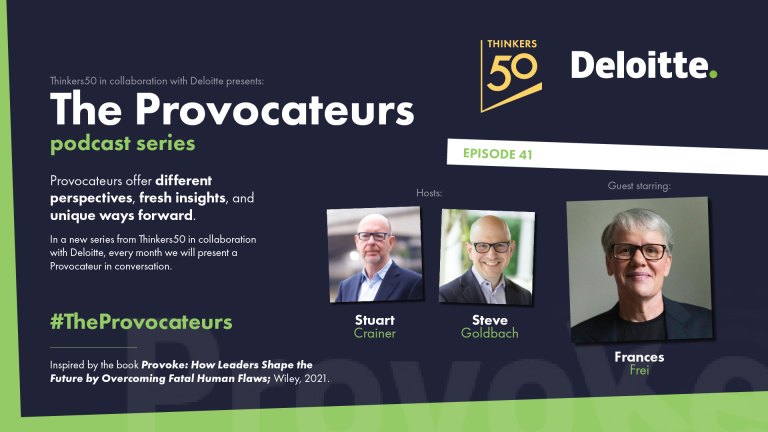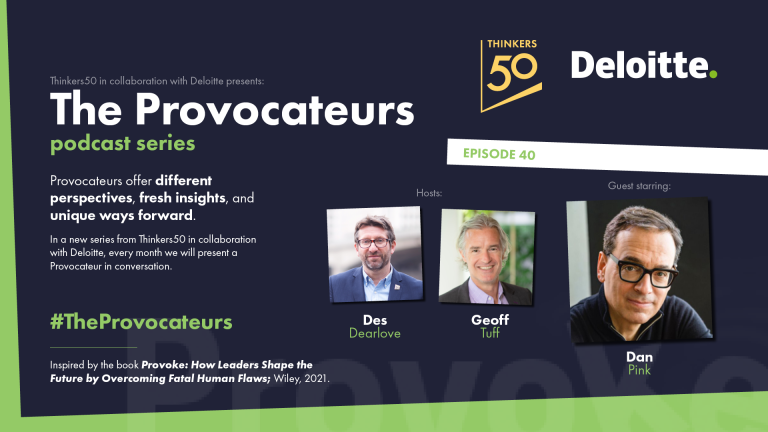
Thinkers50 in collaboration with Deloitte presents:
In this Provocateurs podcast special recorded at the 2025 Thinkers50 London Summit & Awards Gala, creativity strategist Natalie Nixon discusses how organizations can harness creativity as a strategic business competency.
Challenging the misconception that creativity belongs only to artists, Natalie uses her “wonder-rigor” framework to demonstrate that the best engineers, scientists, CFOs, and leaders toggle between imaginative exploration (wonder) and disciplined execution (rigor). This chaordic balance between chaos and order is essential, she says, for driving sustainable innovation.
Turning to AI and the future of work, Natalie contends that technology offers an opportunity for more distributed, improvisational ways of working – which appeal in particular to Gen Z – and AI can actually humanize organizations by creating liminal space for deeper collaboration and wonder.
Natalie is the author of The Creativity Leap: Unleash Curiosity, Improvisation and Intuition at Work (Berrett-Koehler, 2020), and Move. Think. Rest. Redefining Productivity & Our Relationship with Time (Balance, 2025).
This podcast is part of an ongoing series of interviews with executives. The executives’ participation in this podcast are solely for educational purposes based on their knowledge of the subject and the views expressed by them are solely their own. This podcast should not be deemed or construed to be for the purpose of soliciting business for any of the companies mentioned, nor does Deloitte advocate or endorse the services or products provided by these companies.

Creativity strategist and CEO, Figure 8










Inspired by the book Provoke: How Leaders Shape the Future by Overcoming Fatal Human Flaws; Wiley, 2021.
Stuart Crainer:
Hello, I’m Stuart Crainer, co-founder of Thinkers50. Welcome to the Provocateurs podcast. This is a very special edition recorded at the Thinkers50 London Summit & Awards Gala at the Guildhall in London. Provocateurs is a podcast which encourages you to think and feel differently after our conversations with some fantastic people. It’s a collaboration between Thinkers50 and Deloitte. So today I’m joined by Geoff Tuff. Geoff leads Deloitte’s sustainability work globally in the energy and industrial sectors, and with Steve Goldbach is the co-author of a succession of fantastic books. Is it okay to say the word fantastic?
Geoff Tuff:
You can say fantastic anytime you want about our books.
Stuart Crainer:
The books are Detonate, Provoke, and most recently Hone. Geoff as ever, great, great to see you. Perhaps you could introduce our brilliant guest today.
Geoff Tuff:
Absolutely. Nice to see you as well. It’s nice actually to be able to do one of these in person. So our guest today is Natalie Nixon. Natalie is one of those people whose resume is absolutely jam-packed with interest and surprises, if you don’t mind my saying that. Amongst other things, she worked in global apparent sourcing in Sri Lanka and Portugal, earned a PhD in design management while working full-time leading executive education programs and spent 16 years as the professor at Thomas Jefferson University. Along the way, she lived and worked across five countries, shaping her global perspective and sharpening her approach to helping teams adapt, innovate, and thrive in ambiguity. She’s also a dancer, an open-water swimmer and much more. She is a member of the Thinkers50 Radar and has been shortlisted for their talent award. Natalie is the award-winning author of The Creativity Leap and her latest book, Move. Think. Rest. That was published in September of 2025. On top of that, she and I recently had the pleasure of sharing our ideas together on a panel at Harvard Business School, and I’ve come to know that she’s a fantastic conversationalist and we’ll I’m sure have a very entertaining conversation today. So Natalie, welcome.
Natalie Nixon:
Thank you, Geoff. Thank you, Stuart. It’s great to be here.
Geoff Tuff:
So we have a lot to talk about. I don’t know if we start with open-water swimming or dancing, but we should probably stick to your books. But how do you actually make sense of your career? Is there some sort of through-line to the entire thing that actually does make it make sense?
Natalie Nixon:
Well, one could argue that the open-water swimming and the dancing are all relevant. I’m a big fan of saying we need to be a clumsy student of something in our lives, we’re not the smartest person in the room because it transfers over to our work. It certainly has in my case. I would say that the through-line in my very diverse/loopy career is my willingness to commit to following my intuition, to following my heart. And I got the permission slip to do that as a sophomore in college.
I called home a bit nervous because I would have to declare a major in another three weeks, and I wanted to impress my parents after they invested a lot in a very expensive education. So I talked around the issue of really loving cultural anthropology and Africana studies. And finally they said almost at the same time, this is in the eighties, when my dad was on the phone in the kitchen, my mom was on the phone in the bedroom and they said, “Well, what are you enjoying?” And I confessed that I loved these courses in cultural anthropology, these multidisciplinary courses, and almost at the same time, they said, “That’s what you should do.” And my dad said, “Natalie, if you study what you love, you don’t have to turn away opportunities because no one will have to tell you to wake up earlier, stay later, work a lot longer.” It was this big load lifted off my shoulders when they gave me that permission. And I have followed that advice probably to their chagrin at different points. But I really believe it’s a much more efficient way to live.
I am a Gen-Xer, so I’m solidly middle-aged. And so I do experience friends and colleagues who have these wake-up moments at this stage in their lives where they are wondering, what’s it all mean? What’s it all adding up to? So whether it was my entrepreneurial venture as a hat designer, the five years I spent being a middle school English teacher, which was inarguably the best experience I’ve had, it set me up for everything I’ve gone on to do, being a middle school English teacher. Working in global fashion sourcing and living and working abroad for a division of limited brands in Sri Lanka, Portugal, as you mentioned. And then deciding I was tired of being in different time zones from friends and family, and through a series of introductions became a professor. The through-line up to this point of being entrepreneurial and being CEO of Figure 8 Thinking has been to follow that nudge, which is a commitment to figure it out, to ask for help, to take inventory of both earned skills and experiences and lived experience and to commit to dreaming and figuring out how to make that real. So what’s really cool is that now my work as a creativity strategist, everything I’ve done has converged to help me to do the work of helping companies and leaders connect the dots between creativity and business results so that they can sustainably innovate.
Stuart Crainer:
That’s great. With all these experiences, you should be 110 years old.
Geoff Tuff:
I was about to say, how do you-
Stuart Crainer:
It was the five years-
Geoff Tuff:
We missed some of the stuff in the bio.
Natalie Nixon:
Well I’m committed to Linda’s 100-year… It’s great!
Stuart Crainer:
You talk about democratizing creativity.
Natalie Nixon:
Yes.
Stuart Crainer:
Can you talk about that, what you mean by that and how important that is to-
Natalie Nixon:
Yeah. Well, in the early years of building my business, I would get invited into companies to help them build cultures of innovation. And sometimes that became some innovation theater. It became a little copy/paste. It was just trying to keep up with the Joneses and it was often a very siloed approach. And I suspected that we were going about it in the wrong way, that we actually need to start with creativity. The challenge was I realized that if I said to a lot of these leaders and Fortune 500 companies, hey guys, we need to be starting with creativity in order to build a culture of innovation, they would look at me like I had three heads, because most people, a lot of people when they hear the word creative or creativity, they think of art only. So they’re thinking of picking up a paintbrush or a dance studio or music. And it turns out artists are exceptional at wrestling with the ambiguity of the creative process. But I intuitively realized that the best engineers, the best scientists, CFOs, attorneys, coders, executive assistants, plumbers, are super creative. I just need to figure out a way to explain that in a simple, accessible way.
So when I talk about democratizing creativity, it’s really to provide an accessible on-ramp for all of us to access creativity as a strategic competency. Because to be human means that it’s part of our birthright to be creative. It kind of gets drummed out of us by, I used to say high school, but more and more people are even saying middle school. So that began my work and process of doing in my nerdy way, miniature ethnographies to figure out how to build evidence of this more accessible way to think about creativity beyond art. And I landed on the wonder-rigor theory that creativity is our ability to toggle between wonder and rigor, to solve problems and deliver novel value. And as I share that more and more broadly, first through The Creativity Leap and the Move. Think. Rest. book, is another way to think about that. It really resonates with people because it’s this relief that something that they suspect is very innate to them, it’s possible to exercise, it’s possible to access, and it’s possible to build in a very strategic way.
Geoff Tuff:
So the juxtaposition of wonder and rigor, I think is fascinating. A lot of leaders think about creativity as roughly equal to innovation, which means moving fast, breaking things. But we know that you believe in moving fast and fixing things. So a two part question here. First of all, tell us a little bit about wonder and how that plays into leadership qualities and the importance of that. And then secondly, how do you combine wonder with rigor so that at the end of the day you’re ending up with something that is fixed and not lying in pieces all over the floor?
Natalie Nixon:
Well, wonder is something that makes sense for people when they think about creativity, because for the most part, people still are thinking about creativity as kind of doing whatever you feel like, it’s a bit whimsical. The more I researched wonder, the more I learned how some really smart people throughout history have given it a lot of credence. I think about wonder as deep curiosity, as audacity, as dreaming and daydreaming and the ability to pause because it’s really hard to wonder when you’re moving too quickly.
So Socrates said that wonder is the beginning of wisdom. Centuries later, the Jewish theologian and civil rights activist Abraham Heschel wrote that it’s wonder not doubt, which is the root of all knowledge. So if you want to become wiser and more knowledgeable, we actually need to design space and time for wonder, which does require us to slow down a bit. And it does require us to mix up how we work, where we work, with whom we work. And it also allows us to tap into what I call inside-out work. And I think at the future of work, work will increasingly become more inside-out, meaning that the best leaders will be a bit more personable, will want to create environments where people can, or were curious about people’s personal lives and how that adds value to the work, but it’s actually the rigor dimension.
Geoff Tuff:
Before you move on to the rigor, can I just ask you though, because I’m sure some of our listeners will want to know, how is wonder different from curiosity then? I think I’m hearing something different that goes beyond simply being curious about the world around you.
Natalie Nixon:
Well, I think about curiosity as being a component of wonder. I really think of wonder as being this more overarching umbrella where we can plug in the curiosity, the awe, the audacity. Ian Leslie’s written a really great book called Curious, and he defines curiosity as… I just forgot how he says it… It’s a gap in information. So I used to think curiosity is the absence of information, but you need to know just a little bit about something to be curious. So I think about curiosity as a wayfinding mechanism that we as humans, as humankind have always had to make sense of the world. In human development it’s how babies and toddlers and little people figure things out. So it’s a component of wonder in the way that I think about wonder.
Stuart Crainer:
I think the idea of ambiguity is really interesting as well. We talked about how creative people are comfortable with ambiguity, but if you talk to senior leaders, often ambiguity is a really big issue for them because they don’t quite know what they should be doing often.
Natalie Nixon:
Yeah. Well, liminal space is actually what all of this technology and AI know. I’m jumping the gun, we’re going to get into AI more, but liminal space is actually what we’re being gifted with AI and automation and robotics because we can get the answer so much more quickly. So what behind all of that is to figure out, to sit in that liminal space, to sit in that what’s next. And most of us, when we reflect back on our lives and our work, we realize that our biggest achievements happen when we were on that verge of figuring out what’s next. We’re faced with that crossroads of what’s next. So instead of struggling and working against the liminal space and the ambiguity, it’s actually an opportunity to sit still, to ask for help, to revisit, to reframe. And unfortunately we, and as a former educator, we educate in a way that airs on the side of what is the answer, fill in the dots, I need the answer yesterday. And that’s what we have rewarded our leaders for. In reality, there’s so much gray that they have to navigate. So falling in love with the process is really the mindset and activity that in my opinion, we need to incentivize, we need to reward, and we need to hire for so that we can better navigate the reality of work.
Geoff Tuff:
So I feel like we left the two-part, the juxtaposition of wonder and rigor hanging a little bit. Tell us about the rigor component and how that then ties into what you were just describing with liminal spaces.
Natalie Nixon:
Yeah, so the rigor is the part that we typically forsake when we think about creativity. And I referenced that I did this miniature ethnography to figure out a way to make creativity more accessible.
Geoff Tuff:
What have you discovered about Stuart and me in your miniature ethnography?
Natalie Nixon:
Well, you both favor navy suits and navy jackets and blue shirts.
Geoff Tuff:
No surprise.
Natalie Nixon:
But no, but the ability just to have this conversation and to kind of riff is really critical. But rigor is the dimension of creativity that we underestimate. Rigor is about focus, it’s about discipline, it’s about skill mastery, technique, time on task, and all creative endeavors require the rigor. So when I was doing this miniature ethnography, I was looking at the way chefs, dancer choreographers, first responders all work in the moment. And it turns out that you must know the rules in order to bend them, extend them, sometimes break them. But when you’re figuring things out, as I was doing, this consulting work of helping these companies and teams build cultures of innovation, I didn’t really understand how to explain it to them. So this was a very loopy process. It was a very iterative process and doing this ethnography helped me. And it was when I was observing a rehearsal of Ballet X, which is a resident modern ballet company in Philadelphia, that’s when it all clicked for me.
But in the rehearsal, you really see the rigor, you see the repetition, you see the facetiousness to the detail. It was retrospectively that I was like, well, of course I landed on this wonder-rigor paradigm because the root of how I began to get into this work of being a creativity strategist was working on a PhD in the field of design management.
I was working with the Ritz-Carlton Hotel to understand the ways that they design experiences that don’t just help us and make us feel good, but delight us and exceed our expectations. And the theoretical construct I used was jazz improvisation as a heuristic. And it turns out that jazz and all improvisational systems are chaordic systems. And so chaord is a word that Dee Hock, the founder of Visa made up. It’s a mashup of chaos and order, and it stems from chaos theory and complex systems thinking. So of course that was embedded in my brain from way back when, but I wasn’t conscientious of it as I was fumbling through the dark, figuring out how to… It’s not just wonder that makes us creative and that makes processes creative. The wonder-rigor is another example of this chaordic system, of the wonder is the chaos. And chaos is not anarchy, chaos is randomness and order is not control, order is structure. And once you learn about chaordic systems, it’s the thing that can not be unseen. You see chaordic systems everywhere.
Geoff Tuff:
Everywhere.
Natalie Nixon:
So the wonder and the rigor are really important and it’s really important to toggle between them because if you spend too much time with your head in the clouds, you won’t ever get traction. And if you spend too much time in the weeds, you’ll burn out.
Geoff Tuff:
Can everyone do that though? Toggle between the two?
Natalie Nixon:
Yes.
Geoff Tuff:
Because it seems like there are some people I know who have their head in the clouds all the time, and there’s some people I know who are very orderly and very focused on getting things done.
Natalie Nixon:
Well, it’s naming the challenge. It’s naming the opportunity. I could spend all day and wonder, and I have to do more work to commit to the rigor, to what are the constraints? What do I need to learn? What are the guidelines? But what I have learned and discovered, the more I commit to that in my personal life and in my professional practice, is this corollary, the wonder is found in the midst of rigor and rigor can’t be sustained without wonder. They’re copacetic. So you actually will bump into one as, if you’re conscientious of it, as you’re delving into the rigor, as you’re delving into the wonder.
Stuart Crainer:
As you talk about wonder and creativity, when you talk to senior leaders, is their reaction to it changed over time?
Natalie Nixon:
So I actually used to prototype and tiptoe into the conversation. Typically, at the end of a session, I’d be in conversation with the leader. This is before I was really rolling out this idea. And I would say, “Well, there is this other approach that I’ve been using with some other clients where we’re really leaning into wonder.” And I would just, because I was really nervous about talking about this woo-woo word wonder in a corporate environment, and I would notice that their body language would soften. They’d kind of lean into the table, they’d want to understand more. So they are delighted to have a construct that doesn’t forsake the structure, the protocol, the need to have the regulations, but also the evidence showing that you actually will not be able to consistently and sustainably innovate if you don’t dive into the wonder.
The other thing is a lot of organizations are conflating rigidity for rigor. They’re actually not being rigorous. They’re not actually curious about the rules and the focus and the discipline, and they’re actually even not making time for the discipline of the practice. And the difference, the way I distinguish rigidity from rigor is that rigidity is not adaptive. Rigor is adaptive. Rigidity says, we said we’re going to do this and go this way, although alarm bells are ringing and red flags everywhere, we’re still going to do this. So that kind of saving face of cultures where it’s hard to admit failure or use failure as learning, then that’s where rigidity is kind of the go-to instead of rigor.
Geoff Tuff:
So what happens as we get more, I shouldn’t say dominated by machines, but as our work environment becomes more dominated by machines? You started talking about AI before, I would say it’s probably easy to imagine that the more technology we have in place, the more rigid we become, simply because computers operate by rules and ultimately you don’t have that human element of wonder being injected into the system to create the rigor that you’re talking about. Tell us a little bit about how you think about tech and its impact on the ability to balance wonder with rigor.
Natalie Nixon:
Yeah. Well, we don’t necessarily have to become more rigid. If we play our cards right then the technology really can be an added value, co-pilot, co-creator, co-instigator. So I was thinking this morning, I took the bus into Guildhall. It’s like a 15, 17 minute bus ride. I get off the bus. I’m daydreaming, as I am wont to do, looking out the window, busy, hustling bus on London streets and just the sea of people walking back and forth as I’m walking to Guildhall. And even Guildhall historically was this place where these guilds and more contemporary unions would meet. So I was just observing that work as we know it, organizations as they’ve been currently designed are literally changing underneath our feet. The only reason why we have this hustle and bustle, the reason why we have these cities is that pre-industrial revolution. We woke up in the morning, did our ablutions, had some food, walked over the threshold, and we were at work.
And with the advent of a different type of machine, it shifted transportation, it shifted family structure, it shifted ranking order of… The priest was no longer as powerful and all those sorts of things. And the reason why we have this hustle and bustle, and the reason I was on the bus, and the reason why London has emerged as it has is because of a disruptive system around the First Industrial Revolution that provoked people to think differently about work. And people learned new rules, they became adaptive, things did change. And I think similarly now, the opportunity is to use the AI as our collaborator. I was thinking in preparation of this, of a few examples. So kind of an obvious go-to place is in design and technology. So a company like Pixar, you have design teams that are using AI to help with iteration cycles to help with storyboarding. But the key is to plug and play, is to understand that the AI, the technology is a starting point and then to go analog and then to go back in again, that’s a very improvisational way of working. We might feel more comfortable to design work as a beautiful classical music orchestra where all the bows are up at the same time, but that’s actually not quite realistic.
Another example is in healthcare. So there are all these interesting reports and studies of how radiologists have used AI to help model different ways to interpret what they’re seeing in the body. The Mayo Clinic, which is experimental in the United States, has experimented for a long time with service design, and they’re using artificial intelligence as well for a more iterative process. So I think that if we shift away from the what the AI is doing, just the results, and don’t stop there, but get more engaged in the how and get more engaged in a more improvisational riffing process, that’s where we can have not such a dystopian ending, but a better ending.
Geoff Tuff:
So the cool thing that I think I hear you saying, tell me if I’ve got this wrong, and it may actually sound somewhat strange to some of our listeners, is AI can actually be more humanizing by allowing that liminal space and allowing you the ability to actually delve into wonder more than you might have otherwise.
Natalie Nixon:
Absolutely. It can be. A lot of time when we have these conversations about the future of work, how organizations are designed, we are, and it’s understandable, we’re only thinking about ourselves. And by us I mean Gen Xers, geriatric millennials, boomers. We have to really also factor in Gen Z, the Alpha generation, which I know – Gen Z, our daughter is 24. This is a generation that’s kind of looking at us like, how’s that all worked out for you guys? And why are you continuing to work in this way? And I think if we look at the labor supply, when we think about the future of work, we have to be more curious about the ways that they want to learn, that they want to work, more distributed work. So when I reference that the organization, and organizations are organisms, we try to make them machine-like, but that’s where we get frustrated because we forget that they’re imperfect, they’re inconsistent, they’re not predictive because they’re organisms.
There’s these opportunities with Gen Z and the Alpha generation to have more distributed work, to have more ecosystems of work. I think it was Linda. So the opportunity, again, if we’re conscientious, if we’re curious about who’s coming up behind us, if we pause to even ask ourselves, how is this working out for us? The World Economic Forum has set creativity as one of the top 10 skills for, now it’s 2025, but back in 2016 they said it would be… 2015, they said it’s going to be the Number 10 skill by 2020. 2016, they said it’s going to be the Number 3 skill. Last in 2023, the future job skills report, they ranked creativity as the Number 2 job skill. Number 1 is critical thinking. So there’s that.
And then we have all this other data and research, I think ThriveMyWay research has said that 72% of business leaders around the world look at creativity as essential for market competitiveness. So we have these storied organizations and incredible business leaders say, yes, creativity really matters as a business ROI. And yet 75% of employees report that they don’t have the opportunity to build creativity as a capacity throughout the year. So there’s this gap analysis between yes, it matters, and where are we designing space and time to do that. So dealing with those of us who are in the workforce and readying us to build creativity as this capacity, looking at younger people, the ways that they are masters of using this technology and the fact that they are chronically overwhelmed, underconnected, I think according to a study by Wiley, 46% have a beneficial psychological diagnosis related to anxiety. So this is what we have to factor in as we’re designing work and designing organizations. I’m biased, but it’s my view that creativity as capacity building, not just as individuals but as teams and as organizations, is really the way to go. And as you’ve pointed out, as you’ve reflected back for me, the AI and the technology is actually giving us an opportunity because it’s so quick of this liminal space that we now have to do more collaboration. We’re eyeball to eyeball conversations and to pause.
Stuart Crainer:
Tell us about your new book, Move. Think. Rest., which reflects many of the issues you’ve been talking about. But at its core is the notion of productivity. What is productivity? Because it’s one of those things that people kind of understand as a concept and yet misunderstand in so many ways.
Natalie Nixon:
Yeah. What is productivity? Thank you for asking about the new book, but what is productivity? Why do we work? Maslow’s hierarchy of needs — it’s clothing, food, shelter. If we’re lucky we get to embed meaning and purpose into our work as well. But when I really dove into our ways we think about productivity, it’s a relic of the First Industrial Revolution. It’s a relic of looking at work that’s based on speed, output. You measure only what you can see.
Stuart Crainer:
It’s Frederick Taylor-
Natalie Nixon:
Frederick Winslow Taylor, exactly. And that had its place in time. And the reality is that two of the biggest components that drive our work today, search engines and emails are not factored in to gross domestic product. At least in the United States they’re not. So what I was really curious about was number one, observing that when I was procrastinating, when I would step away from the desk and then return, my ideas were clearer, sharper. Something that stymied me started to gel. So it was just a personal reflection. In my work I was observing people dying a slow death at work and my desire to making sure that creativity’s really seen as this business ROI and landing on a both/and model. So if the ways we’ve thought about productivity or either/or, the both/and model that I’m offering is one of cultivation. So instead of asking, how might I be more productive this week? How might my team be more productive this quarter? A different question is what might I cultivate this week? What might my team cultivate? And the difference is that when we’re looking at cultivation in a 21st century way, we value the solo practitioner and the collective. And we can do both.
We value quick spurts of growth, because we can work quickly, but we also value slow and understand as the Navy SEALs say that slow is smooth and smooth is fast, and we also value measuring what we can see. That matters, but also accept that when things are percolating, we need to sleep on it, that that’s also a modality of work. So in Move. Think. Rest., what I do is offer a human-centered operating system to help people tap into this both/and model as individuals, as teams, and as organizations.
Geoff Tuff:
Do you ever chill out and-
Natalie Nixon:
Yeah.
Geoff Tuff:
… do absolutely nothing where it’s not actually work. You’re doing nothing. And I asked that seriously, but you are very impressive in all you do. But in this theory, is there ever time to actually just completely unplug and not be thinking or being productive?
Natalie Nixon:
Well, I mean, my company’s called Figure 8 Thinking. So that’s kind of my default.
Geoff Tuff:
And we need to hear more about that as well. So please tell us about that and tell us why it’s called Figure 8 Thinking.
Natalie Nixon:
Well, no, I mean that whole inside-out work is something that I’ve committed to in my own life. So just in a single day, I take daydream breaks.
I was a mighty daydreamer as a six-year-old, and I’ve stuck to it. My report cards would say, Natalie’s doing fine, but she tends to daydream a bit too much. But I’ll take, it’s a 90-second daydream break. I’ll stand by a window. It just revives me. Micro breaks throughout the day. We reference that I’m a lifelong dancer. I play. I observe in my life and in myself that when I get out of my head and into my body, there’s joy, there is serendipity, there is relaxation, there’s de-stressing. And I look forward to going back to my work in different ways. I also learn all these constant life lessons. So I’ve been studying ballroom dance now consistently for the past five years. And there’s so much about, for example, as the woman, typically you’re the follower. My husband would probably agree, I’m not always the best follower. One of the reasons I’ve been really engaged in our marriage, I love my husband, but also just because it’s helping me to be not always leading. But following and following is a really important leadership principle because as I learned to ballroom dance, when you follow, you must actively listen. You must pause and wait. You must be attuned, you must be intuitive. And it’s a muscle that I am developing.
I am a clumsy student of open-water swimming. I didn’t grow up as a competitive swimmer. I’ve gotten to be a stronger swimmer over the decades and on an invitation from a friend decided to go on a swimming holiday that a British company called Swim Trek organizes around the world. And it was life-changing. I’m not the fastest person, but it gets me… And that’s not the point. The point is to work on my relationship with the water. It’s about hiking through the water. It is about getting out of my head and into my body. I know that I do my best work in the morning. So because I work from home, I’m an entrepreneur, I have the privilege to design my days. And I typically like to clock out by two or three and get up really early because that’s where my mind is sharpest.
So those are the ways that I pause, that I play. And play is a really important component of the Move. Think. Rest. system. It’s not just about having a ping pong table or a dart board in the office, but it’s when we play, we are engaged. I learned that from Brendan Boyle. He teaches a course on play at Stanford D School. And I went out to his class, observed it, interviewed Brendan later, he’s a toy designer. And we really had an engaging conversation about how do we get more executives to design play so that they have more engaged employees. Play, when we were at play, we are collaborating, we are actively listening, we’re asking questions. We’re more empathetic. We’re negotiating, all the skills that we say we want in leaders and in teams.
Stuart Crainer:
It feels very liberating.
Natalie Nixon:
It is, it is.
Stuart Crainer:
So what next, Natalie? What are you working on next?
Natalie Nixon:
Well, I’m taking a beat, a breath after having just written and gotten published Move. Think. Rest. A big interest for me is to make my content more accessible by digitizing it. And using the tools of technology to have my portfolio of work accessible to a wide range of people in different modalities and bits and ways. I love my keynote speaking and that’s a way that I can get immediate feedback on ideas, is the way that I prototype ideas often. But one of the first ways I’m experimenting with that is offering courses. So launching some companion courses to The Creativity Leap and to Move. Think. Rest. So on the one hand, digitizing my IP, but also I’m getting some inspiration of having some more curated, not quite retreats, but curated events that are these wonder-rigor conversations.
Geoff Tuff:
Sounds like no chilling out.
Natalie Nixon:
Well, but to me that’s fun.
Geoff Tuff:
I’m sure.
Stuart Crainer:
Well, Geoff will sign up for a dance retreat.
Natalie Nixon:
Okay. Good.
Geoff Tuff:
That would be cute.
Stuart Crainer:
Natalie, we’re out of time. Natalie’s book, Move. Think. Rest. is available now. And your website, Natalie?
Natalie Nixon:
Thank you. Figure8thinking.com, the number 8.
Stuart Crainer:
Thank you.
Natalie Nixon:
Thank you for having me.
Geoff Tuff:
Thank you.
This podcast is part of an ongoing series of interviews with executives. The executives’ participation in this podcast are solely for educational purposes based on their knowledge of the subject and the views expressed by them are solely their own. This podcast should not be deemed or construed to be for the purpose of soliciting business for any of the companies mentioned, nor does Deloitte advocate or endorse the services or products provided by these companies.
Thinkers50 Limited
The Studio
Highfield Lane
Wargrave RG10 8PZ
United Kingdom
Contact us at:
enquiries@thinkers50.com
Thinkers50 Limited
The Studio
Highfield Lane
Wargrave RG10 8PZ
United Kingdom
Contact us at:
enquiries@thinkers50.com
Thinkers50 Limited
The Studio
Highfield Lane
Wargrave RG10 8PZ
United Kingdom
Contact us at:
enquiries@thinkers50.com
| Cookie | Duration | Description |
|---|---|---|
| LANG | 9 hours | Linkedin set this cookie to set user's preferred language. |
| nsid | session | This cookie is set by the provider PayPal to enable the PayPal payment service in the website. |
| sp_landing | 1 day | The sp_landing is set by Spotify to implement audio content from Spotify on the website and also registers information on user interaction related to the audio content. |
| sp_t | 1 year | The sp_t cookie is set by Spotify to implement audio content from Spotify on the website and also registers information on user interaction related to the audio content. |
| tsrce | 3 days | PayPal sets this cookie to enable the PayPal payment service in the website. |
| x-pp-s | session | PayPal sets this cookie to process payments on the site. |
| __cf_bm | 30 minutes | This cookie, set by Cloudflare, is used to support Cloudflare Bot Management. |
| Cookie | Duration | Description |
|---|---|---|
| l7_az | 30 minutes | This cookie is necessary for the PayPal login-function on the website. |
| Cookie | Duration | Description |
|---|---|---|
| CONSENT | 2 years | YouTube sets this cookie via embedded youtube-videos and registers anonymous statistical data. |
| _ga | 2 years | The _ga cookie, installed by Google Analytics, calculates visitor, session and campaign data and also keeps track of site usage for the site's analytics report. The cookie stores information anonymously and assigns a randomly generated number to recognize unique visitors. |
| _gat_gtag_UA_10408481_1 | 1 minute | Set by Google to distinguish users. |
| _ga_ZP8HQ8RZXS | 2 years | This cookie is installed by Google Analytics. |
| _gid | 1 day | Installed by Google Analytics, _gid cookie stores information on how visitors use a website, while also creating an analytics report of the website's performance. Some of the data that are collected include the number of visitors, their source, and the pages they visit anonymously. |
| Cookie | Duration | Description |
|---|---|---|
| NID | 6 months | NID cookie, set by Google, is used for advertising purposes; to limit the number of times the user sees an ad, to mute unwanted ads, and to measure the effectiveness of ads. |
| test_cookie | 15 minutes | The test_cookie is set by doubleclick.net and is used to determine if the user's browser supports cookies. |
| VISITOR_INFO1_LIVE | 5 months 27 days | A cookie set by YouTube to measure bandwidth that determines whether the user gets the new or old player interface. |
| YSC | session | YSC cookie is set by Youtube and is used to track the views of embedded videos on Youtube pages. |
| yt-remote-connected-devices | never | YouTube sets this cookie to store the video preferences of the user using embedded YouTube video. |
| yt-remote-device-id | never | YouTube sets this cookie to store the video preferences of the user using embedded YouTube video. |
| yt.innertube::nextId | never | This cookie, set by YouTube, registers a unique ID to store data on what videos from YouTube the user has seen. |
| yt.innertube::requests | never | This cookie, set by YouTube, registers a unique ID to store data on what videos from YouTube the user has seen. |
| Cookie | Duration | Description |
|---|---|---|
| DEVICE_INFO | 5 months 27 days | No description |
| loglevel | never | No description available. |
| m | 2 years | No description available. |

Thinkers50 Limited has updated its Privacy Policy on 28 March 2024 with several amendments and additions to the previous version, to fully incorporate to the text information required by current applicable date protection regulation. Processing of the personal data of Thinkers50’s customers, potential customers and other stakeholders has not been changed essentially, but the texts have been clarified and amended to give more detailed information of the processing activities.