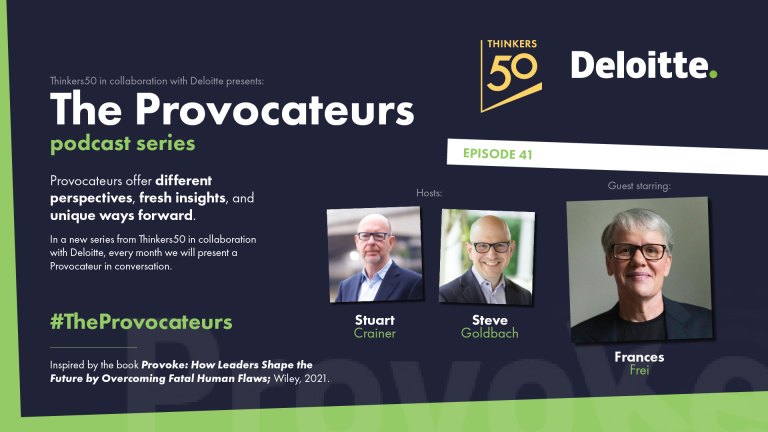
Thinkers50 in collaboration with Deloitte presents:
Steve Goldbach, Geoff Tuff, and Kulleni Gebreyes of Deloitte join Stuart Crainer and Des Dearlove of Thinkers50 to reflect on their highlights and insights from the 2025 Provocateurs series.
Featuring in-depth conversations with leaders and innovators, the 2025 Provocateurs explored pressing topics from sustainability and space exploration to digital health, public policy, and food systems innovation. Throughout the series, compelling stories emerged that illustrate the power of systems thinking, reframing narratives, and leadership under pressure.
We heard about seaweed and rum in Barbados: a circular economy success story combining waste products to create fuel. We learned how modulating electrical motors reframes sustainability as efficiency, delivering rapid returns on investment. And we listened as astronaut Eileen Collins described the extreme pressure of an aborted rocket launch, exemplifying agility and preparation as the essence of leadership.
The 2025 Provocateurs guests included:
What were your key take-aways from our 2025 Provocateurs?
#TheProvocateurs
This podcast is part of an ongoing series of interviews with executives. The executives’ participation in this podcast are solely for educational purposes based on their knowledge of the subject and the views expressed by them are solely their own. This podcast should not be deemed or construed to be for the purpose of soliciting business for any of the companies mentioned, nor does Deloitte advocate or endorse the services or products provided by these companies.








Co-founder, Thinkers50

Co-founder, Thinkers50


US Sustainability Practice Leader, Deloitte

Inspired by the book Provoke: How Leaders Shape the Future by Overcoming Fatal Human Flaws; Wiley, 2021.
Stuart Crainer:
Hello and welcome to Provocateurs. I’m Stuart Crainer, co-founder of Thinkers50. Provocateurs is a podcast which aims to provoke you to think and feel differently. This is our annual episode in which we make sense of the past year, if that’s possible, and the fantastic people we have talked with on the podcast. Joining me in making sense are Steve Goldbach, Geoff Tuff, and Kulleni Gebreyes from Deloitte and from Thinkers50, we have my fellow co-founder, Des Dearlove. And what a year we have had. The 2025 Provocateurs series featured in-depth conversations with leaders and innovators driving change across organizations, leadership, and society. We roam widely. So we have covered everything from sustainability and space exploration to digital health, public policy, and food systems innovation.
Each episode reveals what it takes to lead with purpose, clarity, and impact in an increasingly complex landscape. Our guests this year have been Weslynne Ashton, Katie McGinty, Rajendra Pratap Gupta, Karthik Ramanna, Eileen Collins, Selassie Atadika, Anke Hampel, and Natalie Nixon. Thank you to them all. Kulleni, perhaps we can start the conversational ball rolling with you. You’re vice chair and US life sciences and healthcare industry leader at Deloitte, and there’s a strong science contingent to our guests this year. You and I talked with Rajendra Pratap Gupta, who is founder of the Global Digital Health Summit and the global think tank, the Health Parliament. And there was also the astronaut, Eileen Collins. It takes science to get into space, after all, and system scientist, Weslynne Ashton. Science suddenly seems to be center stage. Do you think that’s the case?
Kulleni Gebreyes:
Stuart, it’s great to be here with you, and I can’t believe 2025 is almost over. And I would tell you, from my experience, science has always been at the center of the stage, but that goes to show you more of my background than anything else. But as I think about everything that you just mentioned, not only is science at the center of the stage, but it’s the navigation platform for all of us, as we’re trying to get through a world with so much complexity, uncertainty, and the rapid pace of change.
So when I think of science, I think of a couple of things and our leaders spoke to it, which is hypothesis-driven thinking. It is being fully committed to getting to the root cause instead of just symptoms of what’s going to happen. It’s action and reaction, not just as a unilateral or bilateral, but multilateral. And it’s also continuous reinvention. So Eileen spoke about that as she talked about the space mission and how she commanded it, which is experimentation, so that it’s not just about designing the perfect launch, but it’s learning from the failures. So that’s hypothesis-driven thinking. It’s understanding how one thing leads to another.
Rajendra said, “Listen, this is not just about population health at the industrial level. It’s looking at individual outcomes, action, reaction, what we do and how that impacts outcomes.” And then when you think about Weslynne, a natural ecologist, or industrial ecologist, who talks about systems and how the forms of capital are more than the way we traditionally think about them, but there’s multiple interaction models and ecosystem plays that we need to think about. So yes, science is at the center, we need to observe, have rigorous discipline around how we learn, and continuously reinvent.
Stuart Crainer:
I’m struck by how the boundaries between science, leadership, and society seem to be continuing to blur. So if you had to pick one scientific insight from this year’s conversations that leaders aren’t paying enough attention to, what would it be?
Kulleni Gebreyes:
It’s interesting. So whether you’re talking about science, engineering, communication theory, we often talk about the signal and the noise and how do we find the signal in the noise? That’s conventional wisdom, traditional thinking. I would say that what we’ve heard over the last year and what we’ve seen is that, instead of assuming the law of averages is the way we should go and that standardization is the answer to getting real results and better outcomes, Stuart, I would argue to say that what we’re learning today is that the signal is in the noise and the insight is in the outlier data.
Stuart Crainer:
And of course, sustainability has also been prominent in our conversations this year, such as with Selassie Atadika and Anke Hampel. Steve, you’re the sustainability practice leader at Deloitte. In the spirit of being a Provocateur, what’s one uncomfortable truth about sustainability that became impossible to avoid this year?
Steve Goldbach:
I think the thing that resonated the most and is uncomfortable with the entire sustainability movement is that human beings remain bad at focusing on things that are long-term in nature. And so in the spirit of provocation, I’ve been going out and saying, “We should be spending less time arguing about distant long-term goals.” We should frame up an ambition, to be sure, so that we’ve got some north star, but arguing over the details of whether goals are in 2050 or 2045 and then debating when people move those goals a bit, I would rather focus less on the next 25 years and more on the next 25 months. And what we need to recognize is that we learn by doing as a species and we need to drive towards action and that we should care less, perhaps, about changing the way people think and focusing a bit more on changing the way people act.
And I think our guests this year really had many different ways in which we could focus on changing action. So Selassie is doing it by creating sheer joy in her work and bringing the spices and flavors of her home country of Ghana back to the forefront through the world of chocolates. And those are actually going to be some of my holiday gifts this year, they’re so delicious. But also, not only can you change people’s action through joy and making things that are inherently sustainable, joyful, you can do it by conventional business theory.
So Anke demonstrates that sustainability is just great business. And the uncomfortable truth there, Stuart, is that you can’t separate what is a sustainability issue and what is a business issue. Sustainability impacts costs, sustainability impacts risk and sustainability impacts your ability to enhance revenue. And so we have to recognize, that in order to drive behavior, we have to have sustainability, not as this thing off to the side, but as a core business issue. But actually interestingly, the thing that I took away the most from the podcast this year and how I want to apply it in the world that I look after at Deloitte is from Karthik, who talked about how to lead in a polarized world.
And one of the things he said is that you can’t argue with people that you inherently like, or I’m getting the words exactly wrong, but there was something about just being able to try to be human with people that you might disagree with on issues. And if you can separate your disagreement from a genuine liking of the other human and make it about being able to have conversations about how to meet shared objectives, then I think we’d make a lot more progress. So my hope is that we can make this less of a polarizing issue and more something that we sit down with people that we disagree with and look for opportunities to collaborate.
Stuart Crainer:
So our third … sorry.
Steve Goldbach:
It was a surprising answer, Stuart.
Stuart Crainer:
The third part of our trio from Deloitte is Geoff Tuff, who leads Deloitte’s sustainability work globally.
Steve Goldbach:
We should totally leave that in. That was funny.
Geoff Tuff:
I just liked the fact that Stuart breaks out laughing whenever he thinks of me. So that’s Eric’s story.
Stuart Crainer:
I was carrying on. Steve was talking about joy and I had a segue …
Kulleni Gebreyes:
He felt joy.
Stuart Crainer:
Steve was talking about joy. So Geoff, joy, Tuff, and the nice segue. And then Steve carried on talking and that’s what threw me. The third part of our Deloitte trio is Geoff Tuff, who leads Deloitte’s sustainability work globally in the energy and industrial sectors. Geoff, if you look ahead based on the signals we’ve heard from our guests, what’s one emerging trend that leaders will underestimate at their peril next year?
Geoff Tuff:
Well, that got serious all of a sudden, Stuart, but I just have to reflect on the fact that Steve is my co-author in most of the writing that I do. When he talks about having to find some common ground between very different points of view, I think we’re probably a pretty good test ground for that. But I would say, so as I’ve been reflecting on the conversations we’ve had this year, actually a lot of what Steve had to say does actually resonate very deeply with me, perhaps not surprisingly, given we work so closely together, but with responsibility for the work we do in the energy space around sustainability, the key trend that we’ve seen in our business this year, and I think that we heard through a number of our different guests, is that economic value and a drive for sustainability are inseparable, and it’s absolutely critical.
We heard it from Anke, we heard it from Katie McGinty, we heard it from others, that it’s absolutely critical that if we want to be serious about sustainability, we need to think about it in economic terms and understand that there is real and immediate profitability that can be earned by driving for more sustainable solutions. Steve talked about the importance of thinking about efficiency and reducing costs with sustainability. Actually, the work that Johnson Controls and that ABB do in the world is intended to bring both better mechanical solutions to the buildings and the equipment that they manufacture, but also more sustainable and more cost-effective solutions as well. And we’re finding that, as I said, both with our guests and in the work that we do day in, day out, that those things are no longer in any way in contention. And actually, the companies that are understanding that you can go and create some advantage by adopting more sustainable solutions are the ones who are ultimately going to probably be the leaders in their industry for the foreseeable time to come.
The second theme that I think we’ve heard time and again from many of our guests is that, and this is not, I wouldn’t say this is a new thing by any stretch, certainly not in the conversations we’ve had on this podcast, but the absolute criticality of not thinking about things in isolation and instead thinking about systems. We heard throughout all the podcasts, and I’m not just talking about energy systems here. We talked about food systems, we talked about health systems, we talked about political systems, we talked about circularity systems, and I could go on, but the thing that we came back to time and again with our guests was we have to see the interconnectedness between all the various different, not only players within the industries that we’re part of, but also the cross-industry connections if we’re going to make whatever type of progress we’re trying to make.
For Steve and I, it happens to be a focus on sustainability, but there are lots of other ways that, for whatever goal any organization has, there’s lots of other ways to look towards, I’ll put it in quotation mark, “systems thinking” as a real key insight. And then the final trend that I’m surprised, I don’t think we’ve actually said AI yet in this reflection episode, but that obviously came up all the time. AI is one of the key drivers behind the activity that we’re seeing in the energy system these days.
We have, in the course of our work, we’ve shifted, over the course of the last 18 months, away from a broad scale conversation about energy transition, even though the energy transition does continue, and more towards energy expansion and energy security and energy independence in order to meet the demand boom that AI is unleashing everywhere around the world. It’s certainly true here in the US, but it’s true for virtually every region of the world. And I’m sure we’ll come back and talk about some of the themes behind AI as we get further into this conversation, but it’s impossible not to pay attention to the exponential impact that AI is having on all of our systems, whether it’s energy, food, health, what have you.
Stuart Crainer:
And finally, but not least, thanks, Geoff. And finally, but not least, my fellow Thinkers50 founder, Des Dearlove. Des was in New York for Climate Week to record an episode of Provocateurs. So Des, after experiencing the energy there, what gave you the most hope, and what caused you the most concern?
Des Dearlove:
Well, as I think other people have said, we have had some great guests and they’ve told some great stories this year, and I’m going to come at this slightly differently. I’m going to pick out three stories and then hopefully pull out some trends and some ideas from the stories. So I think we’ve mentioned Weslynne and I mean she told us a story about seaweed and rum. Anke told us the story about modulating motors and Eileen told us a story about riding rockets and each of those stories, I think, has a lot to teach us as well as being a great story. So Weslynne, as well as being a professor of environmental management and sustainability at the Illinois Institute of Technology, she specializes in small island research and the circular economy. So as I would call it, the seaweed and rum story goes to take us to Barbados.
I mean, it’s probably quite a nice place to go at this time of year. And places like Barbados are microcosms of the world. So if there’s something going wrong ecologically, it tends to become a crisis sooner, faster. So again, there’s lessons to be learned. So she was telling us about a certain type of seaweed called, I’m going to mispronounce this, but I think it’s something like sargassum. And it’s a natural seaweed, which is an ecosystem in itself where, so small fish, a number of other species need this for their growth. Increasing amounts of this seaweed are washing up onto the beaches in the Caribbean. Now that material, once it washes up on the shore, starts to decompose and so it begins to smell, so therefore compromising the beautiful white beaches of the Caribbean and particularly of Barbados.
As some of you may know, Barbados is also famous for its rum, which also produces waste. Now what they’re doing, there’s an experiment Weslynne was telling us to combine the rum distillery waste with the seaweed waste to make fuel that can power the cars on the island because otherwise they have to import all their fuel. So they’ve been running pilot experiments to run cars on compressed natural gas, which is the byproduct of the digestion process of the seaweed, and they’re also using that to create electricity and run electric vehicles. So this is a fantastic story about circularity and I think it’s the sort of story we need to hear more about because it makes it real, brings it to life.
The second story is about modulating motors and this is the story that Anke told at the Climate Week. And she’s chief sustainability officer at ABB, which is global leader in electrification and automation and based in Zurich. Moderated motors, so ABB is the biggest provider of electrical motors and smart variable drives and they are now framing the sustainability conversation around energy efficiency and collaboration rather than it’s just a good thing to do. So she was telling us a great story about motors. I didn’t realize this, maybe you guys all knew this, but most motors are unmoderated. In other words, they run 100% power even when it’s not required. So simply modulating them, retrofitting modulators can have a huge impact in terms of the efficiency of the motors. And there’s an awful lot of motors out there. And from what Anke was saying, the ROI, the return on investment can be, it’s often just a few months. So it’s a really efficient way to talk about energy transition. And it’s another great story that illustrates the point.
I could talk about Eileen Collins as well, if we’ve got time. She was just fascinating. She’s one of those people that you hope to meet once in a lifetime, I think. She was the first ever woman to pilot a space shuttle, and then she was the first ever woman in history to command a space mission. So she’s an amazing, amazing human being. She was telling us in 1999, about sitting on top of the rocket on the launchpad and they’re doing the countdown. Obviously they’ve trained for this. These astronauts have trained for this, and it goes 10, nine, eight, seven, then she said it went back up to eight. Then it went back down to seven, then it went back up to eight, then it came back to seven. She said, “We’d never seen this before in the training, so we knew there was something up.” So you’re sitting there on top of all this huge rocket with all this fuel onboard and it got down to half a second before they fired the engines up and then they stopped the countdown.
So can you imagine sitting there with that going on around you? One of the things she said was that in that situation, as a leader, you have to be prepared for either eventuality. In other words, you might just be going into space or, so you’ve got to be ready to either launch or to scrub, what they call a mode one. A mode one is when you have to get out of the vehicle as fast as you can and take a zip wire to get out before the thing blows up. So can you imagine sitting there as a leader thinking, “Well, it’s going to go one of these.” And she was saying basically that’s the essence of leadership, is being prepared, being agile and being prepared to go either way.
So three stories. I think the first one is very much about what Geoff mentioned, systems thinking. I think the second story is very much about framing and how you tell the narrative. And if you frame sustainability as efficiency, it’s a different conversation. And I think that’s part of one of the things that Steve was alluding to. And then finally, leadership, how we understand leadership, front foot leadership, being prepared for all situations and in extremists, and that was extreme, I think that’s the other great trend that I could see coming through.
Stuart Crainer:
Some of these people’s life stories are amazing, aren’t they? I mean, some of the experiences… That’s what always strikes me. Someone like Katie McGinty, who on the outside, I thought corporate executive, Johnson Controls. But then she tells her stories. She’s one of 10 children. She worked for President Clinton. She worked in government. She worked in India. She moved from being a lawyer to chemist, and it’s pretty incredible. And you feel like, what have I been doing with my life really?
Geoff Tuff:
I was about to say, who knew that being a podcast host could be so humbling?
Stuart Crainer:
There’s so many things are humbling.
Geoff Tuff:
For all of us except for Kulleni. But I mean-
Kulleni Gebreyes:
Well, I’m humbled, trust me!
Stuart Crainer:
Yeah, but these people do remain grounded and humble as well. And that’s what’s amazing as well. I think the best quote of the year came from Selassie who said, “I lead through deliciousness,” which I think cut through quite a lot of stuff, really. And one thing that strikes me looking at all these conversations we’ve had is that there’s quite strong currents of positivity. And I think in the sense, I think Steve was alluding to it, that we’re making progress in tackling these big issues, but in isolated pockets, but understanding there seems to be progress. So I was feeling, listening to the episode, I was feeling more positive about life, which I find difficult at times.
Des Dearlove:
Yeah. I think that was my overriding impression of Climate Week, you were asking about Climate Week, because I came away, I mean, you, Steve and Geoff were there, I came away very positive, considering it might not have been the case, but I did take away… I had some really good conversations with people doing sustainability and I came away very upbeat.
Steve Goldbach:
Well, I think we definitely have a biased sample in the remarkable guests that we have, but I would say that the commonality is that if you’re not approaching life with a glass half full mentality, I think it’s just really hard to achieve extraordinary things if you don’t walk through life with a can do attitude. And I think all of our guests certainly reflect that. Many of them have overcome severe adversity in order to get to where they’re at. And I think what the commonality is that they’ve channeled that adversity into a positivity about the world that allows them to do the things that they have achieved. So I think it’s a good lesson for all of us that being grateful and not getting too full of yourself is often a recipe for success.
Geoff Tuff:
Well, and if I could add to that, Steve, I think part of the reason we all walked away feeling so positively about many of these conversations is it gave us a chance to go deep into some of the stories that you were talking about, Des, or some of the experiences that our guests have had. And it just shows the importance of paying attention to what’s actually happening as opposed to paying attention to the narrative. Because the times when I feel most negative about things generally in the world or whatever the case may be on any given day, it’s when I’m thinking about things at too summary a level, but it’s actually really heartening to pay attention to the progress that individuals and companies are making day in, day out if you just slow down and pay attention to those hotspots of activity.
Kulleni Gebreyes:
And as I hear you all, even though I couldn’t join in Climate Week, but I definitely will next year, the thing that jumps out at me is really also a bias for action in terms of, I mean, Geoff, you just described what I would describe as a transition from pontificating about what it could be, it should be, and why it is, or it isn’t, to prototyping and taking action. And Stuart, you know I love my quotes. As we’re discussing this, the one that jumps in my mind is the author Ash who said, “Start where you are, use what you have, do what you can. ” And I think that it’s really critical for all of us to think about what’s the next step of what we need to do collectively or individually within our own organizations as leaders, and then coming together to have the kind of world that we want to live in, whether it’s sustainability from a planet perspective or longevity and health plan from a personal and human perspective.
Stuart Crainer:
And during the year, Geoff and Steve found time to write another bestselling book, Hone. Tell us more, Steve and Geoff, why should our listeners and viewers buy Hone?
Geoff Tuff:
Well, I’d like to say because it’s a good read. We have actually been hearing from people that it’s a good read, but most of what Steve and I have tried to write about over time has been, first of all, it’s been learned in the work that we do with our clients every single day. So this is not the two of us sitting back and pontificating and trying to come up with theories. It’s actually observations about the way the world is really working. And as all of my co-hosts here know all too well, this is the third in a trilogy of books that Steve and I have written that we never knew was going to be a trilogy when we set out.
And it, so far, I think, has felt to people, and Steve, you should correct me if you’ve heard differently, but the most practical set of advice about how to really pay attention to the behaviors of individuals in your organization or even outside your organization that you know are going to be the types of things that will drive success for whatever you’re trying to achieve and then using what we refer to in the book, commonly referred to as management systems in order to drive those behaviors. And it has felt, I think, to our readers, immediately applicable to whatever job they’re doing at whatever company or organization they happen to work for. So the reaction’s been gratifying, but Steve, you should definitely add to that.
Steve Goldbach:
Yeah, look, I think it has been gratifying and the core premise for the folks who are just hearing about this for the first time is that businesses are, we think, over obsessed with transformation. And the metaphor that we use for the title Hone comes from the world of cooking. And when chefs begin their preparations to cook, oftentimes the first thing they do is hone their knife. And the reason they hone their knife is because a dull knife is actually a dangerous knife. And we asked a chef why does she sharpen her knife before every cook? And we got corrected pretty quickly by Flannery Klette-Kolton, who is one of the four artisans that we profile in the book. And Flannery said, “I’m not sharpening it. I’m honing it.” And honing is totally different. It’s realigning the steel, it’s not taking away steel, it’s not destroying steel, it’s realigning it to cut the way it was meant to cut.
We think that businesses are far too reliant on sharpening their businesses through transformation, which is a destructive and … risky act. It’s costly and it fails a lot. Rather, what we should be doing is taking a first principles approach and continually honing our businesses through minimally viable moves and focusing on the behaviors we need to adapt to an ever-changing world. That’s the core thesis of the book and it can be applied, we think, to everything. I just came from a conversation a half hour ago with a client in the insurance space in the UK who was interested in becoming a learning organization.
And what we talked about was the importance of uninstalling management systems that exist in our organization that actually prevent people from taking actions that would promote learning because instead, what they do is they take actions that are predictable. And unfortunately, things that actually are real, learning actions are things that you don’t know the outcome in advance to. And what you need to do is take away all the incentives that promote us from doing things that are inherently predictable and “safer,” except they’re not safer in a moving world, than things that are less known about what the outcomes will be, but will promote learning.
I’d say the world of AI, we haven’t talked much about AI, but we have to take this philosophy to the world of AI. If companies aren’t experimenting with AI today, they are falling behind. Try new things because that’s definitely where the world is heading.
Stuart Crainer:
The talk of systems thinking takes us back to Kulleni’s point about science, to my ears.
Kulleni Gebreyes:
Absolutely. Science is center stage, right Stuart?
Stuart Crainer:
But the hone… it’s the combination of, there’s a craftsmanship feel to it as an idea, but it’s the intersection between the craftsmanship and the system.
Geoff Tuff:
Yeah. And the good news is, as Steve said, we did profile some real craftspeople, I suppose. In our book, we had Flannery, the chef that Steve talked about. We had Onne van der Wal, who’s a very well-known nautical photographer. He takes mainly most of his photos are of sailboats, but really impressively framed and shot. We had a documentary filmmaker and producer in the mix, and then we had a Canadian rock band. And so all of those things, we thought it was a neat little way to introduce some levity into the book, but we ended up learning a lot from these artisans along the way and drew some real lessons that can be applied to any business situations from each of them, even though they seem like they’re in very different careers.
Stuart Crainer:
Can you develop the Canadian rock band story, Geoff?
Geoff Tuff:
Well, I could talk at length about all sorts of rock bands. And this one in particular, Our Lady Peace, Steve and I are both originally Canadian. And Our Lady Peace was one of the original indie bands in the ’90s that came out, made it huge. They were in an era in the music world where you spent millions and millions of dollars on producing albums and you made millions and millions of dollars from those.
And they’ve actually been able to stay relevant now for 30 years and stay at, we would argue, and I think many of their listeners would argue, is at the peak of their capabilities, but they’ve completely reinvented themselves along the way as the music industry has shifted by doing exactly what we’re advocating in Hone, which is pay attention to the small things you need to do day in, day out to adapt to a changing situation. And so as I say, we had never anticipated, going into the conversation, that there would be a perfect manifestation of some of the ideas, but they ended up being that.
Stuart Crainer:
So we’re not about to change the title of the podcast to Hone at this stage. I mean, obviously-
Geoff Tuff:
Unfortunately, I’ve heard the word honers uttered a few times, which is not nearly as delightful to say as Provocateurs. So let’s stick with Provocateurs.
Stuart Crainer:
Yeah. So if we’re going to stick with Provocateurs for the time being, obviously we reserve the right, as Hone sweeps the world, I’m sure the three of us who aren’t co-authors are willing to go along on that particular ride. But if we’re talking about provocative ideas to carry into 2026, what’s the most provocative idea leaders should carry into next year, do you think, from our conversations this year and your own experiences during the year? What’s a provocative idea for next year?
Geoff Tuff:
So I’ll jump in since my voice is warmed up, and then I’m eager to hear from others as well. But I actually, so the last podcast that we recorded was at the Thinkers50 Gala in London, or one of the last ones that we recorded, it was with Natalie Nixon. And I thought she had a fascinating take on what AI can do to humanity that I will make sure that I take into next year and put to practice myself. And her general point was that AI can actually humanize work by freeing up time for creativity and meaning. And so I think a lot of the time when, and certainly Steve’s laughed at me watching me adopt AI over the course of the last 18 months, but a lot of us struggle with what is the impact of AI on our lives, on the work that we do.
Those of us that have grown up in an industry that is about developing and disseminating ideas, AI could, in theory, be disruptive. But actually, if you think about it as a source of freedom and, as Natalie called it, it creates the liminal space to bring what human beings can and will always bring to the table, which is creativity and deep meaning to the problems that we’re trying to address, that’s where we really start to see the power of humans working with AI together. And I’ll make sure that I keep that in mind as we carry through into the new year.
Stuart Crainer:
Yeah. Natalie had a great line about combining wonder and rigor, which is something to aspire to. Kulleni, provocative idea for next year?
Kulleni Gebreyes:
There are so many ways to be provocative as we think about next year, especially with, Stuart, where we started, which is science at the center. But then when you think about all the examples that Steve and Geoff have shared around creativity being actually a core way to experiment, and you just mentioned embedding wonder into everything that we do. So when I think about 2026 and what’s to come, the concept that I would say is let’s throw away the idea that we should measure twice and cut once and we should look before we leap. And really now it’s about, and Geoff, you said this in terms of starting to use AI, start before you’re ready.
And I think that each of us, instead of waiting to do analysis to understand and measuring to really feel comfortable that we should move in the midst of discomfort and that the data that we need to actually make the right decisions and the actions we need to take to get the outcomes that we want, once again, healthy planet, healthy people, healthy economy actually comes to life as we take action. So it’s looking at inaction as being the costliest strategy for a business or our individual leadership career and making sure that we’re all starting before we’re ready because what we do will actually give us the information that we need.
Stuart Crainer:
Start before you’re ready is a great line.
Des Dearlove:
Leap before you look, I like that as well.
Stuart Crainer:
A provocative idea for next year, Des?
Des Dearlove:
Karthik Ramanna was talking about, I mean, to pick up a point I think Steve made earlier about listening to voices you wouldn’t normally listen to and meeting people, it’s very hard to hate people once you know them. And Karthik talked about creating systems of active listening, literally forcing yourself, provoking yourself to go out and listen to the people you wouldn’t normally listen to and the people perhaps whose opinions you find jarring. But I think that’s a very useful exercise. I think it was Tony Blair that said the hardest part of leadership is not just listening to the loudest voices. I think possibly an even harder part of leadership is listening to the people that violently disagree with you. So I would take that away. I think we need to challenge ourselves to hear both the quieter voices, but also the dissenting voices and put ourselves in harm’s way in a certain way, so that we’re able to accommodate different points of view.
Stuart Crainer:
Does that embrace listening to Canadian rock bands?
Des Dearlove:
Potentially.
Stuart Crainer:
We draw the line there, surely. Steve, a provocative idea?
Steve Goldbach:
Yeah. The thing that I’ve been thinking a lot about is the connection and role of AI and education. And not surprisingly, I think a lot about this because I spend time as a father of an 11-year-old and watch her do her homework and how she learns and how she works. And it strikes me that the thing that is supremely different about a world with AI and the direction of travel that AI is going is that for the better part of human history, our education system has been designed primarily, I think, to teach people to have expertise in a narrow slice of human knowledge. And now, and increasingly what you do, whether it’s in the field of business or medicine or science or philosophy or art, is you become increasingly expertise at knowing that slice of human knowledge. Now we’re entering a world where increasingly that knowledge is available on demand, as you need it, and you can teach yourself that.
And I know this because, as a Canadian, as we’ve established, my daughter was doing a section on the American Revolution and I felt woefully unprepared to quiz her and help her in preparing for a test. So I went to AI and I asked it to teach me about the founding of the United States using the Socratic method, so that I would be participating in the discussion. And it did a really good job at doing it. So it made me start to wonder about if we’re living in a world where new knowledge or at least expertise is available increasingly on demand, what should be the role of education for a world where you don’t need to find a human to access that knowledge, you can do it on demand.
And it started me thinking about the way that we ought to think about evolving education to be more around creativity, more around standing on the shoulders of that knowledge to create new innovation, to create joy and deliciousness, as we’ve established, in new ways. And I don’t know the answer to it, but I’m thinking that one of the first things that will need to be provoked in the future will be what we teach our kids in a world where what they might need to know might be available much more readily than it otherwise was when we were growing up.
Geoff Tuff:
So what you’re saying, Steve, is it really was a good idea for me, 35 years ago, to major in creative writing?
Steve Goldbach:
Perhaps. It certainly helped me a lot in the last 10 years.
Stuart Crainer:
So if we’re talking about self-improvement and education, how about personally? What’s one habit, practice, or mindset that you want to hone as a leader as we step into the future? You’ve told us about Hone and the ideas behind it, but what personally do you want to hone? My personal one is, I want to hone my, I’ve really picked up the positivity and optimism from all the people we’ve had conversations with. And I think it’s something you’ve got to work at because it’s very easy to get dragged down by uncertainty in the world. So I’m going to work on my own positivity and optimism. Kulleni?
Kulleni Gebreyes:
It’s interesting. I had an assessment done of my leadership style a number of years ago, and I was told that my score on prudence was 3% and in experimentation was 97%. But I will tell you that in my experimentation, I’ve actually always looked for the standard of what is in the middle. And so the thing that I’m going to focus on is looking at the outliers to see what doesn’t fit and what’s the lesson to be learned from there, but continuing experimentation, but looking at what doesn’t fit the pattern instead of always seeking for the pattern.
Stuart Crainer:
And Des?
Des Dearlove:
I’m sticking with the listening thing, although I’m picking up on what Kulleni is saying as well. I’m going to listen more to people at the margins and I’m going to listen to more Canadian indie bands and try to hone my knowledge so I can have a conversation with my fellow presenters.
Stuart Crainer:
The surprising thing was Kulleni said she didn’t say she was going to work on her prudence.
Kulleni Gebreyes:
Experiment more.
Geoff Tuff:
Prudence, there’s no desire there for that.
Stuart Crainer:
It’s gone down to 1% now.
Kulleni Gebreyes:
Exactly.
Stuart Crainer:
Geoff, what are you going to hone?
Geoff Tuff:
Well, my co-author will tell you that I need to be more mindful, not in the walking down the street sense, but actually to spend a little bit of time on self-reflection and meditation. And I actually agree with him on that. I have seen it do wonders for him in the way that he has been able to improve his listening and being in the present in the professional world and I need to work on that myself. So I’m pretty sure that that is my New Year’s resolution every single year, so we’ll see how successful I am. But maybe if I just start with two minutes, right, Steve? That’s all it takes.
Steve Goldbach:
Two minutes. Two minutes every day for two weeks.
Stuart Crainer:
Steve, you’ve mastered this. So what-
Steve Goldbach:
No, I’ve definitely not. There’s no ever mastering it. The thing that I’m striving to do increasingly is just make sure that the mantra I take in everything I do is to try to help the other human on the other side of the conversation. And I think increasingly if your orientation in conversations is how can I be of help, of value? And you honestly take that point of view even when it doesn’t necessarily immediately benefit you in the long run, I think that in generally it’s a good mentality and you end up getting rewarded for it. And so I’m going to try to dedicate myself more to just being of help in every situation in whatever way that is. And we’ll see how that plays out and really try to live by that philosophy.
Stuart Crainer:
Yeah. Helpfulness is a great thing to aspire to.
Steve Goldbach:
Yeah.
Stuart Crainer:
Great conversation as always guys. And looking ahead, we’ve got some wonderful people lined up already for the forthcoming series. We’ve got Dan Pink, Francis Frei, Andre Hoffmann, Cecile Bellio, Samuel Money, Spencer Glendon and we will also be joined, on occasion, by the Thinkers50 CEO, Mikko Leskelä, who will add Nordic wit and wisdom on demand. I believe Mikko is here to join us now.
Mikko Leskelä:
Hi. I certainly am, and not just talking about Nordic wit, it’s actually darker here in Helsinki than it’s in Steve’s background picture. I’m trying to stay positive, trying to stay optimistic and it’s easy to do that with you guys. Super happy to be joining you.
Steve Goldbach:
Is the sun coming up these days in Helsinki yet?
Mikko Leskelä:
For a couple of hours still, but I mean, it will get worse.
Kulleni Gebreyes:
It will get worse. That’s one way to look at things.
Des Dearlove:
I think that’s a good mantra.
Geoff Tuff:
That should be the catchphrase for the podcast from now on. Come here for a bit of positivity because it will get worse.
Des Dearlove:
It will get worse.
Mikko Leskelä:
There’s a lot to be looking forward to. I heard the name of Andre Hoffman, for example. I’m very much looking forward to that episode, for example. And he talked about his idea of treating human and social or cultural capital as actual capital that has a compound interest rate. I mean, having people like that lined up, it’s going to be super exciting.
Stuart Crainer:
Yeah. In 2026, we’ll also be celebrating the 25th anniversary of Thinkers50. So we look forward to celebrating along with as many of you as possible during the year. So many thanks for listening and watching during 2025. And thank you to Geoff, Steve, Kulleni and Des and all the people who make the podcast happen. Thank you, Mikko, and we look forward to some great conversations next year. Thank you.
This podcast is part of an ongoing series of interviews with executives. The executives’ participation in this podcast are solely for educational purposes based on their knowledge of the subject and the views expressed by them are solely their own. This podcast should not be deemed or construed to be for the purpose of soliciting business for any of the companies mentioned, nor does Deloitte advocate or endorse the services or products provided by these companies.

Thinkers50 Limited
The Studio
Highfield Lane
Wargrave RG10 8PZ
United Kingdom
Contact us at:
enquiries@thinkers50.com

Thinkers50 Limited
The Studio
Highfield Lane
Wargrave RG10 8PZ
United Kingdom
Contact us at:
enquiries@thinkers50.com

Thinkers50 Limited
The Studio
Highfield Lane
Wargrave RG10 8PZ
United Kingdom
Contact us at:
enquiries@thinkers50.com
| Cookie | Duration | Description |
|---|---|---|
| LANG | 9 hours | Linkedin set this cookie to set user's preferred language. |
| nsid | session | This cookie is set by the provider PayPal to enable the PayPal payment service in the website. |
| sp_landing | 1 day | The sp_landing is set by Spotify to implement audio content from Spotify on the website and also registers information on user interaction related to the audio content. |
| sp_t | 1 year | The sp_t cookie is set by Spotify to implement audio content from Spotify on the website and also registers information on user interaction related to the audio content. |
| tsrce | 3 days | PayPal sets this cookie to enable the PayPal payment service in the website. |
| x-pp-s | session | PayPal sets this cookie to process payments on the site. |
| __cf_bm | 30 minutes | This cookie, set by Cloudflare, is used to support Cloudflare Bot Management. |
| Cookie | Duration | Description |
|---|---|---|
| l7_az | 30 minutes | This cookie is necessary for the PayPal login-function on the website. |
| Cookie | Duration | Description |
|---|---|---|
| CONSENT | 2 years | YouTube sets this cookie via embedded youtube-videos and registers anonymous statistical data. |
| _ga | 2 years | The _ga cookie, installed by Google Analytics, calculates visitor, session and campaign data and also keeps track of site usage for the site's analytics report. The cookie stores information anonymously and assigns a randomly generated number to recognize unique visitors. |
| _gat_gtag_UA_10408481_1 | 1 minute | Set by Google to distinguish users. |
| _ga_ZP8HQ8RZXS | 2 years | This cookie is installed by Google Analytics. |
| _gid | 1 day | Installed by Google Analytics, _gid cookie stores information on how visitors use a website, while also creating an analytics report of the website's performance. Some of the data that are collected include the number of visitors, their source, and the pages they visit anonymously. |
| Cookie | Duration | Description |
|---|---|---|
| NID | 6 months | NID cookie, set by Google, is used for advertising purposes; to limit the number of times the user sees an ad, to mute unwanted ads, and to measure the effectiveness of ads. |
| test_cookie | 15 minutes | The test_cookie is set by doubleclick.net and is used to determine if the user's browser supports cookies. |
| VISITOR_INFO1_LIVE | 5 months 27 days | A cookie set by YouTube to measure bandwidth that determines whether the user gets the new or old player interface. |
| YSC | session | YSC cookie is set by Youtube and is used to track the views of embedded videos on Youtube pages. |
| yt-remote-connected-devices | never | YouTube sets this cookie to store the video preferences of the user using embedded YouTube video. |
| yt-remote-device-id | never | YouTube sets this cookie to store the video preferences of the user using embedded YouTube video. |
| yt.innertube::nextId | never | This cookie, set by YouTube, registers a unique ID to store data on what videos from YouTube the user has seen. |
| yt.innertube::requests | never | This cookie, set by YouTube, registers a unique ID to store data on what videos from YouTube the user has seen. |
| Cookie | Duration | Description |
|---|---|---|
| DEVICE_INFO | 5 months 27 days | No description |
| loglevel | never | No description available. |
| m | 2 years | No description available. |

Thinkers50 Limited has updated its Privacy Policy on 28 March 2024 with several amendments and additions to the previous version, to fully incorporate to the text information required by current applicable date protection regulation. Processing of the personal data of Thinkers50’s customers, potential customers and other stakeholders has not been changed essentially, but the texts have been clarified and amended to give more detailed information of the processing activities.