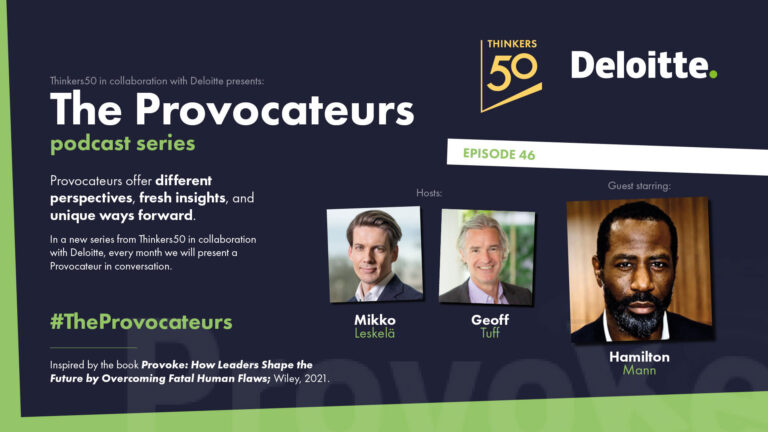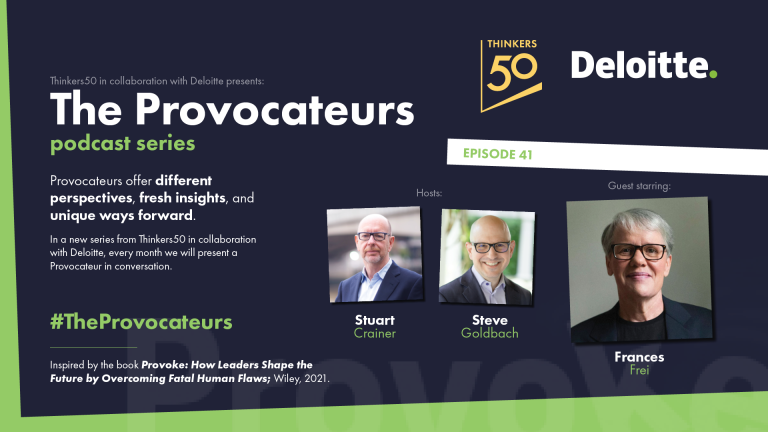
Thinkers50 in collaboration with Deloitte presents:
Hamilton Mann argues that the most urgent challenge posed by AI is not the prospect of future superintelligence, but the concentration of algorithmic power already taking place today. He identifies three layers: capability, as a small number of companies develop the most powerful AI systems; distribution, as those systems reach millions of people; and, most consequentially, governance, where algorithmic systems increasingly exercise powers resembling the legislative, executive, and judicial functions that democracies have historically sought to keep separate.
Conventional technology regulation is not enough, Hamilton says; AI governance should be a question of constitutional design – asking not simply what rules powerful systems should obey, but where their legitimacy comes from.
Hamilton is the author of a new book, Trias Algorithmica: What Code Rules and Artificial Integrity, which was named a Thinkers50 Top 10 Best Management Book for 2025. He also received the 2025 Thinkers50 Digital Thinking Award, following his induction into the Thinkers50 Radar in 2024.
This podcast is part of an ongoing series of interviews with executives. The executives’ participation in this podcast are solely for educational purposes based on their knowledge of the subject and the views expressed by them are solely their own. This podcast should not be deemed or construed to be for the purpose of soliciting business for any of the companies mentioned, nor does Deloitte advocate or endorse the services or products provided by these companies.

Chairman and President, Artificial Integrity Institute;
Author, Trias Algorithmica and Artificial Integrity

CEO, Thinkers50









Inspired by the book Provoke: How Leaders Shape the Future by Overcoming Fatal Human Flaws; Wiley, 2021.
Mikko Leskelä:
Hello, and welcome to the Provocateurs podcast. I’m Mikko Leskelä, the CEO of Thinkers50. In Provocateurs, we explore the experiences, insights, and perspectives of inspiring leaders. Our aim is to provoke you to think and act differently through conversations with some fantastic people. This is a collaboration between Thinkers50 and Deloitte, and my co-host today is Geoff Tuff, Deloitte’s global and US leader for sustainability work with energy resources and industrial plans. He’s also the co-author along with Steven Goldbach of three books, the latest one of which is Hone: How Purposeful Leaders Defy Drift. Geoff, great to see you.
Geoff Tuff:
Mikko, it’s great to be here, and I’m looking forward to doing our first podcast together, but I’m looking even more forward to today’s guest. So Hamilton Mann is with us today, and I’ll tell you as I get into this, he has one of the more impressive and complicated and French introductions that we’ve had on the show so far. So I’m going to do my best to give his bio to do it.
Mikko Leskelä:
Take a shot. Take a shot.
Geoff Tuff:
So here we go. So Hamilton Mann, he is a prominent AI researcher, a technology executive, an acclaimed author, a lecturer at INSEAD and HEC Paris, a mentor at MIT Priscilla King Gray Center, and he conducts doctoral research at École des Ponts et Chaussées – Institut Polytechnique de Paris. How did that do?
Hamilton Mann:
Very great.
Geoff Tuff:
All right, thank you. Thankfully I made it through that part. So Hamilton originated the concept of artificial integrity, which is going to be, I think, part of the focus of our conversation today. And he explained that in his 2024 book of the same name. He also serves as chairman and president of the Artificial Integrity Institute, a nonprofit organization dedicated to advancing AI systems that prioritize integrity over intelligence, which is going to be a fascinating topic to dig into. He’s also the author of the upcoming book, Trias Algorithmica: What Code Rules. I hope I got that one right. And that’s going to be released later this year by Wiley. In addition to all of that, Hamilton was inducted into the Thinkers50 Radar in 2024 as one of the 30 most prominent rising business thinkers. He received the Thinkers 50 Distinguished Achievement Award for Digital Thinking in 2025, and his book Artificial Integrity was named a top 10 best management book for 2025.
Hamilton, welcome.
Hamilton Mann:
Thank you. Thank you very much. Great to see you both, Mikko and Geoff, and very happy to be here.
Geoff Tuff:
Great. Well, then why don’t we dive in? Hopefully there are no more French accents that I’ll need to pull out for the conversation, but let’s start with your argument that AI has become a new form of power. What kind of power are we talking about here and what makes it fundamentally different from other forms of power like political power or economic power or corporate power that most of our institutions were designed to govern?
Hamilton Mann:
Yeah. Okay. So where to start from there? So AIs, or I prefer to call it algorithmic systems, are quite not comparable to those traditional powers that we know as political power or economic power or corporate power. Algorithms and algorithmic power very much represent something more unusual in a way. It is increasingly becoming a power over the condition under which all those forms of power, whether it is political, economy, corporate, are operating. Political power basically and traditionally tells you what you may or may not do. And economic power is more determining what it is that you can afford and the corporate power is like determining what gets produced, or sold. But algorithmic power increasingly operates one level upstream. One level upstream. And this is the big difference with all the other kinds of power that we know. It can influence what you see before you form a political or an economic opinion, which is concerning most of us, of course.
It can also influence what kind of information is going to reach you in the first place before you make any kind of a corporate judgment or political judgments or whatsoever, which also present the form of a possibility to influence any kind of business choices that you want to make. And of course, when it comes to business choices, you can think about any kind of decisions you can take in your each and every day. So that is a very different kind of a power, algorithmic power, because it is the form of a power that designed the environment in which the decision and the actions occurs. And once you see that, there is also something quite unsettling that follows directly, which is for most of political history, we are quite worried about the person who controls the answers.
We want to make sure that there are not big concentrations of people that have a kind of monopoly in terms of controlling the answers. When it comes to algorithmic power, and this is basically the age that we are living nowadays, what we may worry about when it comes to that power is more the control of the ability to question… that algorithmic systems that, basically, will be controlling the menu of possibilities of questions we are most likely to be influenced to be asked. And even the order in which we want to, or we may encounter, the particular set of questions that we want to be asked. So algorithmic power is not simply about what you may… let’s say reading the headlines nowadays, which is thinking about action, autonomous action, or making autonomous decisions; it is more about shaping which questions – and therefore which actions and which decisions become thinkable in the first place.
Geoff Tuff:
So I’m hearing, actually, that there’s actually two aspects to what you’re saying there. Not only does it control or influence the context in which other forms of power are exercised, but it then also helps inform or control the dialogue that ensues and the way that others engage with those other types of power.
Hamilton Mann:
Absolutely.
Geoff Tuff:
Now you’ve got me totally freaked out.
Mikko Leskelä:
Hamilton, what then, has really changed? I mean, let’s think back 15 years. The algorithmic power has been there for quite a while already. It’s been shaping what we see, what we believe and what we buy and increasingly who we become. And I see in your argument that you’re saying that actually the large scale introduction of AI is actually changing even this. And we used to be worried, weren’t we, already 10, 15 years ago about the algorithms. Is there something that has substantially changed now, Hamilton?
Hamilton Mann:
I think what is changing is that the impact of the algorithmic power is very much concerning at the civilization level because it touches something that is very much connected to our psychology as humans. Looking at the kind of a line that that algorithmic power is crossing: when the algorithm comes into your life, whether you are using it through your preferred chatbot or your preferred recommendation systems or whatsoever, it starts to begin to change you.
And I think this is something that most people don’t understand very much. And this is what needs to keep us aware and make us pay attention. For example, we call some of those algorithms or algorithmic systems recommendation engines. Although they are just learning your preferences to give you basically more of what you like. But a sufficiently powerful recommendation system, it is not just about giving you more of what you like. They do it much more quietly, silently. You don’t really acknowledge it, but this is very much what is happening.
If I show you one thing rather than another one, that is a recommendation. You see one thing, you see the other one, you make a decision and okay, we can call that recommendation. Now, if I do that very same process, showing you one thing and then another, but I do it a thousand times, deciding what is visible, deciding what I’m going to repeat, deciding what is going to disappear from your visibility, deciding what is going to be flagged as popular, deciding also what feels normal based on what other people like or say or whatever, so almost deciding, also, what becomes emotionally salient in a way, then I’m no longer simply giving you more of what you like.
Mikko Leskelä:
Yeah. So with this pace and this amount of repetitions, we actually lose sight of the algorithmic power. So we used to use products that had an algorithm baked into them. We were still sensing that this is the algorithm doing their work, but with the new powerhouse that the AI is, we kind of lose sight of that and we just start to go with the flow. Is that what you’re saying?
Hamilton Mann:
Absolutely. Because it brings some kind of new, advanced possibilities with the capability of interacting with you with natural language, and all of this based on that very process that comes with a form of a feedback loop, in terms of showing you what you basically is expect to be shown, presenting you things that are shown to us as a preference or as a recommendation. Even though it is absolutely not your preference in the first place, but it is presenting like this, it starts to change you because it starts to make you feel like, oh, this is something that I prefer…
Geoff Tuff:
It’s actually impacting your preference.
Hamilton Mann:
You just start to buy those kinds of generated AI or implemented generated AI preferences that are shown to us and that you take for granted. So this is where that algorithmic power is starting to change people at a kind of an unprecedented pace that we haven’t seen before with other forms of algorithms.
Geoff Tuff:
So I have lots of follow up questions on that because I can actually see how what you’re saying right now, Hamilton, plays out in all sorts of different spheres, not just product preference, but the type of political organizations you might align with, the groups you might affiliate with, et cetera, et cetera. But let me keep it at the more fundamental level to begin with. A lot of what we hear people being concerned about these days, a lot of the public conversation about AI is focused on what happens in the future when we have these super intelligent machines and are they actually going to at some point have the ability to take over the role of humans? I think your argument is the much more immediate concentration, immediate danger of the concentration of algorithmic power in the hands of a few. And so I’d ask you to maybe just comment on that and why you see that as the bigger risk now versus what comes in the future.
And also I’m intrigued, so I understand the concept of what you’re saying and I understand the risk of it. How much do you think those few are actually exercising that power today? How much are we being influenced without even knowing it today versus this simply being a risk that may come in the future?
Hamilton Mann:
Yeah, no, that’s a very key point. And I will take the opportunity to deep dive into the ramifications of that system. Let’s park for a second the super-intelligence topic. I’m coming back to that later. There are actually three concentrations happening at once. And I think this is something that we need to pay attention to, even more than the fact that there are just a few companies at the end of those capabilities, in our planet. So the first concentration, which is the one that is more visible, is happening at the level of capability.
So let’s put it like happening at the level of capability layers. So this is the fact that you have a small number of companies. They do have that capability to build some form of frontier algorithms, algorithmic systems, et cetera. This is the tip of the iceberg.
There is something that needs to be acknowledged even more in that point, a second concentration. The second concentration happens at the level of distribution. And the level of distribution is basically also something that we can see with naked eyes, which is the layers of the reach of those very same kinds of private institutions that happen to concentrate the first element that I was mentioning with the ability to reach millions – and sometimes billions – of people around the world. And that’s a form of concentration in itself also as well. When you think about the first concentration, which is the concentration of capabilities in the hands of a few companies, and then you combine that concentration with the reach and the form of a distribution that touches billions of people, it starts to become questionable.
But we are still at the level of what I will call a form of a submerged but still discernible body of the iceberg, let’s put it this way. I think what is very important to notice, which is something that is not that discussed nowadays, is the third level of concentration, which happens at the level of the governance layer. So you have the capability layers, you have the distribution layers. And what is very much for us to be worried about and to question and to challenge even more is what happens in the third layer, which is the governance layer. And at that governance layer, again, often captured by a few of those private institutions and companies, this is where the algorithmic power is exercised, which inherently combines functions that our political systems we have historically tried to separate.
And I’m talking about functions like legislative power, functions like executive power, and functions like judicial power. At the third layer, you have some of those algorithmic systems. They very much fuse those three forms of political power that we know very well in any kind of political discourse. Of course, we don’t name those kinds of powers with those terms – legislative, executive and judicial. But basically they have similar forms of traction, similar forms of influence and similar forms of power to societies. So we are very much at the level of the hidden base of the iceberg, the part of the iceberg that is quite invisible. And this is actually the most consequential part of the iceberg, the most consequential of those three layers of concentration of power. Why? Because the first two concentrations, they tell us who controls the algorithmic power.
This is what they tell us. This is of course a trigger for asking questions and challenging “how do we want to regulate?” But basically the information that we get with the first two concentrations is who controls that algorithmic power? The third concentration tells us something very much more interesting, which is the nature of that algorithmic power. The nature of that algorithmic power is not just about generating you the text that you like for any form of task that you have to perform or deliver for your boss or whatever. The third layer in itself tells us how it is that this capability layer, and how it is that these distribution layers, actually concentrate in terms of power? So if you have something concentrating any form of a power because they have capabilities and because they have distribution, at least you can sleep well knowing that the power that is concentrated is not something consequential.
The third layer is very much there to tell us, guys, because of the two first layers, let’s double click on the power that is very much created and let’s double click on the power that is distributed. So I think this is basically where we do have some things to question, the type of societies we want to build when it comes to what we call AI, and especially when it comes to building societies with algorithms.
So back to the super-intelligence type of things, which is basically what you were saying in terms of, okay, we heard a lot of people saying that, okay, in the future we all are going to live on Mars and we will have super intelligence and we will have singularity, et cetera and so on and so forth.
My take is very much quite pragmatic in that I think it is worse to make a prediction. I mean, it doesn’t cost any money, so anybody can make a prediction.
The good news is that we know that when it comes to predictions, and even though those predictions are very much well-informed with some data and so on and so forth, any prediction that you make today may be wrong tomorrow because new data comes into play and change the landscape that has been used to make the prediction. So I don’t know if we will have super intelligence. I don’t know. Maybe yes, maybe no, maybe it is something different and so on and so forth. When you talk to people, everybody has their own definition of what it is. I don’t know if we will have super intelligence.
And so I think that when it comes to thinking about what we can do to build societies that we want to live in, what is it that we can do to foresee a better kind of a world where human beings can strive to continue to build on values in the world of algorithms, I think we need to also look at the very problems that we have to solve today, not be too distracted with some potential issues of problems we may have tomorrow. Because when we do that, what happens is that we displace the level of attention that we need to have in terms of what is happening now to what may happen tomorrow.
But the point is that if we don’t have today with the very situation that we need to handle, I mean, there is less chance that we will be relevant in terms of facing and, I will say, coping, with the challenges that may come tomorrow.
Mikko Leskelä:
So you are basically also saying that this is very much a burning governance issue and we can’t do the governance the way we used to. So using some kind of conventional technological regulation, which is by the way, in the EU, it’s one of the things we boast we do well, but it’s more like something deeper in the structure of society, almost like constitutional design, would you say?
Hamilton Mann:
Absolutely. And the funny thing about the EU advances that sometimes we think we have, and sometimes the US has told us that we have in terms of regulating digital space and AI systems and so on and so forth, is that paradoxically, because you have very advanced algorithmic systems that fuse that form of legislative like, executive like, judicial-like power, they are very much well advanced in terms of regulating our life more than the EU.
Mikko Leskelä:
Now let’s imagine that we were rewriting the constitution today in the age of AI and algorithmic power. What would it look like? What kind of things would it need to address?
Hamilton Mann:
So to answer that question, first, I think it is worth looking at the difference we need to make in terms of what is regulation and what is constitutionalism. Regulation, to put it very simply, asks what rule should powerful systems obey no matter what kind of a system it is, corporation, institution, systems, right? What rules should powerful systems obey? That’s regulation. Constitutionalism, ask a very different question. It is an upstream kind of a question, which is why do these actors that we’re trying to regulate, why do these actors have all this power to begin with?
So the constitution doesn’t take for granted what it is. It just questions what it is. As opposed to regulation that tends to take for granted what it is and thinks “okay, it is what it is, so how do we put some rules of the game to cope with what it is.” And that’s the big difference. So let’s imagine that tomorrow every frontier AI company, not to name any one, complies with regulations that have been put in place. For example, requiring perfect transparency and they do, requiring them to publish excellent model cards and they do, requiring them to eliminate bias in any form to their greatest instance as possible and they do very well.
And still, even if they do everything written in the regulation, we still have a constitutional question that remains because the concentration of power does not become legitimate just simply because it is well regulated. So the question when it comes to the constitution is very much about where does the legitimacy come from? Where does the legitimacy come from? What makes an algorithmic system legitimate in the first place? And so we know how to ask such kinds of questions when it comes to voting, for example. We know that you are, for example, elected for X, Y, Z kind of a role, a public role. And so we know that that person is going to speak from that role and their legitimacy is basically won by the election.
When it comes to algorithmic systems, these are the constitutional questions we need to ask ourselves just because such – not all of them but some – algorithmic systems are so powerful that they diffuse those three functions of power that constitutionalism has been working to… So I think that we are becoming in a way accustomed to trading performance and, somehow, also compliance, as a source of legitimacy because the thing is working well and we are okay with that. We don’t question it. Oh, it generates something very great. It looks like it something that I could have been writing that, even like, maybe I’m not sure I’ve been writing as much as it did in that form of quality and so on and so forth. And so we just sometimes treat the behaviors of such kinds of systems at the surface level of performance, or sometimes compliance, and forget about questioning the legitimacy in the first place, the source of legitimacy in the first place.
If a model complies with every regulation, we should still question the legitimacy. So basically I think a concentration of power does not become legitimate simply because it is regulated, that’s one. And second, the great achievement that constitutional thinking, basically, was able to bring to society is that it is not just about regulating authority, but it is about preventing power from becoming so concentrated that meaningful contestation, meaningful ability to say no or to challenge that power becomes just impossible.
This is what legitimacy brings to the debate, and brings to that conversation – being able to give us, as humans in the face of algorithmic systems that are so powerful, the power to contest, to say no, to challenge, to question. If we are not able to create that source of legitimacy in which that power is exercising, then progressively we are going to lose, basically, our very power to say no, to contest, and to challenge that power because it goes at the speed of the bits. And so sometimes even though we put a human in the loop, I mean we are just human. We are imperfect as humans. And so in many cases, because we are in the loop, we are, basically being in a system where we cannot have the human possibility to contradict or to counter the power in itself.
So to me this is the reason why we need to think constitutionally about these things. So maybe let’s give a few examples in terms of, if we had to write basically that constitution, what kinds of examples could be put in the paper. First, we can think about whether there will not be no consequential algorithmic decision. I’m putting it this way, like a consequential algorithmic decision, because I don’t want to fall into a trap of one size fits all. There are different forms of algorithms and they are not all equal. So just thinking about the most consequential ones, which are the ones that have the biggest capabilities, the biggest distribution, and the biggest fusions of those three functions that we were talking about. I think that first we need to think like they should not acquire finality just because the machines have been producing something.
What I mean by that is that whatever that machine is producing, whether it is – a recommendation for a credit, a recommendation or advice for hiring somebody or someone – whatever that machine is producing, it should not be considered as a finality.
A second point could be also from a kind of a constitutional level perspective, like a company that builds consequential algorithm systems cannot be the only institution determining whether that system is safe, fair, robust, or socially acceptable. Constitutionally speaking, that could be also an example of things that we collectively agree to write.
Because if you have one single institution with big capability, big distribution, big fishing of algorithmic power, just deciding by itself with no deliberation, no conversation, no democratic debate, deciding by itself that the very system that they have been building is safe, is fair, is okay for society because of the capability and because of the distribution at scales to millions, to billions of people, it very much creates a kind of a society where you put all your eggs in the same bucket.
Geoff Tuff:
And there are no checks and balances at all.
Hamilton Mann:
Exactly. Exactly.
Geoff Tuff:
So this is a fascinating and honestly quite frightening topic that I think a lot of what we’ve talked about so far is the subject of your upcoming book, Trias Algorithmica, and I’m probably butchering the name of it there. But let’s take a step back and get to your previous book and some of the underlying principles behind this, the whole notion of artificial integrity, because I do want to make sure that in the limited time we have left, we spend a little bit of time on that concept because you do draw a distinction between artificial intelligence and artificial integrity. And I think, and some of this has come up in our conversation so far, we’ve learned to do a good job of asking how right does the system get it? How capable is it of approximating what a human answer might be? But we’re not as good at asking, should we trust it?
And so I guess the question to you on that, and I’m doing you the disservice of asking you to summarize an entire book in a few minutes, but what does artificial integrity mean to you? How will we know when an AI system actually possesses it? And how do we get to a point where we can not just ask after a technology is deployed, should we trust it? Is it harmful? But how do we get out in front of that and actually not allow a technology to emerge in the first place until we’re sure that it is trustworthy? That’s a lot of questions built into one, but please do comment.
Hamilton Mann:
Yeah. So let me, let’s unpack a little bit on that. So first you’re completely right. We have spent most of the history of AI and algorithmic systems asking one question very obsessively: what can the machine do? And this is still the question that many people are asking. And when I say many people, I’m not thinking just about AI developers, I’m thinking very much about society in itself. What can the machine do? Artificial integrity begins with a very different question, which is what should the machine do? As simple as that, what should the machine do? So intelligence is fundamentally about capabilities, and we talked about capabilities a bit earlier. It is about, can the system reason, for example. Can it predict, can it generate some kind of outcome? Can it plan? Can it take actions autonomously?
Can it, let’s say, optimize on some very specific goals or direction that we give them? This is, basically, the type of question that people are passionate a lot about with AI nowadays. Artificial integrity is about governing the exercise of those capabilities, governing the exercise of those capabilities. So it asks, should this problem be solved? It asks, should I solve it? In being the AI system in itself it asks, who should actually make this decision? Me as a machine in a way, or maybe the human, the users. It asks, what values are the intention there? What might be harmful? What happens if I’m wrong? Those kinds of questions. And so this is basically why I describe artificial integrity as a form of a metacognition or metacognitive capability, because it is the intelligence developing the capacity to interrogate its own intelligence. Most of the AI systems nowadays lack these very simple capabilities.
So because there is an assumption embedded in much of the technological progress that we make, and especially when it comes to AI, that if a system is becoming sufficiently capable of accomplishing an objective, a task or whatsoever, then accomplishing the objective is somehow justified.
This is pushing us in a society where sometimes we put in the market things that are very impressive, that are very convincing, that are very powerful, but I mean, impression, power, and convincing is also something that can generate harm and consequential harm in a way, just because it is convincing and just because it is powerful and just because, of course, it is something that can influence as we talked about earlier. So this is basically what artificial integrity affords. It’s a way to inform better the kind of artificial intelligence that we are building, so that the system is able to know how to use that intelligence the right way, in a way. So of course we still have a gap to fill in terms of advancing such a kind of capability.
There is much research around that topic going on. This is not always called artificial integrity in the first place, but this is basically the same kind of a family. I’m thinking about some kinds of work that is done when it comes to alignment with value, for example.
I think governing intelligence, so creating artificial intelligence machines that are able to self-govern their very own intelligence is basically what makes the distinction between alignment with value and artificial integrity in a way, right? Because alignment with values is basically something that you can train the model on, a bit like once in a while, and then maybe try to adjust along the way, after the model is already deployed, along the way adjust the model to make sure that it is most likely to behave in alignment with those values.
Artificial integrity goes a step further. It’s very much about giving the ability to such systems to think ex post and ex ante. Ex ante in terms of now that I’m processing the things that the user has been asking me, what is it that I need to generate, produce; what is the kind of outcome that aligns not only with value but with context, not only with context, but with the users, whether it is someone who is five years old or someone that is 19 years old, or someone that has vulnerabilities no matter the age, and so on and so forth.
And ex post, in terms of, I am able to learn in terms of the consequences to which I have been participating by the generation of the outcome that I’ve been produced, and I am able to learn from those consequences. So it’s going to inform also the behaviors that I’m going to have for the next action. That’s artificial integrity. So of course, needless to say that we are not there yet. There is a lot of to do with a lot of work to do in terms of researching in that direction, because this is basically, again, very important. This is a form of a safeguard that ensures us that when you have autonomous systems behaving in societies, they’re not just behaving because they have an amount of intelligence like X, Y, Z degree. They are behaving also with a form of a compass that always interrogates, questions, and challenges the very own course of what is it that they are going to produce with their intelligence.
Mikko Leskelä:
Gentlemen, they say time flies when you’re having a good time. Hamilton, we won’t let you go. We wouldn’t be Provocateurs if we did. We won’t let you go without asking you to give us a bit more provocative closure for this discussion also. And we’d like to ask that if you could provoke one fundamental rethink in the way business leaders are approaching AI right now, so leaders of private organizations, what would it be?
Hamilton Mann:
To me, the point is very straightforward. I think business leaders all around the world, they need to acknowledge that when it comes to algorithmic systems, it is not just about technological systems entering the technological stack that they have in their corporation, the technological stack that we may see or have in any kind of an institution. There is much more to pay attention to. And I say much more to pay attention to at CEO level, at board level. And what needs and what deserves attention beyond the technological stack, kinds of integration, adoption and so on and so forth, or even the productivity gain that you may expect to have from it, what needs to gain attention, and especially when it comes to CEO and board level, is that the algorithmic power is a power.
So it is also entering the authority stack. Enter the authority stack within the wall of your corporation. And you know what I mean? It means that, of course, in any corporation, public or private, you have processes, you have governance, you have hierarchy. We know that in any corporation, and of course even in business, you have power into play. Dotted lines and so on and so forth.
So I think what is very key for a business leader to understand is that when it comes to algorithmic systems and inviting and hiring algorithmic systems within the force of your companies, look at it not just as a technological stack, let’s say integration and transformation, look it at a kind of authority stack that will come to be integrated with the authority stack that is very much the foundations upon which your corporation is living and ask yourself a few questions, like where the power of my authority stack, my existing one, where the power that I’m working with the governance that I’ve been putting in place and that I’ve been working for days and years to distribute and to organize, where those powers shift. Is there any form of displacement? You need to be aware of it. You need to know that, and you need to know that first before any deployment, not after. So that’s to me, something that leaders need to pay attention to. Bottom line, I think as a leader, you also have a role to play when it comes to societies beyond profit, beyond revenue. And I think this is something that can remunerate all of us in terms of thinking about the world we’re building with algorithmic systems. Personally, I don’t want a society where we begin redesigning human beings around what AI optimized best. I prefer a society where we design AI around what being human is at its best. And I think I’m going to leave there. This is, I think, something that leaders can be invited to think about when it comes to, let’s say, the decision of deploying algorithmic systems within the world of their corporation.
Geoff Tuff:
So Hamilton, I think that was fantastically said. I want to ask you a question and maybe we’ll just book another podcast to delve into it in more detail, and then we’ll go over to Mikko for the close. But recognizing that many leaders out there agree absolutely with what you just said, some are going to need to be compelled as a catalyst to believe that there’s real economic value in doing the things that you’re suggesting. Where would you suggest profit oriented companies start on the road to what you’re describing today with more of an economic value orientation in mind? What should they be asking themselves, what should they be doing, and who should be responsible for it in the company?
Hamilton Mann:
Well, I think basically, I think the question about legitimacy, I think is a good question to start with. And this is very much at the heart of any governance principle that leaders set up within their corporation. We want to make sure that any decision is based on a kind of a foundation of legitimacy, because this is what drives and what drives action the right way. This is what motivates people, right? When you are in an organization where decisions flow from the top and you don’t know what is the legitimacy of it, right? Sometimes what we call, what is the meaning of it? What is the purpose of it? You start to demobilize people, right? And I think this is at the heart of what leaders need to pay attention to when it comes to that transformation. Algorithmic systems that automate, that orchestrate, that take autonomous actions within the world of your company, it’s great.
I mean, the first day you impress and you’re like, “Wow, this is great. Let me take a picture.” But do not forget that you are basically, in the very first place, a human asset first. A human asset first. And so leaders need to continue to question, how is it that I’m going to give legitimacy to what I’m doing, to the decision that I’m taking in hiring algorithmic systems that happen to be included in my organization? Because what I want in a way is that I augment my operating models with those new capabilities, joining with the human forces and not having something that diminishes the power of humans just because the algorithm is coming. And so this is, to me, I think, something that leaders need to reflect on. There is no secret sauce and no step-by-step process to follow through.
And this is basically what makes the beauty of leading, right? Because everything is not written. Sometimes you just have to observe, know the context, feel, the ambience in a way to basically decrypt how it is that you are going to script your way to go for it. But basically, it gives an invitation to leaders to acknowledge the fact that there is an amount of leadership that is unprecedentedly needed in corporations, in institutions nowadays, just because there is that trade off that leaders need to make purposefully in terms of what is it that I’m giving to the machine? What is it that I want to keep, in the end, of the human? Why? And be very transparent and clear about that why. Beyond profit, beyond productivity, beyond numbers. Because at the end of the day, if you just look at the short term benefits, it doesn’t give you the opportunities to make the long run.
Mikko Leskelä:
Geoff, you may be right. Maybe we need to book another session after Hamilton’s new book is out. But at this point, so many thanks to our guest, Hamilton Mann.
Hamilton Mann:
Thank you. Thank you guys. Thank you, Geoff, and thank you, Mikko.
Mikko Leskelä:
Oh, it was such a pleasure. And thank you for listening to this podcast episode. This is the Provocateurs podcast with Thinkers50 and Deloitte. We’ve been Mikko Leskelä and Geoff Tuff. Please join us soon again for another episode of the Provocateurs. Thank you, everybody.
Geoff Tuff:
Thanks, Hamilton.
Hamilton Mann:
Thank you. Bye.
This podcast is part of an ongoing series of interviews with executives. The executives’ participation in this podcast are solely for educational purposes based on their knowledge of the subject and the views expressed by them are solely their own. This podcast should not be deemed or construed to be for the purpose of soliciting business for any of the companies mentioned, nor does Deloitte advocate or endorse the services or products provided by these companies.

Thinkers50 Limited
The Studio
Highfield Lane
Wargrave RG10 8PZ
United Kingdom
Contact us at:
enquiries@thinkers50.com

Thinkers50 Limited
The Studio
Highfield Lane
Wargrave RG10 8PZ
United Kingdom
Contact us at:
enquiries@thinkers50.com

Thinkers50 Limited
The Studio
Highfield Lane
Wargrave RG10 8PZ
United Kingdom
Contact us at:
enquiries@thinkers50.com
| Cookie | Duration | Description |
|---|---|---|
| LANG | 9 hours | Linkedin set this cookie to set user's preferred language. |
| nsid | session | This cookie is set by the provider PayPal to enable the PayPal payment service in the website. |
| sp_landing | 1 day | The sp_landing is set by Spotify to implement audio content from Spotify on the website and also registers information on user interaction related to the audio content. |
| sp_t | 1 year | The sp_t cookie is set by Spotify to implement audio content from Spotify on the website and also registers information on user interaction related to the audio content. |
| tsrce | 3 days | PayPal sets this cookie to enable the PayPal payment service in the website. |
| x-pp-s | session | PayPal sets this cookie to process payments on the site. |
| __cf_bm | 30 minutes | This cookie, set by Cloudflare, is used to support Cloudflare Bot Management. |
| Cookie | Duration | Description |
|---|---|---|
| l7_az | 30 minutes | This cookie is necessary for the PayPal login-function on the website. |
| Cookie | Duration | Description |
|---|---|---|
| CONSENT | 2 years | YouTube sets this cookie via embedded youtube-videos and registers anonymous statistical data. |
| _ga | 2 years | The _ga cookie, installed by Google Analytics, calculates visitor, session and campaign data and also keeps track of site usage for the site's analytics report. The cookie stores information anonymously and assigns a randomly generated number to recognize unique visitors. |
| _gat_gtag_UA_10408481_1 | 1 minute | Set by Google to distinguish users. |
| _ga_ZP8HQ8RZXS | 2 years | This cookie is installed by Google Analytics. |
| _gid | 1 day | Installed by Google Analytics, _gid cookie stores information on how visitors use a website, while also creating an analytics report of the website's performance. Some of the data that are collected include the number of visitors, their source, and the pages they visit anonymously. |
| Cookie | Duration | Description |
|---|---|---|
| NID | 6 months | NID cookie, set by Google, is used for advertising purposes; to limit the number of times the user sees an ad, to mute unwanted ads, and to measure the effectiveness of ads. |
| test_cookie | 15 minutes | The test_cookie is set by doubleclick.net and is used to determine if the user's browser supports cookies. |
| VISITOR_INFO1_LIVE | 5 months 27 days | A cookie set by YouTube to measure bandwidth that determines whether the user gets the new or old player interface. |
| YSC | session | YSC cookie is set by Youtube and is used to track the views of embedded videos on Youtube pages. |
| yt-remote-connected-devices | never | YouTube sets this cookie to store the video preferences of the user using embedded YouTube video. |
| yt-remote-device-id | never | YouTube sets this cookie to store the video preferences of the user using embedded YouTube video. |
| yt.innertube::nextId | never | This cookie, set by YouTube, registers a unique ID to store data on what videos from YouTube the user has seen. |
| yt.innertube::requests | never | This cookie, set by YouTube, registers a unique ID to store data on what videos from YouTube the user has seen. |
| Cookie | Duration | Description |
|---|---|---|
| DEVICE_INFO | 5 months 27 days | No description |
| loglevel | never | No description available. |
| m | 2 years | No description available. |

Thinkers50 Limited has updated its Privacy Policy on 28 March 2024 with several amendments and additions to the previous version, to fully incorporate to the text information required by current applicable date protection regulation. Processing of the personal data of Thinkers50’s customers, potential customers and other stakeholders has not been changed essentially, but the texts have been clarified and amended to give more detailed information of the processing activities.