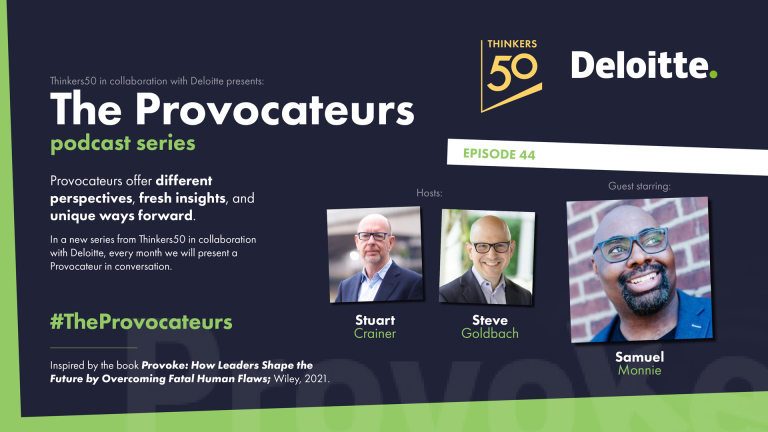
Thinkers50 in collaboration with Deloitte presents:
What if the biggest problem with marketing today is the way we’ve been taught to think about it?
Samuel Monnie, once a “reformed marketer” but now “marketing reformer,” argues that traditional marketing frameworks like the 4Ps (product, price, place, promotion) no longer reflect the world we live in. Instead, we should look towards a more human model: purpose, people, progress, and prosperity.
In this episode he explains why aligning business with values is not just ethical but a commercial imperative. He brings the data to dispel the myth that profit and purpose are in conflict. And explores how organizations can “learn, unlearn, and relearn,” embracing curiosity, listening more deeply to customers and employees, and focusing on progress over perfection.
Samuel is co-founder and co-CEO of New York-based Purpose Hive. He has led brand and business growth at companies including Braun, Campbell’s, Grainger, Safeway, Proctor & Gamble, and Sustainable Brands.
This podcast is part of an ongoing series of interviews with executives. The executives’ participation in this podcast are solely for educational purposes based on their knowledge of the subject and the views expressed by them are solely their own. This podcast should not be deemed or construed to be for the purpose of soliciting business for any of the companies mentioned, nor does Deloitte advocate or endorse the services or products provided by these companies.

Co-founder and co-CEO of Purpose Hive


US Sustainability Practice Leader, Deloitte








Inspired by the book Provoke: How Leaders Shape the Future by Overcoming Fatal Human Flaws; Wiley, 2021.
Stuart Crainer:
Hello and welcome to The Provocateurs Podcast. My name is Stuart Crainer and I’m co-founder of Thinkers50. In Provocateurs, we explore the experiences, insights, and perspectives of inspiring leaders. Our aim is to provoke you to think and act differently through conversations with some fantastic people. This is a collaboration between Thinkers50 and Deloitte. And so my co-host today is Steve Goldbach. Steve leads Deloitte’s sustainability practice in the US. He’s also the author along with Geoff Tuff of three books, Detonate, Provoke, which inspired this podcast series, and now the final book in the trilogy, Hone: How Purposeful Leaders Defy Drift. Steve, great to see you.
Steve Goldbach:
Great to see you as well, Stuart. And I’m very excited to be back to talk with our amazing guest today. Today we have Samuel Monnie who calls himself the reformed marketer, who is now a marketing reformer. He is the co-founder and co-CEO of Purpose Hive, which is based here in New York City where he spends his time helping organizations make sense of the shift towards more values-driven markets. He’s had a broad career leading brand and business growth across companies like Braun, Campbell’s, Grainger, Safeway, and Proctor & Gamble. He also spent time as the senior vice president of revenue at Sustainable Brands. And along the way, he’s been in the classroom teaching international business and more recently brand strategy at DePaul University in Chicago. He’s originally from the UK of Ghanaian heritage and has lived and worked in Germany and Switzerland and now calls the New York area home.
And as I’m sure we’ll hear, he’s been a very loyal Manchester United supporter through thick and thin. And I do want to share a personal anecdote about how Samuel finds his way onto this podcast. So I first met Samuel at a sustainability dinner hosted in, I think… In and around Climate Week 2024 or soon thereafter. And what was particularly endearing to me at the time was I had made a remark at dinner that someone had said was a little spicy and sort of accosted me in a public way, which I kind of felt bad about because I didn’t think it was so spicy. And Samuel came to me afterwards and said, “I actually really liked the point you were making, it was about the importance of storytelling in the world.”
And then – we had not stayed in touch – and then we ran into each other at a conference and immediately recognized each other. And he was kind enough to come see Geoff and I speak amongst the other two or three people that were there in the room, so he had a lot of empathy and we reconnected. We said, “We got to have him on this podcast.” So Samuel, welcome. Thanks for being here.
Samuel Monnie:
Thanks for having me so much. And just I think a little embellishment to the story of correction is, I think actually I brought up the storytelling during the conversation. So I think the point you made, I came back in to the broader group and talked about the importance of storytelling in the space of climate sustainability and purpose and all those areas. And I think I was sort of a marketer in the room full of experts and I just thought, “Well, okay, I’m going to say what I’m going to say and I hope it lands.” And I think it did. So fast-forward to today and here we are.
Steve Goldbach:
Here we are and it was appreciated. I think we can get into that story as part of our conversation and the importance of it. But you’ve described yourself, as a, as I said in the intro, reformed marketer turned marketing reformer. And both Stuart and I felt like that was a provocative way to introduce yourself. What do you think needs reforming in the world of marketing?
Samuel Monnie:
Well, the full quote is, “I used to be a reformed marketer. Now a marketing reformer because I believe that business should serve humanity and not vice versa.” And I wrote that all by myself. I’ve been in marketing for a number of years. I’ve sort of taught it. I’ve studied it and got the degrees in it and practiced it at the companies that you mentioned and just felt that the constraints of the stories that marketing is… There’s these four Ps of marketing. Product, price, place, and promotion, which have been around since the ’60s. They’re great, but they don’t explain the full world that we’re in right now.
And I think expanding it and bringing to life the stories that were always there is really the part of the reformation and reforming I’m trying to bring so the aspects… So these four Ps that I’m sort of saying, product, price, place, promotion, sort of old and can be expanded to include people… Purpose, people, progress, and prosperity. Those are the ones that I feel that I’ve always been there and can be more brought to life in the space of marketing. So it’s like purpose and shifting demands and behaviors to be more inclusive and equitable, just to have that positive impact. That’s what purpose can do. And then you’ve got the aspect of people and the leadership to be a bit more compassionate, a bit more engaging, a bit more imagination and serving people. You’ve got progress, which is really about this idea of better solutions that raise the bar for everyone. So everyone’s got to benefit from this, not just a few.
And then prosperity. So listen, I’m in business as well. You’ve got to make money if you’re in a commercial system. I get it. But prosperity means that everyone thrives and everyone can be… It can use nature and humanity in a more balanced way. And so yes, you can still make money. I’m trying to change, reform the commercial system, but prosperity means that everyone wins and the system’s truly thriving. So those are some of the elements that I’m bringing to life and championing and storytelling about and working on to have that positive impact.
Stuart Crainer:
So when did you see the light, Samuel? In your marketing journey, which is working in Europe, working in the States, a variety of organizations, at what point did your ideas about marketing practice evolve and change?
Samuel Monnie:
Well, I like to think that I was always… I was one of those pesky students as an undergrad that was questioning the professors. And I remember I got in trouble. Well, I was always asking questions. And so when you’re being taught this stuff, I say, “But what about this? What about that?” And so I was always wrestling with the orthodoxy of marketing. And as I continued to study and then practice and grow and learn, I became more open. And I lived in Germany and in Switzerland and my heritage is Ghana. So I would travel the world.
And I remember one place I went, we went out for a meal in Malaysia. I was in a global role and took us to this restaurant and said, “Oh, is it okay because the restaurant has food served on banana leaves?” And I’m thinking, “Wait, that’s great. You’re using a natural resource and it’s free and it’s better and it fits. So this is not ‘sustainability’ or…” It’s like, “Oh, that makes sense.”
So as you’re exposed to all these experiences and these life experiences and these customer experiences, and I started realizing that I was trained more or less in one way of doing marketing. And it was kind of, “Sell more. Growth at all costs.” And slowly but surely, I started asking more of these questions and these questions that were showing up in my life, I needed to manifest and bring to life. And I think my biggest blessing, if I was a superhero, my superpower would be curiosity, but there’s a weakness with curiosity. You keep going at stuff and looking at things and opening doors…And for example, I studied in Northern Ireland and for those who are not so familiar, there was unrest and conflict between communities of Catholic and Protestants. And basically 17 people told me not to go to Northern Ireland, “Oh, you don’t want to go there.” 17 people tell me not to do something, guess who’s going to go because I have to experience it for myself. And I loved it. I got my masters there and it was such a great experience. So I’ve always been that… The curiosity has, I think, forced me to do better, know better, learn better beyond my discipline. And so with all these life experiences and the humbling stories that one of the brands I worked on was Duracell. Duracell make batteries. And it was only a few years ago as I’m going through this process, I suddenly thought, “Well, what happens to the battery when you finish using it? What do you do with it? How do you get rid of it? Who does that? What’s in it? Is it safe? Is it okay?”
I’m thinking, “Wait, how come I didn’t think about this stuff when I was working on the brand?” And it’s because you’re in this system, you’re in this process, you’re in this context that’s forcing you in one direction. And as you look up and as you look around and you speak to your colleagues and you start to explore other solutions, you can grow and you can suddenly realize, “Oh, there are other ways of doing things. And fast-forward to a time, I think around a decade ago, I was working within the Campbell’s company and I suddenly adopted the sustainability team there because they were having more fun, they had great solutions. You’d read the sustainability report. “Wow, there’s so many great claims in there, so many great stories.” And so I was hanging out with them and realized, “Oh wow, there’s this whole area of sustainability and purpose and positive impact that is part of commerce and part of business that can actually be the unlock to growth and more revenue and more creativity and discovering that and realizing, “Oh, it was always there from the beginning.”
And I can tell you a couple of examples. Actually, I’ll tell you one quick example. So saying it was there from the beginning, one of the brands that Campbell’s owned was Pepperidge Farm. Pepperidge Farm was founded by a woman called Margaret Rudkin. Basically, she had a son who had lots of allergies and asthmatics. So he was put on a diet of fruit and veg and just nothing processed, couldn’t take any processed food. And I think she traveled and she discovered some foods overseas. And so she came back and said, “Look, I’m going to try this bread, which is whole wheat and just nutrients in there.” And everyone said, “Nah, it’s not going to work.” Anyway, the son loved the bread. The bread was… He didn’t have any allergies or reactions. And long story short, she became an entrepreneur and Pepperidge Farm was born. So basically she was trying to solve the problem of food that her son could eat.
That was the premise. That was the purpose. That was the founding of this organization, this company that became hugely popular. And so I thought, “Wait, there’s this story about Margaret…” And it was kind of there, but it was always there from the beginning. And so for me, purpose in business and this reformation I’m trying to drive is, it’s… Pardon the pun, it needs to be sort of baked in, not bolted on, but often you’ll find it’s actually there. And so this idea that there’s a separation is not the full story of marketing or business or companies or organizations. So let’s tell the full story and have the opportunity to do more. So for me, it was that aspect of reflecting on my own journey, realizing that I was actually part of the problem and what I could do to be better. And actually from the seat of marketing and branding, you can actually have that positive impact, work with people in the system to improve things.
Steve Goldbach:
And Samuel, so I want to delve into this a little bit further. I could imagine that people listening to this podcast could hear you saying there is a conflict between purpose and profit. And you and I have had enough conversations to know that the whole point of what you’re saying is that there isn’t a conflict, that actually leveraging the four Ps that you say purpose, people, progress, and prosperity actually makes for better marketing outcomes. I think you even led with that. Can you share a bit about how you think that that mechanism works, what it is that… Why it’s not a trade-off, but why it instead leads to better outcomes?
Samuel Monnie:
I think there’s a misconception that they’re at conflict, but actually it opens up more tools, more opportunities, more avenues to actually grow. And this is not my opinion. And so this is where I’m going to drop some data and I’ve written down a few things just to make sure I get it right. So if you look at, for example, the eco-consumer, Kantar says there’s a $450 billion market. Walton did a study that purpose-aligned companies have a sales lift of 11%. And then there’s Edelman, their survey, it hovers around 60% of people make brand choices based on their values. So the idea that there’s a conflict, the data says people are deciding based on values, based on their beliefs, based on these elements. And so harnessing that in your business helps you grow more. Understanding that helps you serve more people. And so these work interdependently, symbiotically, and not as antithesis.
And I think that’s the aspect to suddenly realize, “Oh, actually these are ways that we can delight people. We can meet more of their needs. We can serve more people. We can include more people in this.” I think both of us right now are wearing AirPods as we’re recording this. And what I love is a big company like Apple… And I’ll talk about smaller companies, but a big company like Apple has been on a journey. They started bringing accessibility, I think in the early to mid 2000s into their OS systems and then brought some features to the phone. And then they launched AirPods Pro 2, I think it was, a couple of years ago, 18 months ago, which has a hearing aid functionality. And so that’s an example where they started from, where they were, and they evolved and iterated and incorporated something that now it’s not a separate product, or it’s not over there. And they’ve just normalized supporting people with hearing challenges, which happens to a lot of people, happens to a lot of people as they age, and they’ve just put it into the core of their proposition.
Yes, it’s a slightly premium price product, but they have a better story to tell. They have a new story to tell. It works just as integrated into the core product. It makes sense, includes more people. And so there’s a win from doing that. And so accessibility isn’t something we think of as an afterthought, or for just people with disabilities over here. What if we all benefit? There’s no trade-off or compromise. It’s actually core. So hopefully I’m answering your question by showcasing how if you see it as additive and inclusive, then you get more ways to solve a problem versus less ways or a distant way. We’ll get to it when we have time, we’ve got bigger things to focus on. This is actually a big thing you can focus on now.
Steve Goldbach:
Well, what I particularly love about it is the idea that people buy what their values are because one of the frameworks that I’ve always really valued in the field of marketing was that of Byron Sharp’s, which is very… I love the simplicity of it, that people buy from products that have physical and mental availability. And physical availability now, you can take to the digital world where it’s just easy to purchase, but mental availability comes, as we’ve talked about a lot on this podcast, through something that doesn’t create any cognitive dissonance. And when something’s aligned to your values, that’s a great example of mental availability and creating that. And the more that you can create mental availability in your products, as you’re saying, by serving multiple markets at once, with your example just now, I think that’s a tremendous example.
Samuel Monnie:
Yeah. And what I love about that is I feel good about it and I don’t currently have hearing challenges. So I feel better that I just buy a product, but it helps other people who have this condition. So I feel good. Oh, great. But also they’re included in the core product. So it’s additive, but it’s also, I just feel a bit better about myself and I feel better than I’m having a positive impact by using and buying something that has more utility for more people. So there are these other just deeper things about, to you say, when you’re thinking about values, it’s, “What it means to me? What do I stand for? What do I believe in?” And I want to, Samuel Monnie wants to do something that has a positive impact. I’m not alone. Most people have values. If you live in this world, you make things based on values and decisions.
And as with the time of recording, there’s a lot of businesses and brands now realizing that this is not something that they can avoid. The values-driven concept is about loyalty. It’s about trust. It’s about advocacy. It’s about reputation. It’s about people. People have these feelings and these thoughts. And I’m a Brit, but we’re based in the US right now and there is this politicization of a lot of these issues where it’s left or right, so people don’t want to get involved in politics.
When it comes to the ingredients in food, that is a huge community of people on, inarguably, both sides of the aisle, believe that these ingredients shouldn’t be in our foods. And so now if you’re saying, “I’m avoiding politics,” you’re avoiding 70%, 80% of the market because it’s not politics that’s driving, it’s values that are driving them. And so the stories I tell are very much about how to think about the world and explain it in a way as a marketer, as a business, as a brand leader that is relevant for the world we’re actually in.
Some of these old models, I think, constrain us. But if you actually realize, “Oh my goodness, this is the most human thing ever to make a choice based on wanting to do something better.”
I’m not naive. I’ve been in business and I’ve been in brands where you’ve got to hit your numbers and you’ve got to deliver, but if you can actually see the opportunity and possibility and grab those aspects, you can actually win with more people and more stakeholders and more communities and ultimately make more money. So yes, I said it. I’m trying to shift commerce here. So this is about the system of economics and making money. An example that I love is the Unilever brand and business. If you go back to the 1890s, I wasn’t around… None of us were around then, but the story is that there’s a global pandemic-
Steve Goldbach:
Well, Stuart might have been!
Samuel Monnie:
I’ll let you have that discussion later on. But people were dying of disease. And so they launched Lifebuoy, which was a soap that was antiseptic and disinfecting, carbolic soap. And to solve a problem that people are dying of disease, hand washing, cleanliness is good. It solves the problem. It reduces the issues. They’re making a commercial product that they can sell at a profit and making money. So this idea that purpose was always there, was always there. It’s actually something that’s solving a real human problem, commercializing a solution, making money from it, and it’s a win-win. And so this opportunity is abundant and surrounds us. So sometimes we’ve got to go back to the stories of how business and marketing was founded from the get go and realize that these opportunities, these possibilities, our imagination, our creativity, our solution-based approach that can help more people and more people thrive have always been there. Let’s grab onto those. Let’s hold onto those and bring them to the fore.
Stuart Crainer:
Is the big difference now, Samuel… I’m just kind of thinking about it, that purpose and values now have the data behind them? You can point to any number of research findings which show that they’re good for business. They’re not philanthropic or altruistic. They’re actually good for business. Do you think that’s true and do people get that now?
Samuel Monnie:
I think there is a misperception that there’s a gap between them. And so I showcase a lot and I shared some examples of some data that people want it, but the majority of people make decisions based on their values, or there’s a purpose. There’s another resource that I love. And New York University, they have their sustainable market share index. They’ve been measuring in the CPG consumer packaged goods or in overseas, sometimes called FMCG, fast moving consumer goods categories. They’ve been measuring 36 categories like toilet paper and paper towels and I think shampoo and lotions and floor cleaners and diapers and various categories in those CPGs. 250,000 products, been doing it for 12, 13 years.
And the market for sustainably marketers, they’re saying, “What percentage of the products in these categories are sustainably marketed?” That’s gone up in 2024 from around 23.8% to be precise. And it’s gone up in 2025 to 25.4%. So from around 24 to over 25% of those categories are sustainably marketed. And so the reality is that we just need to look at what people are doing and buying. And that data I’m quoting is not survey data or self-reporting. It’s actually what people are spending money on. And I’m a Brit. I was in the UK a few weeks ago and I was shocked because I went to the grocery store, had a little situation at home, needed to buy some toilet paper, went to the store, and I was bombarded with most of the shelf… Half the shelf was recycled toilet paper in paper packaging. And it was just all over the shelf. And there was a smaller section for the stuff wrapped in plastic. And it was like, “Ooh, who does that? Who wraps in plastic in 2026? Who would do that as a brand?” And it was just normalized.
Now, these retailers aren’t doing it out of charity. They need to make money. They need to make a margin… So they’re only doing this because it sells and makes the money. That was the conclusion I gave, that retailers are selling stuff that makes the money, ta-da! So when these things are just what you see in everyday categories, you suddenly realize, “Wow, this is real. This is huge.” And so sometimes it takes just walking into a store not on autopilot. So I tell that story about… I was a bit provocative because on my LinkedIn post I said, “Who gives a crap about the values? Ha ha ha, pardon the pun.” And there’s a brand which is huge in UK, and I think some of the other… called Who Gives A Crap.
Anyway, let’s not digress. But my point being that look around and you’ll see that this is not fringe or niche. This is actually quite common when it comes to people… Especially people’s health, what they eat, what they put on their skin, what they ingest, especially on… Those are areas that people are much more sensitive to what’s in it? Where’s it made? How’s it made? Where’s it come from? What’s happened? What’s the impact of doing it? And you’ll see that people are spending their money based on these values and these decisions. And so it’s not an opinion, it’s evidence backed and evidence proven.
Steve Goldbach:
You often talk about the learn, unlearn, relearn cycle, which lays out the idea that real progress requires not just learning new things, but actually unlearning what no longer serves you before you can relearn. How can management teams do that collectively? What’s that process look like? What’s a productive way to relearn? I remember when I was in the… I think one of the most effective ways is to just spend time with consumers is a great way to do that because it’s an experience. But how do you promote that learning in your practice?
Samuel Monnie:
I think the premise came from a quote I love, Alvin Toffler said, “The illiterate of the future are not those who cannot read or write, but those who cannot learn, unlearn and relearn.” And I love that because it provokes you to think, “Okay, what are the things I’m learning that I need to hold on to? And maybe it’s things like… Okay, purpose actually does lead to greater creativity, greater possibility. What do I need to unlearn?” And hopefully from the vibe I’m giving… I’m not playing it safe. I’m not staying timid and just keeping your head down and hoping it doesn’t come to you because the world is changing. And I feel that the relearn aspect that I really push is about starting from where you are. It’s about progress over perfection. And I know in business, it’s the hardest thing is to say, “I don’t know,” especially if you’re in a group full of senior people.
“I don’t know, but I’m going to find out. I’m going to go and learn.” And if you can recognize… Because the Apple story I told from before is that they started 20 years earlier and slowly iterated to become better. So start from where you are. You don’t have to be perfect. It doesn’t have to be ideal. The conditions don’t have to be just right for us to do this thing. It’s making those steps because it’s about being more connected to humanity. As you said, talking to people and hearing what they have to say, really embracing it and embedding it and responding to it and incorporating it. And I think as a marketer and as a brand leader, it’s humbling when people share with you what they’re going through. And if you can take that on board, use your imagination, use your creativity, respond to culture, you can actually have more reasons to be relevant to them, have more ways to show up for them and have more ways to impact them.
But remember, and the other thing I talk a lot about is it’s not only people outside – if you’re a brand or a company – it’s also the people who work for you, your employees. Until the AI and robots take over, there’s still a lot of humanity in business. And Gallup’s survey says that only a third of people are engaged at work, but like two thirds of people are disengaged at work. They’re looking for more meaning. They’re looking for more care. They’re looking for more community. They’re just looking for more substance. And so if you change your organization’s number from a third being engaged to 40% being engaged, increase it by seven points, that’s a huge increase in productivity. So if I’m the CFO, I’m thinking, “Right, people are happier. People care more. They’re more connected. They’re more communicative. They’re more collaborative. They just find more in what they’re doing. That means they’re going to be more productive. That means they’re going to show up. That means there’s going to be less attrition. They’re going to be less sick. And that’s all measurable stuff so we are going to make more money.”
So this is again about just running a good business, is doing this and incorporating it more.
Stuart Crainer:
I think Sam, you kind of got to one of… Why I’m skeptical about some of the discussions about purpose, for instance, that there’s a sense that some of it’s performative, like purpose is like everyone had a vision in the 1990s, or whenever everybody had a vision, and now everybody’s kind of rediscovering that they’ve got a purpose. How can you cut through that kind of performative aspect? How do you know it’s genuine?
Samuel Monnie:
You know it’s genuine when it’s coming from a place of really understanding who you are, understanding your audience and doing something that matters. I’m a storyteller, so I’m going to bring another example. There’s a recent example from AXA, the insurance company, and they’ve had success from an initiative which was about the three words, which is, “And domestic violence. And domestic violence.” So what they did was, which I thought was genius, was retrospectively adding those three words to 2.5 million insurance policies. And within days they had hundreds of people take advantage of it. I think in the first year there was like 1,300 people who used that. So this is about saving lives. This is not performative. It’s not just a campaign or a slogan.
Steve Goldbach:
Sorry, can you just expand? What did they do to what they added it to? Can you expand on the story a bit to contextualize that-
Samuel Monnie:
Yeah. So what they did was within, I think, their insurance policy, so home insurance policies, they actually included the aspect of “and domestic violence” was something that they would provide support for the insured person. And in that context, it was in the body of the policy so people could literally reach out for help and support in a very, very difficult situation which affected many, many people. And they did it in a way that you didn’t have to make the effort. It came to you. It saw you. Understood that this was a real challenge, a real problem for some people, and made it easy for you to actually access that support.
And I want to get the numbers right. There’s like 1,200 people reached out within the first 10 months to take advantage of this thing. And what they’re now doing is rolling it out, I think, to Italy. And more of the insurance companies are now saying, “Wait, what did you do? How did you do this?” But what I love about this is a way to change what you do and offer to the marketplace in a way that is not performative. It’s actually substantive and meaningful. And some of the data showing that sales went up, new contracts went up almost 10%.
So you’re also essentially selling more, but this could be a system-wide change. They did two million people. If all the companies start doing it and making it just a norm and an offering, you’re supporting millions of people in a really meaningful way that touches hearts and humanity. And it’s basically saving lives. So that is, for me, an example of how you can actually integrate it. Yes, you can communicate it, you can make it a campaign, but this is something that is helping people and helping humanity. And it moves from performative to actually really personal and really meaningful and really touching the experience that people have with your proposition. Now, insurance is not necessarily the sexiest category in the world, but now all of a sudden, they’re winning awards. They’re winning creative awards. They’re getting attention. And for something that is about humanity and us and not necessarily another issue.
So if insurance organizations and companies can do it, I feel that… I talked about insurance, I talked about tech, I talked about food companies. So this is something that is possible to many, many people, many companies. But that story I love because it’s very personal and very visceral and very real and very human and very meaningful. And so you can do it in a way like that. That’s a story to inspire folks to see, “Wow, actually, how do we change what we do and offer?” So I link that back to the CEOs who said, “We’re there for you,” during COVID. But you can actually be there for you in a meaningful way that isn’t just a TV ad and a look to camera, but actually in the core of what you offer in a valuable way that literally will save lives.
Steve Goldbach:
And maybe that’s a good place to start to close this podcast, which is I hear you challenging this notion that… I think one of the skepticisms that people have about the relationship between purpose and marketing and business performance is that it is performative. We see it in the world of sustainability with concerns about greenwashing. And I think what you’re saying is there is absolutely profit to be made when your actual demonstrated behavior aligns with the core values of the consumers that you’re trying to target. And there should be nothing controversial about it. It’s actually just caring. Is that a provocative idea you wish people would embrace? Is there another way you’d say that?
Samuel Monnie:
I’m going to write that down hopefully. Well, we’re recording this, so I’m going to take you in favour… Absolutely! It’s this idea that purpose and performance are not intention, they’re actually driving each other. They’re reinforcing each other. They’re integrated. And it’s about these conversations and decisions that are hugely values driven, but human experiences. This is about humans and helping brands and people and companies connect more deeply with them to build more trust with people. And you have that possibility. You have that potential. And so see that and be about it and know that from some of the stories I told, that was always in business. This was always in this idea or this ideal of this cooperation and this system that works together. And so know that it’s just as about business and profit to care and to support and to inspire and to solve these problems.
Business absolutely has that obligation and that responsibility, communities, society expects you to do that. And also you’ll be rewarded commercially. And so this is not something that can only live in philanthropy or nonprofit. It actually can be the core to your brand and to your business and to your growth and to your success today and onwards in the future. And so that’s what inspires me to keep doing what I do because that’s a story of not just hope from a… They say that, “Hope’s not a strategy.” But without hope, your strategy will fail. And so for me, this values-driven approach is something that is true, it’s real, it’s measurable, and it’s happening. So it’s just about being about it.
Stuart Crainer:
And in many ways, the most beautiful expression of purpose and performance is sports. And in particular, Manchester United, the British soccer team who I know you’re a supporter of. And I think it’s an interesting example because it shows some of the complexity of what you’re talking about, Samuel, because what should the purpose be of a soccer club? To make money? To win trophies? To entertain? And communities. Where are the communities and who are the community? And it’s got many of the issues are embedded there, showing some of the complexities, I think.
Samuel Monnie:
Yeah, it’s very complex. And when you talk about community, that’s the thing. I’m based in the US. I used to live in the South of England. I’d travel up to Manchester to watch the team and it’s a global organization. It’s a global brand of people from all over the world that support the team. But also if you look at the players who play for the men’s team and the women’s team, they are also people from all around the world. So it’s a very inclusive space. It brings people together. And what I love about sport is… Especially the football tradition, soccer tradition, is that you’ve got a stadium of 70,000 people all singing together.
And if you say to most guys, “Oh, when was the last time you sang with other guys?” “Well, who does that?” But in a sporting stadium, you have a community and you have this feeling. And what we know is that commonality is huge and has a positive impact, but it’s the aspect of they have their local communities to support, but they are part of a global community. I know we digress a bit from this, but for me, the power of sport and music and these other aspects to connect people is huge. And so from a brand perspective, obviously as a Manchester United fan, I think we’re the best, but I shall continue to enjoy the upward momentum that this sporting team has. And I’ll be watching them from a distance from my TV screen. I may or may not be singing along with the audio from the fans in the stadium.
Steve Goldbach:
Well, I’m glad that the two of you can agree on your sports enjoyment. I’ve been a long-suffering Toronto Maple Leafs fan and we’re going to suffer for another few years, it seems, on our end. So I’ll let the two of you enjoy. All right. Well, before we wrap up, Samuel, is there a way that people can find you on the interwebs? Where can they reach you?
Samuel Monnie:
They can absolutely reach me. So they can reach me, samuel@purpose-hive.com. So samuel@purpose-hive.com is the website, Purpose Hive. There’s a contact form in there, so you can find us on the internet, or you can find me on LinkedIn where I’m pontificating, sharing and looking to inspire and storytell about all things values-driven, purpose, and positive impact. So LinkedIn or through samuel@purpose-hive.com.
Steve Goldbach:
Samuel, thank you so much. That’s all the time we have for today, and thanks to all of you for listening. This is The Provocateurs Podcast, and we’ve been Stuart Crainer and Steve Goldbach. And please join us again soon for another episode of The Provocateurs.
This podcast is part of an ongoing series of interviews with executives. The executives’ participation in this podcast are solely for educational purposes based on their knowledge of the subject and the views expressed by them are solely their own. This podcast should not be deemed or construed to be for the purpose of soliciting business for any of the companies mentioned, nor does Deloitte advocate or endorse the services or products provided by these companies.

Thinkers50 Limited
The Studio
Highfield Lane
Wargrave RG10 8PZ
United Kingdom
Contact us at:
enquiries@thinkers50.com

Thinkers50 Limited
The Studio
Highfield Lane
Wargrave RG10 8PZ
United Kingdom
Contact us at:
enquiries@thinkers50.com

Thinkers50 Limited
The Studio
Highfield Lane
Wargrave RG10 8PZ
United Kingdom
Contact us at:
enquiries@thinkers50.com
| Cookie | Duration | Description |
|---|---|---|
| LANG | 9 hours | Linkedin set this cookie to set user's preferred language. |
| nsid | session | This cookie is set by the provider PayPal to enable the PayPal payment service in the website. |
| sp_landing | 1 day | The sp_landing is set by Spotify to implement audio content from Spotify on the website and also registers information on user interaction related to the audio content. |
| sp_t | 1 year | The sp_t cookie is set by Spotify to implement audio content from Spotify on the website and also registers information on user interaction related to the audio content. |
| tsrce | 3 days | PayPal sets this cookie to enable the PayPal payment service in the website. |
| x-pp-s | session | PayPal sets this cookie to process payments on the site. |
| __cf_bm | 30 minutes | This cookie, set by Cloudflare, is used to support Cloudflare Bot Management. |
| Cookie | Duration | Description |
|---|---|---|
| l7_az | 30 minutes | This cookie is necessary for the PayPal login-function on the website. |
| Cookie | Duration | Description |
|---|---|---|
| CONSENT | 2 years | YouTube sets this cookie via embedded youtube-videos and registers anonymous statistical data. |
| _ga | 2 years | The _ga cookie, installed by Google Analytics, calculates visitor, session and campaign data and also keeps track of site usage for the site's analytics report. The cookie stores information anonymously and assigns a randomly generated number to recognize unique visitors. |
| _gat_gtag_UA_10408481_1 | 1 minute | Set by Google to distinguish users. |
| _ga_ZP8HQ8RZXS | 2 years | This cookie is installed by Google Analytics. |
| _gid | 1 day | Installed by Google Analytics, _gid cookie stores information on how visitors use a website, while also creating an analytics report of the website's performance. Some of the data that are collected include the number of visitors, their source, and the pages they visit anonymously. |
| Cookie | Duration | Description |
|---|---|---|
| NID | 6 months | NID cookie, set by Google, is used for advertising purposes; to limit the number of times the user sees an ad, to mute unwanted ads, and to measure the effectiveness of ads. |
| test_cookie | 15 minutes | The test_cookie is set by doubleclick.net and is used to determine if the user's browser supports cookies. |
| VISITOR_INFO1_LIVE | 5 months 27 days | A cookie set by YouTube to measure bandwidth that determines whether the user gets the new or old player interface. |
| YSC | session | YSC cookie is set by Youtube and is used to track the views of embedded videos on Youtube pages. |
| yt-remote-connected-devices | never | YouTube sets this cookie to store the video preferences of the user using embedded YouTube video. |
| yt-remote-device-id | never | YouTube sets this cookie to store the video preferences of the user using embedded YouTube video. |
| yt.innertube::nextId | never | This cookie, set by YouTube, registers a unique ID to store data on what videos from YouTube the user has seen. |
| yt.innertube::requests | never | This cookie, set by YouTube, registers a unique ID to store data on what videos from YouTube the user has seen. |
| Cookie | Duration | Description |
|---|---|---|
| DEVICE_INFO | 5 months 27 days | No description |
| loglevel | never | No description available. |
| m | 2 years | No description available. |

Thinkers50 Limited has updated its Privacy Policy on 28 March 2024 with several amendments and additions to the previous version, to fully incorporate to the text information required by current applicable date protection regulation. Processing of the personal data of Thinkers50’s customers, potential customers and other stakeholders has not been changed essentially, but the texts have been clarified and amended to give more detailed information of the processing activities.