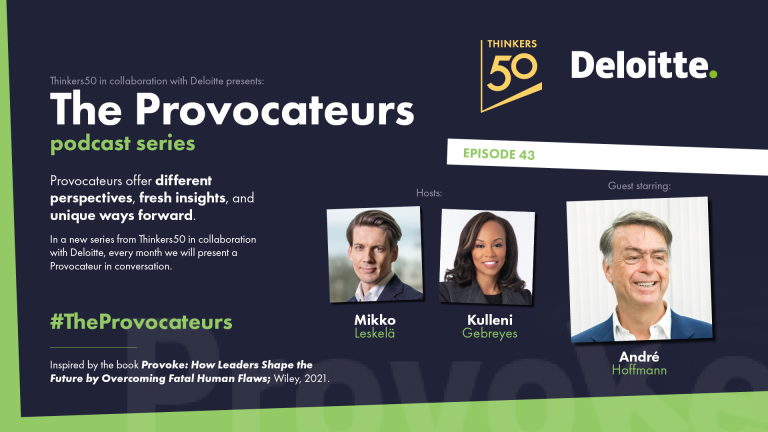
Thinkers50 in collaboration with Deloitte presents:
What if the real purpose of business is not simply to make money, but to serve humanity?
André Hoffmann is vice chairman of Roche Holding, co-founder of Intent, and co-author of The New Nature of Business: The Path to Prosperity and Sustainability. In this rich conversation with Thinkers50 CEO Mikko Leskelä and Kulleni Gebreyes, vice chair and US life sciences and healthcare industry leader at Deloitte, André challenges the traditional view that financial capital alone defines success. Instead, leaders must recognise:
Discover how leaders can align profit and purpose, prosperity and sustainability, and ultimately become good ancestors.
This podcast is part of an ongoing series of interviews with executives. The executives’ participation in this podcast are solely for educational purposes based on their knowledge of the subject and the views expressed by them are solely their own. This podcast should not be deemed or construed to be for the purpose of soliciting business for any of the companies mentioned, nor does Deloitte advocate or endorse the services or products provided by these companies.
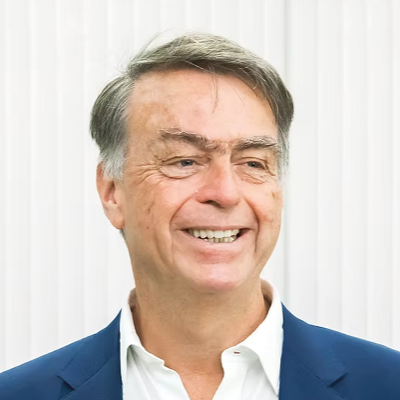
Vice Chairman, Roche Holding; Co-founder, Intent.









Inspired by the book Provoke: How Leaders Shape the Future by Overcoming Fatal Human Flaws; Wiley, 2021.
Mikko Leskelä:
Hello and welcome to the Provocateurs Podcast. I’m Mikko Leskelä, the CEO of Thinkers50. In Provocateurs, we explore the experiences, insights, and perspectives of inspiring leaders. Our aim is to provoke you to think and act differently through conversations with some fantastic people. This is a collaboration between Thinkers50 and Deloitte. And my co-host today is Kulleni Gebreyes, vice chair and US life sciences and healthcare industry leader at Deloitte. Kulleni, it’s so wonderful to see you.
Kulleni Gebreyes:
It’s absolutely wonderful to see you and it’s amazing to be back. I am incredibly excited to talk today with our guest, André Hoffmann. Welcome. And for those who don’t know André, André is the co-founder of Intent. It is an international platform, accelerates sustainable solutions. He’s also the vice chairman of Roche Holding, the international pharmaceutical company. He’s the author with Peter Vanham on a book, The New Nature of Business: The Path to Prosperity and Sustainability. And in it, André and his co-author argue that we must move beyond financial capital to recognize the value of three other forms of capital, natural capital, social capital, and human capital. We’re going to hear more about that today. André is also a member of The B Team, which is a group of business leaders aimed to catalyze a movement of leaders driving a better way of doing business for the well-being of the people and the planet. I think André, you say it’s using common sense, and so I know we’re going to get into a lot of these themes as we talk today. André, welcome to the podcast today.
André Hoffmann:
Thank you very much, Kulleni. Thank you very much, Mikko. Very nice to be here and thank you for having me invited.
Kulleni Gebreyes:
Wonderful. So André, maybe let’s jump in. You’ve got so many incredible stories to tell, but you also have a fascinating backstory. So your great-grandfather, Fritz Hoffmann-La Roche, pioneered the nascent pharmaceutical industry and started Roche. Your father, Luc Hoffmann was one of the founders of the Worldwide Fund for Nature [or the World Wildlife Fund as it’s also known]. So you’ve got the industrialist influence, the entrepreneur influence; you’re a dedicated conservationist – the environment influence on the other… So tell us what it was like to grow up to be you and how did it impact your view of business and the natural world and how they come together or are in conflict with one another?
André Hoffmann:
Well, hello to everybody and it’s of course a very nice way of introducing this conversation. Yes, I was born in a family which had two characteristics. The father was a famous zoologist, very interested in birds, in particular, the ornithologist. And he spent a lot of time at an early age trying to establish migration patterns of birds and that led him to establish himself with then his wife, but at the time on his own, in the place called the Camargue. The Camargue is the delta of the Rhône River and it’s one of the sort of obligatory stops for birds who go from Europe to Africa and that’s where they tank up before they do the crossing of the Mediterranean.
And so I grew up in a place which was very much a nature reserve. But at the same time my father is also the grandson of the founder, as you just mentioned, Kulleni, Fritz Hoffmann-La Roche, the pharmaceutical… We prefer to define ourselves as a biotech company, but we’re in health and we are into looking after patients. And so the idea of being able to look at about two things at an early age was a great help. My father invited a lot of scientists who came to his reserve in the Camargue to study nature. And so I grew up with people around the place, A, speaking English, which is why I speak English and not Schwiizerdütsch [Swiss German], but also people who are interested in talking about what truth is, what science is, how do we understand what nature is if we don’t have some sort of technological background?
And then later on in life, after I completed my studies, I went to the board of the company – and I’ve been the vice chair of Roche now for nearly 30 years – and what I found the most common between the two things was this idea of science. How can we use new ideas to do something different with our societal model? And so I’m now a father of three living in Switzerland and trying to continue to push with this idea that the system deserves to be the most efficient possible for all of us. And so that’s why we should be constantly probing the borders of what it is that is acceptable.
So in a nutshell, that would be what I do. Being the vice chair of an international business like Roche is quite an onerous job in terms of time. But it also left me a little bit of time to be able to go and do other things and in particular to understand impact and try to promote the use of impact.
Kulleni Gebreyes:
André, I will say your point of view truly resonates, as a physician who now has entered the business world, I think, in bringing to different world perspectives makes us all better leaders. So thank you for that great response.
Mikko Leskelä:
André, coming from that background, you still describe yourself as an environmentalist and capitalist and also an optimist. How on earth can you be all of those three at once or how do you balance those things? How does that show in the work that you do that you are all three of them?
André Hoffmann:
Well, I would start with a little anecdote. When I started entering the business world… because after having left my home in the Camargue, I went to work in the stock exchange in London for a while and then I took a degree and I worked in a number of different companies before joining the family business. And the question I often had was, “What is nature? What can we as businesses do for nature, the conservationist side?” Because when I left home, I also started working a bit with WWF, which my father co-founded and where I volunteered in different projects but also then joined the governance of the international organization as a treasurer.
And after you look at these things, you have to realize that in fact nature is not just something that you need to protect, it’s the life support system on earth. And so trying to do business in an environment where nature is not looked after, is not part of the system, cannot be very productive in the long term. So when I arrived and asked my fellow business people, “Hello guys, what are we doing for nature?” They would say, “Ah, don’t be ridiculous. We make money.” So nature is somewhere else. “It’s in the Amazon. It’s in the Camargue. Let us make money. When we finished with making money, we give you a little bit back for your birds in the Camargue.”
And that sort of fundamental mistake of believing that the same people are living in different silos is just absurd. As the image I use in the book, we all swim in the same pool and if one side of the pool is damaged, the other side suffers as well. So the idea of saying there is one type of humanity which only creates value through exploitation, and on the other side of humanity there is a part of the world which has to restore what has been destroyed, it’s just not very coherent. So that allows me to say that business can be a force for good if it’s well managed, and I‘m an optimist by nature… That’s more difficult to explain, especially in current circumstances. But being a capitalist and a conservationist is not contradictory. That’s what I wanted to say.
Mikko Leskelä:
I do understand that once you get the idea that business is actually part of nature and companies are part of nature, it makes you by default also an environmentalist. But the part that I wonder the most about is that the optimist part in everything that you see outside right now happening and everywhere, do you still consider yourself an optimist and how do you do that?
André Hoffmann:
Well, perhaps again, there is this notion of public good towards private interests. When companies were started, it comes from the Latin com pani: eating bread together. So the idea was to bring resources, pull resources together so that you can do something together for all. And then the industrial revolution comes around: the business of businesses. Business mantra has developed in the late ’70s and then suddenly we start saying, “Well the best way to measure the performance of a company is that it is profitable,” which, by the way, is not illogical. If you want to have prosperity, you need to create the wealth somewhere. So let’s have each business producing wealth and once the wealth has been produced, it’ll serve humanity.
The problem is that it is a little bit short-sighted because it’s a very narrow lens. The idea of saying, “I will make profit at all cost and I will then give it back to society through salaries and through dividends and through shares, prices, whatever, it misses the real point. The real point is that success is something else than just financial success. Success is contribution to society. And we can discuss that later on a bit more if you want, but what I’m trying to say is that businesses were successful because when I was born we were 3.5 billion, we are 8 billion now, and we live good lives on average. So the idea of saying that profit comes first has been a successful way of coming to a prosperity, which by the way is in trouble at the moment. But again, that’s another subject.
What I’m trying to say is that if you just concentrate on building up prosperity, it gives you the authorization of deciding that you don’t need morality. You don’t need to be decent. It’s not your problem. Your problem is to make the money and you push it out to society and then society can deal with what Milton Friedman called the externalities.
And it’s not even a question of right or wrong, it’s amoral. It’s not immoral or moral, it’s amoral. You just don’t think about it. And I think that is what has created the most problem in society as a whole, the sort of pushing back of the responsibility for your behavior onto the others. If you look at the way we live our lives, a lot of the big issues, we have delegated solutions to these big issues to others. I would like personally to die at home, but I’m not sure I’m going to be allowed to do that because the medical system insists that I should go into a hospital where all sorts of diseases will be treated and perhaps some created. So I don’t want to go into that sort of conspiratorial conversation because that’s really not the purpose. The purpose is to see where does responsibility start and where does it end?
Kulleni Gebreyes:
André, you’re challenging us and provoking us to think differently about how purpose and profit can and should align, how prosperity and sustainability… That we should make progress on both at the same time instead of picking one or the other. And I think there’s another provocation you have in your book that says, “Don’t just think about how you spend money in terms of giving money. Think about how you make money.” So if I merge all of these things together, the question to you is… So what kind of leadership do we need both in the business world and across all the other industries and sectors to make progress on this path of prosperity and sustainability actually working together? How do you think leaders should rethink their style of leadership and how they show up?
André Hoffmann:
Well, thank you for the question, Kulleni. I think that’s absolutely fundamental. One of the side effects of focusing on short-term profit maximization is that you look at life in business but also in public life, also in NGOs, also in governments, you look at this in terms of the difference between cost and income and about using the financial instrument, the financial models to describe a situation. Well, I’m afraid that’s not how we live our lives. We do have values. We do have decency as we said before. And these things have to be taken into account as well. So my idea would be to say that there is a way of looking at the consequences of what we are doing in other ways than doing it just on the financial pattern. So we need to go to this definition of the three capitals you alluded to in your introduction.
Whenever we do something, whatever walks of life or business it is, we have impact on three big capitals. The social one, us. Why do we talk to each other? Why is one plus one often more than two? If you talk about common projects, what’s our social responsibility to each other? What’s the social contract we choose to execute? All this relationship, rights and obligations among people.
The second big capital is of course the human capital. Us individually, the really very simple question, are we happy? Are we where we want to be in life? Are we doing every morning something that allows us to say that we live our values? It sounds trite when I say it like this, but try and experience one day when you’re in front of a mirror, have a look and decide, “Am I today living my values? Can I take my values to work for instance, or will my boss ask me to do something in order to get to the profitability, which is not something I believe in?” Or the opposite? In an NGO, “Is my boss not completely unaware of the consequences of what he’s trying to do by pushing too much one sort of agenda?” And it doesn’t have to be the boss, it can be you as well. Taking your values to work is an important part of happiness is what I’m trying to say.
And the third one of course, and that’s where I come from because I’m a conservationist, as we said in the introduction. The third one is nature. But nature is not the tiger, the panda, the iconic species, the Amazon. No, nature is us, all of us. Nature is life. Biodiversity is nothing else than life. If we don’t together do something for life, we’re going to run out of it. Do I have to continue the sentence? And it’s quite clear that’s what’s going to happen there. I define nature as the life-supporting system on earth. And if we destroy it, well, we have no life left.
I’m sorry, I got slightly waylaid. I wanted to talk about these three capitals because I think that’s one way of measuring what success actually means in a business. A business that is only delivering quarterly increases in profit is not really helping the society as a whole. Suddenly we have this new definition, what is business? Business is not something that makes money. Business is something that serves a purpose. You were kind enough to talk about Roche, our company, before. We have defined our purpose in one single sentence, doing today what the patients need next. So that means that everything we do in our company is because we think about the patient and not because we think about the shareholders. Now, as a majority shareholder of the company, it’s embarrassing to have to say that, but you do not work the company for shareholders. Work the company because it contributes to society, to the social capital we were just talking about.
Kulleni Gebreyes:
André, that really resonates. And we talk about this at Deloitte all the time, especially in life sciences and healthcare, which is… We are a business, but we are in the business of creating value and then we capture some of that value we create. But the goal of the business is to actually improve healthcare and advance the science of health as well. So I love the description of the inseparability and the interdependency of the three forms of capital that you’ve described.
André Hoffmann:
Because of course what we do is that we measure the fourth one, we measure the produced capital, and we have good systems for this. We’ve been doing financial accounting for… I don’t know how many generations. What we don’t really have yet is an impact accounting system that truly, truly works. There are lots of attempts at the moment. There’s for instance no legislation about it. There are a couple of attempts at introducing impact accounting for quoted companies, but certain… There are a bit of headwinds at the moment to be able to do that officially, however it appears in a number of companies on a voluntary basis. And I think that should be important elements for companies to report on.
Mikko Leskelä:
André, why I think your concept of those four different kinds of capitals is fairly revolutionary is the fact that if you truly think about them as capital, of course you understand with financial capital, it’s not just enough just to preserve them, but they should actually accrue interest or they should grow. And when you apply that to the human capital, it kind of flips. We are not to exploit human beings or employees or anybody anymore, we should actually add to their wellbeing in every form. Maybe the most difficult kind of capital that you described to understand is the social capital. Could you use an example of how at Roche you view the social capital and whether there’s something that you actually can measure whether it’s increasing or not?
André Hoffmann:
So the notion of measurability, of being able to put the number into something is a very interesting one into the context of these different capitals because we assume like mathematics or like physics that most of the things are linear, A plus B equals C. Well, if we look at nature, and again, the conservation inside of me wants to look a lot at nature, nature is complete chaos. There’s absolutely no logic to it. It goes all over the place all the time. It does the most extraordinary things. It reinvents itself every quarter of a second. It’s everywhere.
And so the idea of saying, “We humanity, we have a big brain and we have now identified how things work and we’re going to do something about it,” it’s a bit naive. It’s perhaps also a bit difficult to realize. So it’s difficult to give you a true number onto what the social capital and how you get involved in social capital benefits. But there are many ways in which you can give evidence in an anecdotal way. A company which looks after its employees is a more stable company than a company that only rewards them and forgets about the rest. What can I give you? A building site where people hate each other is a dangerous place to be. You have to understand what unites a group and what brings us together in the same direction. And that, as I said before, is a question of clearly defining the purpose.
You are not coming to a company because you want a salary. You’re coming to a company because you want together to do something for the purpose of the company. And I think that’s a dimension we often forget. It’s so much easier to measure a salary. It’s so much easier to measure the perk. Have you got the Ferrari? It’s so much easier to simplify things and that’s a tendency we humans have. And that’s dangerous because the world is complex. And I think we see that more and more now.
So as you can see, I’m avoiding your question because I don’t really have an answer. I can tell you things that we all know. Kulleni did in the introduction, referred to common sense. You have to be a bit careful with common sense because it gives you an excuse for a lot of things. But it is true that if you act in a way that does not correspond to the feeling of being humans, you start behaving in… You invent yourself a reality which is not the right one. You can’t even lie to yourself if you’re not careful.
Mikko Leskelä:
From your difficulty answering this, I get that it has to be something a bit more qualitative when it comes to the social capital. And I see a flip side to this. When you understand business as a part of nature, or as a part of social systems, you actually have the possibility to see business as a beautiful thing also, don’t you?
André Hoffmann:
Yeah, I am coming back to my definition of business as a company of before. If you can really use the incredible spirit of entrepreneurship, which has driven humanity for a long time, if you can look at it in a way where success is not just increasing the dividend, but in a way where success is the positive contribution to the common good, that’s an incredible thing. That means that we humans together can do things which were unthinkable a couple of decades ago. Innovation. Innovation is nothing else than doing something that hasn’t been done before. And if you start time and time again to do things that haven’t been before, and if you keep in mind the common good, you could make such a big difference. And I believe that business as a force for good is in fact one of the only solutions for solving the big problems of humanity.
If you look at the big groups who can make a difference, look at companies managed for profit. Well, all they do is to regenerate money. Look at NGOs, all they do is satisfy the members. And if they go away from the mission, the members will be unhappy. Look at universities, all they want to do is to publish and put in a drawer. Once you publish, you’re a happy person. I’m sorry, you’re obviously a university person. I’m so sorry! You know what I mean? Businesses run for impact. Businesses run for positive impact on society. Could be a big part of the solution, in fact.
Well, in the US you talk a lot about philanthropy. This is again what Kulleni said before, it’s not how you spend the money that matters, it’s how you make it. And so it’s important that we should continue as businesses to produce the contribution to prosperity that we are producing, but taking into account the planetary limits and try to make sure to not break things when we are doing it. Because the idea of saying, “I cut the forest, I get 100 and then I give 10 back to WWF so that they can go and replant it,” is just absurd. I need to take 10 every year. And then everybody’s happy.
Kulleni Gebreyes:
As I connect, André, your response to Mikko’s question and just the broader implications of how we think about it, it reminds me of a conversation I had with my grandmother. My background is I studied ecology and evolutionary biology. So everything you’re saying in nature connects. Then I became a physician and practiced and now in the business of life sciences and healthcare. And as I was explaining all of this to her, she looked at me. This is decades ago, and she said, “Why do you all have to measure something to make it seem valuable?”
And that moment popped up in my head because she was surprised at our inability to find value in something we couldn’t measure. And she’s like, “Can’t you just feel it and see it?” And so you’re taking me back.
Kulleni Gebreyes:
André, as we think about this incredible book that you’ve just published, I’m hoping you can share with us why now? Why did you take the time and energy to publish it now? What inspired that and what are the outcomes that you would like to see as a result of this book and your perspectives being out in conversations?
André Hoffmann:
Yeah. Well, I’m coming back to the beginning of our conversation. When I was born, there were 3.5 billion people. Now there are 8 billion people. The 8 billion people on the planet today live on average, healthier lives, better lives, longer lives, better educated lives. And I think the whole totality of this is something that indicates that the way of producing prosperity in business has not been the bad solution. We have brought forward living standards for humanity. We have perhaps even empowered part of humanity to come to life, which wouldn’t have been possible otherwise.
But you can also see that this prosperity model is showing some cracks. If you look at the facade of our common house, you can see it’s cracking all over the place. And I would see the symptoms of these cracks in the three different capitals we just looked at. Nature, I don’t have to tell you. Climate change, pollution, plastics, persistent organic pollution, et cetera, et cetera. You look at society. You go towards the human capital, you have exactly the same things. “What am I going to do? How come that I’m not going to get a better job than my parents? How am I going to be able to participate in society?” All these things are very much inside our daily lives. And so we need to address these symptoms and how do we address symptoms? By proposing a cure. And so I wrote this book because I thought it’s time to sort of ask the real question, what is success?
Success is not just a growing bank account or the materiality that comes with it. So of course you need the minimum. There’s absolutely no shadow of a doubt that you do need… You need a bed. You need a house. You need the education of the children. You need the food. You need all these things. Of course you do. And by the way, the strong should help the poor in that context. But that’s maybe another conversation. So you need that, absolutely.
But anything over it is a little bit more complicated. I can’t imagine that the richest man on earth is 350,000 times happier than I am. There’s a plateau at some stage. It stops. And so we need to understand these dimensions. We also need to make sure that we address these issues by understanding the origin, the root causes of this. As you said, my father was one of the founding members of WWF. WWF when it started raised funds for saving the elephants in East Africa. Well, I’m still a member of WWF. I still receive letters every three months telling me we need to raise funds for saving the African elephants. So clearly we have succeeded in protecting the elephant because it still exists. But you haven’t solved the reason why the elephant is under pressure.
So let’s have a look at this. Let’s have a look, not just at the economy, but let’s have a look at the way we live together. And there comes this idea of the three capitals. And from the three capitals you can see that there is one element that really is lacking in the way we have constructed business. We haven’t got a price on nature. We consider nature as being without any price. So we use it because it’s cheap and we lose it because it doesn’t have a price. And so how do we reconcile this by putting nature on the balance sheet and how can we… Once it is on the balance sheet, and you talked about the increase in value in the balance sheet before. Once you have it in the balance sheet, how do we manage it in a way where we don’t just exploit it, but we also thrive on it?
I give you a very simple example, the tree. When I look at the tree, I look at the value of a tree, it’s the equivalent of the wood that it contains. In other words, the tree is dead and that’s where I get the value. But the tree alive has much more value. It’s connected to other trees. It’s part of a system. So this idea of putting a price on life, it’s something that we really need to work much harder on.
And life is not just well-being for individuals, it’s also a societal system. It’s a system that works together. So for me, the idea of taking my pen and the skill of my fellow co-writer to together describe what it is we could do for society by using business as a force for good and by inventing a new nature of business was a natural development. I use it as a basis for my advocacy. I do as much advocacy as I can. That’s one of the reasons why I’ve accepted this invitation. Thank you very much for having me on. But then there’s also other things that go with it. I just said some very rude things about the foundations and business, but from time to time we do need philanthropy.
And the idea of saying, “I’m going to buy myself indulgence by investing into nature on a no return basis,” it’s not enough. I need to make sure that nature is not in danger to start with. So yeah, all that to say that there are things in my toolbox, which I’m trying to use. I’m, of course, influencing Roche as a company as much as possible to be a sustainable business because our future is by saving life and if we save life at the cost of other things, we are probably not doing the right thing so let’s sort of look at it holistically and things of that nature.
Kulleni Gebreyes:
André, as a fellow capitalist I will tell you I absolutely love the idea of business as a force for good. And you bring up the concept of the tree. I’m hoping you can tell us a little bit more about even the frame that you’ve described in the book, which is the roots, the trunk, and the crown as the new nature of business. Would you mind sharing a little bit about that analogy that you’ve used also for the new nature of business?
André Hoffmann:
Yes, of course. The logic of trying to look at the way a tree incorporates itself in the system is very similar to the way we should be conducting business. We need to be deeply rooted. We need to build a strong trunk and we need to be able to receive the lights from the leaves and from the sunshine. And I think the combination of these factors is what should make us successful in business. You cannot just be running after an idea and making a maximum amount of it and then walking away. So the winner takes all of the flipping of the young investment is a dangerous thing to do. You need to be rooted, you need to be really part of society, and you need to build a strong trunk. And of course, you cannot do that without photosynthesis. So you need the other side as well. The tree also is a good example of how you can contribute to society by becoming part of a forest rather than by standing alone in a schoolyard or something like this.
Mikko Leskelä:
André, in your book, in the very beginning, you talk about the company founder myth and how it is misleading. Now, coming from Roche, that also has a very strong founding story. What do you mean by that? What’s the myth of the founder and how is it misleading?
André Hoffmann:
Well, one of the reasons why this book has achieved a little bit of notoriety is because I did not talk only about ideas. I wanted it to be… As I just said, rooted into something that actually has happened. And so I decided to use my family history to explain how society functions, and we have this absolute admiration for people who are financially successful. So the idea of saying that somebody has filled his bank account just because he was at the right place at the right moment, the right idea, doing the right things, is I think a little bit of narrowing of what really happened.
My great-grandfather was successful, but he also committed a lot of trial and error. And I think that what I’m trying to write about in the book is that he’s the result of the free capital we just described. The fact that he was on the side of the Rhine made the difference because at the time, that was an important part of what business was in Europe. The fact that he was also the result of a long series of social development in his town and the fact that he was helped by his father and all these things together mean that the single person who changes the world is a little bit of [inaudible 00:37:34]… we are all part of a group.
Kulleni Gebreyes:
So André, it’s 2026. There’s no conversation you can have in the business world or even in the private world without asking about AI. And so I can’t believe we’ve waited this long to ask you about AI. But as you think about the new nature of business and Roche as a biotech company and all the forms of capital that you’ve discussed, how do you see AI enabling or creating additional challenges with the proper use and use of business as a force for good? But how does AI enter and become integrated as part of this picture of the new nature of business and all the different forms of capital?
André Hoffmann:
Well, there’s one thing that we can learn, yes, from nature again, is that it’s not a question of identifying what are the factors for deciding. It’s a question of making sure that you understand the interrelation, interdependencies on the different factors. So AI allows us to apprehend, use, rationalize, analyze humongous amounts of data, things we haven’t really started thinking about in the past.
Past pharmaceutical research, just to give an example, would be based on a hypothesis. You identify parts of the disease pathway that can be treated. You identify a molecule and you try to match them. And then from time to time, it works. From time to time, it doesn’t. But the way we do it with AI is exactly the opposite. We actually look at reality, at facts, at data. We put them on the table and suddenly out of the data emerges a pattern which gives us the theory we can then go and test. And that’s a bit of a… It’s reversing the rules. It’s saying we need a bit more humility. We cannot always understand it all. We need to hear what the world is telling us before we act on it. So I find that’s the major benefit for AI in the research world.
Now, for the healthcare, for the health systems, to be able to spend more time understanding symptoms, into treating symptoms is, of course, a wonderful benefit for the patient population. And that is something that we perhaps in the past have not been able to integrate in a way which really makes sense for the individual patient. So the long-term result of this ongoing analysis of AI could be really very, very significant for healthcare. I have to make a little bit of an aside here. We talk about being in the business of health. In fact, we are in the business of disease. Our job is to cure. It’s not to maintain health, but if we were able to remain healthy, we could make a big difference. And the combination that we have at Roche of diagnostic equipment and biotech research allows us to be closer to this than we’ve ever been before thanks to artificial intelligence.
Kulleni Gebreyes:
André, we have written quite a bit about longevity as well as increased health span. So I think that what you’ve closed that response with also makes a lot of sense because there is more value we can create by keeping people healthy instead of curing them after they’ve been ill. So that really resonates for me as well.
Mikko Leskelä:
Guys, we are reaching the end of the Provocateurs Podcast episode, but there’s one question that we ask every time we have somebody here as a guest. And the question, André, is that we’d like to hear, what is the one provocative idea that you wish more people in the world would embrace right now?
André Hoffmann:
Well, as a synthesis of what we’re trying to do, we are neglecting nature because we take it for granted and we take it as limitless. We keep on thinking that clean air, fresh water is not only for free, but that there’s enough of it for everybody. That’s just simply not true. If you don’t start looking after the stock, after the capital, we are going to lose it. So when I talk about business, I would like to think that the real science, the real genius of business would be to create something that allows us to use life, to help life, and to stop thinking of nature just as a stock that we can use. We’ve been liquidating nature and social capital. Social capital as well, of course, just to create an artificial value, which does not help us to continue to help nature and social capital.
Do you understand the contradiction? We are using it as something that is a resource. I position as husbanding it as if it was a long-term factor for success. And I think that’s really what I would like people to go home and think about. How can we every day in our daily occurrence in the social, human, and in natural capital, make a small contribution to this long-term value? How can we be good ancestors? How can we make sure that the next generation is going to benefit from the same life as we have?
Mikko Leskelä:
That’s a beautiful guiding principle for us. Kulleni, any concluding remarks from your…
Kulleni Gebreyes:
Yeah, I would say doing now what patients need next and business is a force for good, André, are words and motto to live by. And you’re also reminding us that we’re all like fish in a tank and we don’t know that we need that water and we’re in that nature and we need nature not just for ourselves, for generations to come. So thank you for sharing your thoughts with us today and putting in the world such incredible content, and book, in The New Nature of Business. We appreciate you!
André Hoffmann:
Well, thank you very much. And I’m very glad that I reminded you of your grandmother! That’s a real compliment.
Kulleni Gebreyes:
It’s always a good day.
Mikko Leskelä:
Yeah. All good things to an end. That’s unfortunately all the time we have now. So thanks for our guest, André Hoffman. Thanks to you for listening to this podcast episode. This is The Provocateurs Podcast with Thinkers50 and Deloitte. We’ve been Mikko Leskelä and Kulleni Gebreyes. Please join us again soon for another episode of The Provocateurs. Thank you everybody.
André Hoffmann:
Thank you very much. Thank you.
This podcast is part of an ongoing series of interviews with executives. The executives’ participation in this podcast are solely for educational purposes based on their knowledge of the subject and the views expressed by them are solely their own. This podcast should not be deemed or construed to be for the purpose of soliciting business for any of the companies mentioned, nor does Deloitte advocate or endorse the services or products provided by these companies.
Thinkers50 Limited
The Studio
Highfield Lane
Wargrave RG10 8PZ
United Kingdom
Contact us at:
enquiries@thinkers50.com
Thinkers50 Limited
The Studio
Highfield Lane
Wargrave RG10 8PZ
United Kingdom
Contact us at:
enquiries@thinkers50.com
Thinkers50 Limited
The Studio
Highfield Lane
Wargrave RG10 8PZ
United Kingdom
Contact us at:
enquiries@thinkers50.com
| Cookie | Duration | Description |
|---|---|---|
| LANG | 9 hours | Linkedin set this cookie to set user's preferred language. |
| nsid | session | This cookie is set by the provider PayPal to enable the PayPal payment service in the website. |
| sp_landing | 1 day | The sp_landing is set by Spotify to implement audio content from Spotify on the website and also registers information on user interaction related to the audio content. |
| sp_t | 1 year | The sp_t cookie is set by Spotify to implement audio content from Spotify on the website and also registers information on user interaction related to the audio content. |
| tsrce | 3 days | PayPal sets this cookie to enable the PayPal payment service in the website. |
| x-pp-s | session | PayPal sets this cookie to process payments on the site. |
| __cf_bm | 30 minutes | This cookie, set by Cloudflare, is used to support Cloudflare Bot Management. |
| Cookie | Duration | Description |
|---|---|---|
| l7_az | 30 minutes | This cookie is necessary for the PayPal login-function on the website. |
| Cookie | Duration | Description |
|---|---|---|
| CONSENT | 2 years | YouTube sets this cookie via embedded youtube-videos and registers anonymous statistical data. |
| _ga | 2 years | The _ga cookie, installed by Google Analytics, calculates visitor, session and campaign data and also keeps track of site usage for the site's analytics report. The cookie stores information anonymously and assigns a randomly generated number to recognize unique visitors. |
| _gat_gtag_UA_10408481_1 | 1 minute | Set by Google to distinguish users. |
| _ga_ZP8HQ8RZXS | 2 years | This cookie is installed by Google Analytics. |
| _gid | 1 day | Installed by Google Analytics, _gid cookie stores information on how visitors use a website, while also creating an analytics report of the website's performance. Some of the data that are collected include the number of visitors, their source, and the pages they visit anonymously. |
| Cookie | Duration | Description |
|---|---|---|
| NID | 6 months | NID cookie, set by Google, is used for advertising purposes; to limit the number of times the user sees an ad, to mute unwanted ads, and to measure the effectiveness of ads. |
| test_cookie | 15 minutes | The test_cookie is set by doubleclick.net and is used to determine if the user's browser supports cookies. |
| VISITOR_INFO1_LIVE | 5 months 27 days | A cookie set by YouTube to measure bandwidth that determines whether the user gets the new or old player interface. |
| YSC | session | YSC cookie is set by Youtube and is used to track the views of embedded videos on Youtube pages. |
| yt-remote-connected-devices | never | YouTube sets this cookie to store the video preferences of the user using embedded YouTube video. |
| yt-remote-device-id | never | YouTube sets this cookie to store the video preferences of the user using embedded YouTube video. |
| yt.innertube::nextId | never | This cookie, set by YouTube, registers a unique ID to store data on what videos from YouTube the user has seen. |
| yt.innertube::requests | never | This cookie, set by YouTube, registers a unique ID to store data on what videos from YouTube the user has seen. |
| Cookie | Duration | Description |
|---|---|---|
| DEVICE_INFO | 5 months 27 days | No description |
| loglevel | never | No description available. |
| m | 2 years | No description available. |

Thinkers50 Limited has updated its Privacy Policy on 28 March 2024 with several amendments and additions to the previous version, to fully incorporate to the text information required by current applicable date protection regulation. Processing of the personal data of Thinkers50’s customers, potential customers and other stakeholders has not been changed essentially, but the texts have been clarified and amended to give more detailed information of the processing activities.