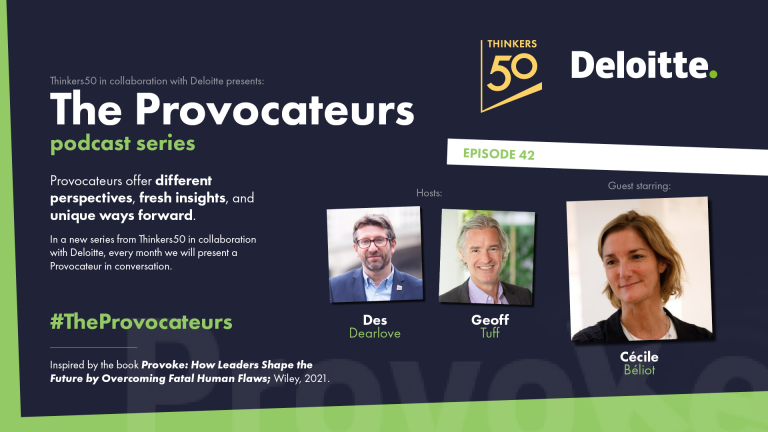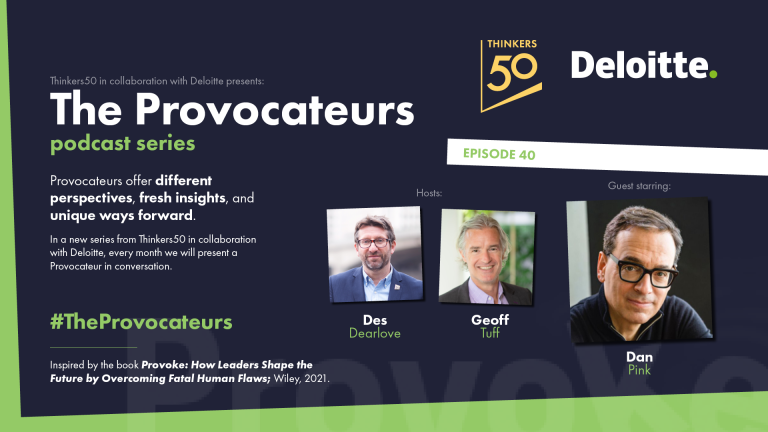
Thinkers50 in collaboration with Deloitte presents:
Cécile Béliot is the first female CEO of Bel Group, known for iconic cheese brands The Laughing Cow, Babybel, and Boursin, as well as GoGo squeeZ fruit pouches.
As only the second executive from outside the founding family to lead the 150-year-old company, she shares how she’s honoring legacy while driving transformation in today’s challenging environment – proving that companies can deliver both profitability and sustainability.
Cécile defines sustainability through two interconnected pillars: social impact for providers (fair wages, financing the transition to regenerative farming) and facilitating healthy eating habits for consumers.
To embed this vision at the company’s core, Bel transformed the Chief Financial Officer role into Chief Global Impact Officer – a bold move that changed how the entire organization thinks about performance and accountability.
Cécile’s provocation to business leaders everywhere is simple but powerful. Put an “AND” in everything you do. Not short-term or long-term. Not purpose or profit. Companies that embrace the “AND” – managing the tensions rather than choosing sides – unlock innovation, collaboration, and the ecosystem transformation needed to thrive today and tomorrow.
This podcast is part of an ongoing series of interviews with executives. The executives’ participation in this podcast are solely for educational purposes based on their knowledge of the subject and the views expressed by them are solely their own. This podcast should not be deemed or construed to be for the purpose of soliciting business for any of the companies mentioned, nor does Deloitte advocate or endorse the services or products provided by these companies.
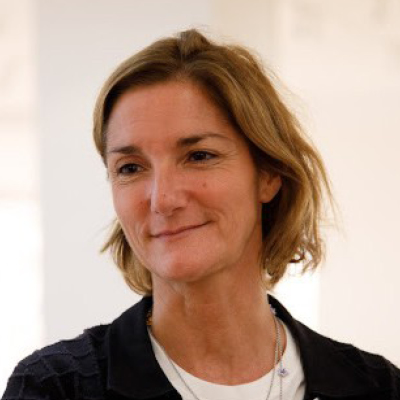
CEO, Bel Group










Inspired by the book Provoke: How Leaders Shape the Future by Overcoming Fatal Human Flaws; Wiley, 2021.
Des Dearlove:
Hello and welcome to the Provocateurs podcast. Our aim with these podcasts is to provoke you to think and act differently through conversations with insightful leaders who offer new perspectives on traditional business thinking.
I’m Des Dearlove, co-founder of Thinkers50. This is a collaboration between Thinkers50 and Deloitte. And my co-host today is Geoff Tuff. Geoff is Deloitte’s global and US leader for sustainability work with energy, resources, and industrials clients. He’s also the author, along with Steve Goldbach, of three books: Detonate, Provoke, which inspired this podcast series; and now the final book in the trilogy, Hone: How Purposeful Leaders Defy Drift.
Geoff, great to see you.
Geoff Tuff:
Des, as always, it’s fantastic to be here. I appreciate you always taking the time to kick things off here, but I am thrilled to introduce our guest today. Our guest today is Cécile Béliot. Cécile is the CEO of Bel Group, the global food company behind iconic brands, including The Laughing Cow, Babybel, Boursin, and GoGo squeeZ. She was appointed in May 2022, and she’s the first woman and only the second executive outside the founding family to lead the 150-year-old company.
Before joining Bel in 2018, she spent 17 years at Danone in various marketing and management roles, including general manager of One Danone France, and managing director of Danone Waters, France and Benelux. Béliot is leading the group’s transformation towards sustainable and responsible performance with a focus on becoming the leader in healthy snacking across dairy, fruit, and plant-based categories. And I can tell you that through a number of different interactions we’ve had with Cécile over the course of the last year, she has a fascinating story and incredible ethos, and I really look forward to hearing more from her in this podcast.
So Cécile, welcome.
Cécile Béliot:
Thank you. Thank you. I’m super happy to be here also, and I love the provocative thinking that you convey. I really believe that there are ways to shake the way we see things, and I hope I will provide you some insights and conviction that there is another way to run a company today and to deliver both profitability and sustainability.
Geoff Tuff:
I’m quite sure that you will. Maybe as we get into it, can you just paint us a very quick picture of what brought you into this industry? What brought some of the clear passion you have for not just the industry, but the way that you manage the company? Just a little bit of your history.
Cécile Béliot:
Yeah, for sure. So I usually say that … I don’t know if you know this concept because it’s a Japanese concept that is called Ikigai. So the Japanese used to say that if in life you found your Ikigai, then you find the secret of happiness. And I believe that I was lucky enough to find my Ikigai quite early in my career.
So the Ikigai is the intersection between four cycles. The first cycle is what you love to do. And I’ve always been passionate about humanities, social sciences, psychology, philosophy. And it’s true that I love the food industry and I love food because food is about culture. Food is about social relationships. Food is about sovereignty. Food is about health of the people and health of the planet. So there is so much behind the food that my passion for people found a good place to continue to nurture my passion for people and humanities.
The second cycle is where you’re good at. And usually when you’re passionate about something, you’re good at it. And I’ve started in marketing because marketing in food is all about studying people’s behaviors and understanding the communities and how they relate with their food. So I was building a lot of connection with my passion.
The third cycle is about, is it meaningful for you? And based on what I told you about food, there is so much behind food that yes, it’s a fantastic meaning. You are one of the very essential industries. And I say, “You know what? Then the first thing you need to provide to your people is food.” Food security, food security for everyone because food is not a business like any others. Food is first and foremost a human right.
And the fourth cycle is you make money from it. So the good news, I found a way to connect my passion with where I’m good at with some things that give meanings to my action, and to provide me with revenues.
Des Dearlove:
Well, that’s a very thorough answer. I have to say, I’m very impressed with the four cycles and the way you’ve obviously navigated through that. But I mean, you were also the first woman CEO of Bel Group in its 150-year history. What unique pressures or expectations came with that milestone and how did you navigate that?
Cécile Béliot:
I didn’t feel that it was bringing more pressure on me because first of all, the change of governance, Bel is a family-owned company, so they do things with a very long-term frame. So the split of the governance between chairman and CEO was well-prepared by the family in advance. I was already part of the company. I was deputy CEO. I had time to build trust with my shareholders, but also to build trust with all the people within the company. So I would say that the change of governance was very smooth because of that.
And what it brought, and I was not totally expecting that, I knew that being the first woman, I would embody at least the topic of gender diversity. And this topic has always been very close to my heart because, as I often say, “It’s super difficult to become what you cannot see.” It’s very, very difficult to become what you cannot see. I was having a kind of a role model to play, and I’ve always played this role model. So that’s why I communicate a lot about women leadership and the importance of diversity at every level of the organization.
What I was not expecting, and it was really an interesting insight for me, after my nomination, I travelled all over the world. So you go from country to country, to another one. And just after my nomination, I was visiting Morocco and then I was visiting Vietnam. And in both countries, people were coming up to me – not only the women. Interestingly, when I was in Morocco and in Vietnam, you have men, Moroccan men who told me, “If the family is capable of putting a woman as CEO, it means that one day we could have a Moroccan leader at the EXCOM.”
So what I’ve realized is that when you embody a diversity, you are a role model not only for the woman, you’re a role model for every kind of diversity. And I think it just reaffirms and strengthens the importance of this role modeling.
Geoff Tuff:
That’s a fantastic point.
So let’s actually talk about that. You’ve got a number of different aspects to your profile that makes you a little different from previous leaders. You’re only the second leader outside of the founding family to lead Bel. How do you or how have you, how do you continue to honor what’s come from the past, honor the family’s legacy, even as you recognize that we’re operating in a very different world today? And there’s, I’m sure, multiple different facets of this, both how you respect the legacy and do things differently, how you prevent what is a common breakdown point for many companies, which is to say, “Well, this is the way we’ve always done things.” I can imagine that’s only more powerful in a family-owned business.
Tell us a little bit about how you’ve managed that journey.
Cécile Béliot:
In fact, we’ve been able to transform ourselves massively and to bring a lot of innovation, but as you were saying, we always stay true to who we are. And the fundamental point is that the DNA of the company has always been built on two very strong legs, innovation and sustainability. My chairman, he put sustainability at the core of everything we do 20 years before I joined the company. And it’s one of the reasons why I joined Bel, by the way. So we are always very true to our values and to our mission.
And innovation has been part of the DNA of the company because if you look back, this company has been built 169 years ago, but the real start of the company, I would say the moment the company has started to thrive, was the launch of The Laughing Cow. And I’ve always said and explained that, can you imagine? This brand is 104 years old. So this brand has more than a century. And I don’t know if you realize how innovative that was 100 years ago. First of all, to dare to put and to use as an icon a cow laughing with a red face and earrings, even today, no, I don’t know if you would have a lot of agencies that could come with the kind of ideas to create a brand named The Laughing Cow because you believe in the power of laughter, and this is still on core in the brand DNA and purpose.
Second, the company has always been very, very innovative because Leon Bel, if you look at it this way, the first one, he was a kind of a genius, genius in branding and marketing, and he was a kind of genius also in product innovation. The guy has invented portion control snacks because he has invented not only the technology to melt cheese and to be able to put it in a can so that you can keep it for the next six months, so it allows the company to export beyond the village where they were selling cheese. And that’s how we have succeeded in Morocco, in Algeria, in the Middle East, because we were not needing chilled supply chain, and it was the inventor of the portions. And portions today is at the core of what we do in the company DNA, and we believe that it’s a fantastic asset because you have the right size, so right number of calories, right nutrient content because you can sell by portions. So in many countries, emerging countries where you have this affordability topic, selling by portion is a very strong asset because it protects the food so you never waste. You never have a waste of a Laughing Cow portion or a GoGo squeeZ pouch because it’s protected.
It brings a very specific experience and so you had experience: when you open a Babybel, everyone is talking about the opening experience because you open it and you discover the cheese and you have a little Pac-Man made from the wax and he is the one who has invented this. So innovation has been part of the company DNA.
So yes, we continue to reinvent our portions. Before, we were thinking we were a cheese company. We moved from this vision of a cheese company to a healthy snack company with this idea that we sell portions. So it could be portions of goodness made of milk, but also made of fruits. That’s how we did the acquisition of Materne, GoGo squeeZ, but could be portions of veggies, could be portions of plant-based. And that’s exactly how we have continued to deploy our strategy all over the world and diversified our portfolio. But we always stay true to who we are, to our history, and to our mission, and our mission is to feed the world with healthy and sustainable food and snacks.
Geoff Tuff:
First, I want to clarify that the original question is how did you fit into a family-run business? It sounds like just your natural ethos and the way you think about management fit, a long history of innovation and sustainability.
My question was, you made the point that the sustainability has been at the heart of the company for over 20 years at this point. I’m interested to know, how has the definition of sustainability, what is sustainable, changed over time? Because we are living in this day and age, we’re living in a time where there is a shifting definition and different people define sustainability for different purposes, but how has that journey looked for Bel?
Cécile Béliot:
So the way we define sustainability is really based on the key stakes related to the food system today. We consider that we are part of the food system and that we have to show and prove to the rest of the industry and retailers that it’s possible to change, to change the food system.
So when you look at the food system and why we consider that it’s broken today and why we all know that with the actual system, we cannot feed the 10 billion people we will be in the coming years. So when you look at the food system today, on one side, it creates obesity and many diseases related to bad food habits. You have on one side, 1 billion people suffering from obesity, but you have also on the other side, 1 billion of people and kids suffering from malnutrition. And today, the new news is that in emerging countries, these kids, they have both at the same time. They suffer from obesity and malnutrition because the way we feed them is through what we call packaged food, which means in reality that we are pushing for consumption of what we call empty calories made of sugar or fat when we should provide them access to good nutrition, which mean that food that will bring nutrient to them, protein, calcium, magnesium, fibers, and that’s not the case today.
The second topic related to food, and I believe that the people who follow your podcast are very aware about that, but the food system generates one-third of the total CO2 emission on the planet. So there is no way to stick to any kind of climate trajectory if you do not deal with the way we feed the world, and it’s related to two things. First, what do you put on your plate? Second, how do we farm?
So in the way we define sustainability, yes, of course we define sustainability on nutrition and the quality of nutrition we provide to the many. Yes, of course, we define sustainability based on the diversity of product that we propose through our portfolio, and we believe that we are here to foster the good eating habits. So that means that each of our brands, they will do the promotion of fruit, veg. We have what we call the pairing strategy. We push kale through a brand like Boursin, which is very indulgent. We use Boursin to create more meals and desirable meals where the main part of your meal is veggie because there is no better way to enjoy your salad than to put Boursin on it. So there is many ways to leverage the brand to shift consumer behavior so that half of your plates every day is made of fruit and veg. We have also accelerated on plant-based alternatives because for the people who want to decrease animal protein, we need to have the good option. So that’s why we have Babybel Plant-Based, Laughing Cow Plant-Based and so on.
The second topic is how do we farm? Because we have to move away from the intensive farming which destroys the soil in order to move to regenerative farming practices. And that’s why at the heart of what we do everywhere we operate, either when we have conversation on apple orchards, either when we talk with dairy farmers, we finance and we do not see that as an extra cost. We see that as a much needed investment. So we finance transition towards regenerative practices, and today in France, for instance, in the way we calculate the price of the milk, we pay for performance.
So the more sustainable you are, we have eight practices that have been identified. Each of them, you have an incentive related to it. So the more sustainable you are, the more you get from a price of the milk point of view. So this is how we define sustainability as you understood, the quality of your food and also the way we farm.
And obviously, we also embrace sustainability in the broad sense, which is the impact on our ecosystem. So if you want to support the farmers to do this transition, you have to make sure that first they have fair revenues. And that’s why even before we talk about incentivizing them about transition toward regenerative agriculture, the base price of the milk is not coming from the market price. It’s coming from what we consider as a fair revenue because we start by looking at their cost of production. On top of it, we put a decent salary.
So fair wages is also part of what we call sustainability. And if we do that for our farmers, you can imagine that we cannot guarantee fair wages for the farmers if we are not absolutely convinced that within the company, for our own workers all over the world, if we cannot guarantee that we are fair wages … And fair wages is not the minimum salary you should provide them. It’s a real calculation made with an NGO specialized on that and it’s based on, is the salaries that I provide to my workers. For instance, in Azores, in this little island in the middle of the ocean, is this revenue, allows them to have a decent house, allow them to feed their kids properly, allow them also to protect them from a health insurance point of view, and allow them to put a little bit of savings every month so that if you have any accident in life, you do not fall into poverty?
So this definition of fair wages is a definition that has been provided to us by an NGO and these NGOs, they have data localized. So the fair wage in Azores is not the same in Paris and is not the same in Morocco, for instance.
So you see that we have a broad perspective on what we call sustainability. It’s on one side, social impact, impact on our workers, fair wages, how can they climb the social ladder? It’s how we farm to make sure that we foster sustainable farming, and it’s obviously how we support consumers to adopt healthy heating habits in a very broad sense.
Des Dearlove:
It’s fantastic to hear you talking about regenerative farming. In November, the big Thinkers50 event, our theme was regenerative business and what we can learn from regenerative farming and how that can be brought into the whole kind of business sphere and what that means. And we had a friend, Paul Polman was there talking about … Or rather, he wasn’t there, but he did join us virtually.
But what I was going to ask you because you mentioned purpose, and obviously being a family-owned business, that gives you a longer perspective on these things, but there’s also the organization, it has a special legal status, as I understand it, in France. I mean, it’s a bit like a B Corp, but it’s not. It’s something … Can you tell us a little bit about what that means and how that works?
Cécile Béliot:
Yeah, absolutely. So in fact, in France, you have a legal status that we call mission-led companies. And when you go for that legal status, it’s a very big move for our shareholders because when you decide to go for this legal status, it means that whatever happens in the world, whatever crisis, war, crazy inflation, you have to deliver every year on your sustainability commitments.
And you know that even before we were a listed company, so we’re not anymore today, but five years ago it was a listed company. So we have the same kind of governance than a listed company because we believe that transparency is great. So we have an audit committee, we have a board, and on top of this right now, we have what we call the mission committee. And the mission committee is an official body from the governance with external board members. Usually they come from … They are experts in their field. We have one expert on regenerative farming, we have one expert in nutrition. So we’ve built this community of experts and they are external board members and they are here to challenge us on the KPIs, on how we manage delivering them year after year. And they are here to stem the fact that, yes, this is the right level of ambition for a mission-led company, and yes, we keep on delivering on that.
And I’m telling you that I think it’s a bold decision because you see the way in which we have to operate. And it’s a true conviction that we have acquired, especially because we took the decision to move to this mission-led company status two years after the start of the Ukraine war and the crazy inflation we had to handle. And the reason why I was very comfortable to do this move at that time is I told my shareholders, “If we’ve been capable to stick to our commitment and not to delay any kind of investments on the sustainability part, despite the crazy inflation we have to support, it means that we can go for it.” We believe in that. We believe that this is a way to be different from the market.
For us, I know you’re convinced, but we strongly believe that business without sustainability has no future and we are a family-owned company, so we are obsessed about the next generation. But sustainability without financial performance has no impact because we are here to scale. So the only way to scale is when you have both because sustainability needs investments, needs CapEx, and it’s deployment all over the world. So that’s why we are so aligned and so convinced that there is a way to manage both at the same time and to deliver great results on both.
Geoff Tuff:
So Cécile, I’m glad you went there because that’s where I wanted to take my next question. You have recently sunset the role of chief financial officer and introduced the chief global impact role instead, and I’d love to hear a little bit about that, but I also would imagine that some of our listeners are hearing what you have to say and they hear a very motivating and uplifting story about how to stay committed to your core principles and how, with a certain legal status, it gives you the ability to stay true to those principles, but how does it impact economics? What can companies that are not listed in that way understand about the way that you’ve built your business model and what allows you to pay, as I understood it, a premium to some of your suppliers who are running more sustainable businesses themselves, how does that ultimately clear financially in a way that would make sense to many of our listeners that don’t have the same listing status?
Cécile Béliot:
Sure. And I think we are living proof again that there is a way to put what I called an ‘and’ in everything we do. I do profitability and sustainability. I have global brands and they are super locally relevant and on core. We are 169 years old and we are super modern and we look forward. We are caring and demanding. We do propose higher revenues to the farmers and we propose the right value equation for the consumer. I believe that the issue of the world is that we keep on opposing things instead of combining them. And that’s a very big mistake that we do today. We oppose short term and long term. You know what? We cannot oppose them.
I’m not saying that there is no tension. There is tension in everything we do, in every moves, but there is always a narrow path so that you never lose sight of the long-term perspective, which does not mean that the path is not you go right and you go one step right and one step left, and sometimes you have to go back and then you come back, but you never lose sight on the mission and where you want to go.
And we put in place a governance, as you were mentioning, that is really helping us to accelerate and operationalize this vision. The moment we decided to shift from a role of chief finance officer to the role of chief global impact officer, I would not have even expected that it could create such a movement and transformation within the company. So first of all, we have not played on words. We have decided that we cannot name finance “finance” anymore because they are in charge of piloting the performance of the company. And as we define performance on two legs equally important, sustainability in a very holistic way, as you understood it, and financial performance, we’ve decided to name them chief global impact officer. And the beauty of the finance function is that the moment you’re giving them the accountability to monitor and pilot sustainability, these people, they are obsessed about, “I need data, I need granularity, I need to change, I need to process.” And the role of the finance team is to put focus, operationalization, and stretch. They are the ones who define what winning means in the company.
And as for me as a CEO, the way I define value creation with my shareholders is also built on two legs. It was bringing a lot of consistency, and it has created a lot of conversation within the process that we were leveraging. So for instance, we have a process like budget process or performance review. When you decide to do a budget process with the two legs, it means that when a country presents its budget, it will present its own objective in terms of net sale, gross profit, ROC, EBITDA, but it will also present its commitment in terms of how do I accelerate on healthy nutrition for all? How do I accelerate on my weather trajectory? How do I accelerate on my CO2 footprint? And if you want to allow that kind of conversation, you need to integrate into your system, into your SAP system, the data, meaning that these people, they need to be able to forecast. If I do this and this with my portfolio, what will be the footprint?
So today in our system, we have data on CO2, Scope 1, 2, 3 for instance, at the SKU, meaning at the product level, embedded into SAP, which mean that when I have conversation with the retailer, I can provide to the retailer depending on the assortment that we negotiate and the forecast that we have on the volumes, I can tell him, “This is how much we’re going to improve together the CO2 footprint of my assortment. This is how we’re going to improve it,” and I have exactly the same for the water consumption, Scope 1, 2, 3, at the product level. We have data and nutrition for each of our products.
So we have embedded that into our system so that the budget process, the strat plan process, the monthly performance review, the CapEx investments … For instance, we have a CapEx, it’s for industrial investment. So we have a CapEx committee. There is no CapEx that we assess where we do not have evaluation of these CapEx in terms of impact for financial impact, obviously, but also impact on CO2 water and so on. And we even integrate into the payback of this CapEx the positive impact of sustainability.
So we have succeeded to … So it’s easy for carbon to define a price for carbon, so we integrate. The price for carbon for us is 150 Euro per tons, which is three times higher than the market price, but which is a real price recommended by NGOs. So that’s how we define the price for carbon internally, but we have also been able to define the price for water because I need to accelerate massively. Today, 70% of my industrial footprint is on regions where we know that we have already, and we will have, water scarcity, and dairy business is very heavy in terms of water consumption. So I need to accelerate the way I manage water in my factory and I really need to deliver a strong roadmap in reducing my water consumption. But water costs nothing. The reality is that we do not pay today as a real price for water.
So to be able to justify this CapEx, if I just use the cost of water as I pay water, there is zero payback. It’s 20, 25 years payback. It doesn’t make sense. We have worked with an NGO again in order to define a price for water, I would say city by city, location by location, because the price of water in Morocco is not the same price as in France. You can imagine. And I have taken into account in this price of water, the price of not doing anything. For instance, there are regions where I already know just projecting the water scarcity that if I do nothing for two months per year, I could not run my factory at 100% and I would have to cut 30% of my volumes just to stick to the maximum water consumption I could have.
So this loss is integrated into my water price and we have also integrated the impact that we have on the ecosystem because when you pump too much water, then you have a negative impact on the ecosystem, and we have integrated this price also in the water price. And that has allowed us to massively accelerate investments on water because from 25 years of payback, you move to six, seven years, which is financially very good. That’s how we integrate the long term into our thinking, and that’s how the global impact officer makes a lot of sense.
Des Dearlove:
That all makes a lot of sense to me. But I mean, you were talking about data and one of the data points I remember from when we heard you speak at Climate Week in New York was you mentioned, and you were in conversation with Paul Polman, who tops the Thinkers50 ranking at the moment, but you mentioned that just 2% of people are ready to change food behaviors to help the planet. I mean, we’ve talked about helping the farmers, we talked about shareholders, consumers.
I mean, how do you drive behavior changes at scale so that consumers, the poor part at the end of the … that drives everything, so that those people are ready for this change?
Cécile Béliot:
Yeah. You know, it’s one of the biggest learnings that I’ve built over the time. We need to do what’s right for the planet and for the people, but what is important is not to be right. What is important is to have impact. And I keep on saying that to my team because unfortunately, and we’ve discovered this when we were launching plant-based options, plant-based has no impact as a claim. People, yes, it has an impact on the vegetarians and vegan, which is between 2 and 4% of the population. Okay, right. But I’m talking about the others.
The reality is that people shift behaviors when you create desire, when they think that, “Okay, there is something for me.” Either it’s better, we are in food, so indulgence is part of it. Either it’s better for my health, people are ready to move when it’s good for their health. Either it’s fun, it’s convenient. That’s what I call building traction. And that’s where the power of our brands is fantastic because when I do advertise on the Babybel, there is a long story about the sustainability of our milk. I do not advertise on that because I don’t believe it will create the traction in front of the shelf. But this is so fun, so convenient. This is real food, three ingredients only. It’s full of protein because cheese has always been full of protein. People start to rediscover that, but that’s always been the case. And when I play on the playfulness and convenience and content in protein, then Babybel is booming all over the world. So I do a great job doing that.
When I was talking about Boursin, we have discovered that when we use Boursin to promote veggie consumption, veggie gratin, salad and so on, we have a much bigger engagement on social media. And you know why? Because people are trying to eat more veggies, but you know what? You feel it’s not good enough. So you need to bring creativity, you need to bring this indulgence that Boursin can provide to that kind of meal.
So that’s what I mean by creating desire. And I will never say to my consumer that, “By the way, you have looked at 100 recipe on Boursin, and 90% of them are only made of veggie.” Because if I say that, I’m going to be part of the vegan community. I want to be as much inclusive as possible.
So if you make it … We keep on saying that if you are at the intersection of health, sustainability, and fun, you have it all. It has to be fun. It has to be desirable for the kids. So it took me a while to understand all of this, but right now I’m really convinced about that, and even on plant-based, we barely see that it’s plant-based. We offer a lot of taste and we leverage new snacks with crazy flavors and it works much better.
Geoff Tuff:
Yeah. It’s really interesting, Cécile, I did not know the full story and the breadth of management ideas you brought to Bel, but going back to the earlier comment you had around tension, I’m interpreting a lot of the success that you’ve had as a company, and you yourself as an executive, to the ability to simultaneously hold and manage the tension between opposing ideas in a way that many companies can’t.
I mean, if I just think about the struggles that we have a lot of the time in our sustainability business trying to help companies understand how they can make money from sustainability in a way that doesn’t trade off either one, I could imagine the temptation for many companies is to say, “Okay. We’re going all in on sustainability, therefore that’s what we’re going to market on. That’s what we’re going to sell our products on and we’re going to expect end consumers to pay for that.” And the reality is we’re not yet living in a place widespread globally where consumers are willing to pay for sustainability. Yet you’ve figured out a way to be able to build it into your core business model, but not necessarily focus on it as you go out into the world and market your products, which I think sounds like a fantastic recipe for success.
I am interested to know though, as you expand into other markets like the US, like China, like India, for your brand portfolio, which I think has a lot of resonance in Europe and it does present sometimes as a European-oriented set of brands, how do you think about varying the message or varying what you focus on for other global markets?
Des Dearlove:
Sorry, if I might just say something there too, Geoff. I mean, one of the great things about your products
Geoff Tuff:
I thought Cécile was our guest on this, Des. I didn’t-
Des Dearlove:
Well, no, I was going to say, because one of the great things about the products is that they have different adaptations and they’re understood differently in different places. I mean, in the States, it’s very much a Babybel, and I brought my kids up on Babybel, it’s very much a snack thing you put in… But if you go to somewhere like Morocco, it’s understood differently, I think.
Cécile Béliot:
Yeah, absolutely. No, you’re absolutely right. So first of all, it’s true that we have a common ground on sustainability, meaning that we all work for the mission, as I was telling you. But exactly like on finance, by the way, not every country has the same mandate within my country portfolio from a finance point of view. You have some countries where they have a mandate of hypergrowth, like the US, and you have countries where you know what? First, fix your margin.
So when you look at the sustainability KPIs and the way we translate them, each country contributes to the big picture, but they do not have the same mandate. In Sub-Saharan Africa, the priority is to give access to nutrition to as many people as possible, and the priority is accessibility of good nutrition. And that’s why, when I was telling you that sometimes it creates tension, and we have difficult conversations, it’s because we were so much advanced on our sustainability agenda, on the sourcing, and we were having, for instance, every time we used palm oil, it’s segregated. The palm oil coming from Denmark ticks all the boxes, except that at a certain moment when we were going through the mega inflation during the Ukraine war, we had to step back in some countries of Sub-Saharan Africa because if you keep that kind of sourcing, you’re out of the market. And the priority is to feed the world and to provide good nutrition to the many, but we never have a cut. Everything that we do with NGOs on inclusive business, and we always stick to the mission, which is to give access to as many people as possible in Sub-Saharan Africa on food and protein.
When you are in the US, the fight is different. The fight is really healthy snacks for the kids, and for the adults.
And that’s where we have a role to play, so that’s our fight. And for this, Babybel is fantastic. And for this, GoGo squeeZ is also fantastic because there is no better way for your kids to discover the taste of the fruits. And by the way, we have real data proving that when you provide GoGo squeeZ to your kids, they’re going to eat more fresh fruits. And we have started with fruit, now we put fruit and veg, and tomorrow we’re going to put 100% veg because we need to help people to eat more veggies all over the world.
So that’s the fight for the US and you will also have a fight for France and so on. So we really adapt the portfolio depending on the main fight. So every country, when they define their strategic plan, they define the fight they want to be famous for.
Geoff Tuff:
That, I think, is a fantastic close to wrap on this. Cécile, we are running up against our time, but I’d like to ask you one last question that we ask all of our guests in keeping with the name of this podcast, The Provocateurs. If you had to leave one big rethink to provoke leaders in the world today across all businesses, not just in the food industry, but across all businesses, one or two sentences, what’s the big thought that you would leave us all with?
Cécile Béliot:
If I could convince all of them that there is a way to put an and, A-N-D, in everything they do, and that we have to stop opposing, we have to combine. And yes, obviously it will create tension, difficult conversation, but it fosters creativity, it fosters innovation, it fosters collaboration, it obliges you to open up to your ecosystem and that’s the way to thrive today and tomorrow. So yes, there is a way and we will continue to showcase that.
Geoff Tuff:
That’s a great one. Thank you.
Des Dearlove:
And you’re right. We’re up against our time constraint, I’m afraid. Cécile, I would’ve loved to have talked more with you and maybe we’ll get another chance sometime. So huge thank you to you. And Geoff, it’s always a pleasure. I’ve been Des Dearlove. He’s been Geoff Tuff and we look forward to seeing you next time.
Cécile Béliot:
Yeah. Thank you so much. Thanks for the visibility you’re providing to the ones who think differently. I think we also need leaders and podcasts and media like you. So I believe that there are a lot of companies that keep on transforming themselves and keep the compass. So we need more people like you.
Des Dearlove:
Thank you.
Geoff Tuff:
Thank you for the time, Cécile.
Cécile Béliot:
Thank you.
This podcast is part of an ongoing series of interviews with executives. The executives’ participation in this podcast are solely for educational purposes based on their knowledge of the subject and the views expressed by them are solely their own. This podcast should not be deemed or construed to be for the purpose of soliciting business for any of the companies mentioned, nor does Deloitte advocate or endorse the services or products provided by these companies.

Thinkers50 Limited
The Studio
Highfield Lane
Wargrave RG10 8PZ
United Kingdom
Contact us at:
enquiries@thinkers50.com
Thinkers50 Limited
The Studio
Highfield Lane
Wargrave RG10 8PZ
United Kingdom
Contact us at:
enquiries@thinkers50.com
Thinkers50 Limited
The Studio
Highfield Lane
Wargrave RG10 8PZ
United Kingdom
Contact us at:
enquiries@thinkers50.com
| Cookie | Duration | Description |
|---|---|---|
| LANG | 9 hours | Linkedin set this cookie to set user's preferred language. |
| nsid | session | This cookie is set by the provider PayPal to enable the PayPal payment service in the website. |
| sp_landing | 1 day | The sp_landing is set by Spotify to implement audio content from Spotify on the website and also registers information on user interaction related to the audio content. |
| sp_t | 1 year | The sp_t cookie is set by Spotify to implement audio content from Spotify on the website and also registers information on user interaction related to the audio content. |
| tsrce | 3 days | PayPal sets this cookie to enable the PayPal payment service in the website. |
| x-pp-s | session | PayPal sets this cookie to process payments on the site. |
| __cf_bm | 30 minutes | This cookie, set by Cloudflare, is used to support Cloudflare Bot Management. |
| Cookie | Duration | Description |
|---|---|---|
| l7_az | 30 minutes | This cookie is necessary for the PayPal login-function on the website. |
| Cookie | Duration | Description |
|---|---|---|
| CONSENT | 2 years | YouTube sets this cookie via embedded youtube-videos and registers anonymous statistical data. |
| _ga | 2 years | The _ga cookie, installed by Google Analytics, calculates visitor, session and campaign data and also keeps track of site usage for the site's analytics report. The cookie stores information anonymously and assigns a randomly generated number to recognize unique visitors. |
| _gat_gtag_UA_10408481_1 | 1 minute | Set by Google to distinguish users. |
| _ga_ZP8HQ8RZXS | 2 years | This cookie is installed by Google Analytics. |
| _gid | 1 day | Installed by Google Analytics, _gid cookie stores information on how visitors use a website, while also creating an analytics report of the website's performance. Some of the data that are collected include the number of visitors, their source, and the pages they visit anonymously. |
| Cookie | Duration | Description |
|---|---|---|
| NID | 6 months | NID cookie, set by Google, is used for advertising purposes; to limit the number of times the user sees an ad, to mute unwanted ads, and to measure the effectiveness of ads. |
| test_cookie | 15 minutes | The test_cookie is set by doubleclick.net and is used to determine if the user's browser supports cookies. |
| VISITOR_INFO1_LIVE | 5 months 27 days | A cookie set by YouTube to measure bandwidth that determines whether the user gets the new or old player interface. |
| YSC | session | YSC cookie is set by Youtube and is used to track the views of embedded videos on Youtube pages. |
| yt-remote-connected-devices | never | YouTube sets this cookie to store the video preferences of the user using embedded YouTube video. |
| yt-remote-device-id | never | YouTube sets this cookie to store the video preferences of the user using embedded YouTube video. |
| yt.innertube::nextId | never | This cookie, set by YouTube, registers a unique ID to store data on what videos from YouTube the user has seen. |
| yt.innertube::requests | never | This cookie, set by YouTube, registers a unique ID to store data on what videos from YouTube the user has seen. |
| Cookie | Duration | Description |
|---|---|---|
| DEVICE_INFO | 5 months 27 days | No description |
| loglevel | never | No description available. |
| m | 2 years | No description available. |

Thinkers50 Limited has updated its Privacy Policy on 28 March 2024 with several amendments and additions to the previous version, to fully incorporate to the text information required by current applicable date protection regulation. Processing of the personal data of Thinkers50’s customers, potential customers and other stakeholders has not been changed essentially, but the texts have been clarified and amended to give more detailed information of the processing activities.