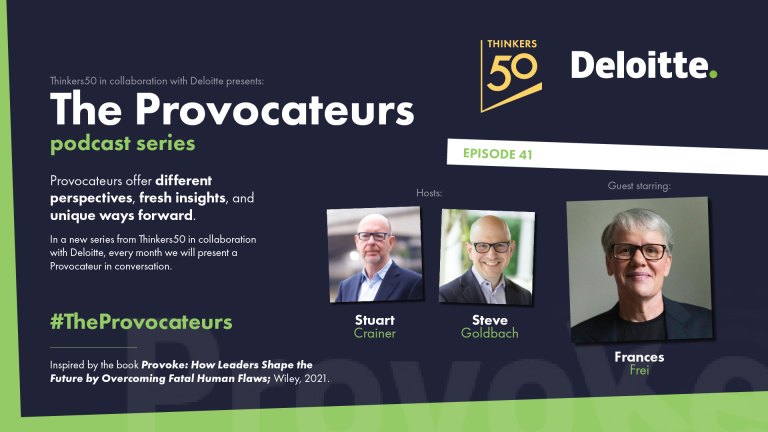
Thinkers50 in collaboration with Deloitte presents:
Frances Frei is a professor of technology and operations management at Harvard Business School and, together with her partner Anne Morriss, is the bestselling author of Uncommon Service: How to Win by Putting Customers at the Core of Your Business; Unleashed: The Unapologetic Leader’s Guide to Empowering Everyone Around You; and Move Fast & Fix Things: The Trusted Leader’s Guide to Solving Hard Problems. Frances and Anne are #7 in the Thinkers50 Ranking.
In this episode, Frances reveals the three pillars that define the architecture of trust, three key mistakes repeatedly made by organizations, and why “move fast and break things” is actually slower than moving fast and fixing things. Discover:
This conversation took place in London’s historic Guildhall during the Thinkers50 London Summit & Awards Gala in November 2025, with Frances joining Provocateurs hosts Steve Goldbach, leader of Deloitte’s Sustainability Business in the US, and Stuart Crainer, co-founder of Thinkers50.
This podcast is part of an ongoing series of interviews with executives. The executives’ participation in this podcast are solely for educational purposes based on their knowledge of the subject and the views expressed by them are solely their own. This podcast should not be deemed or construed to be for the purpose of soliciting business for any of the companies mentioned, nor does Deloitte advocate or endorse the services or products provided by these companies.
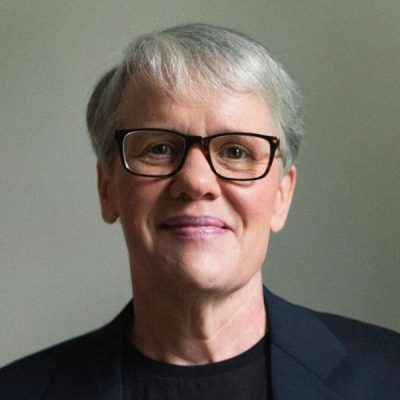
Professor of technology and operations management at Harvard Business School


US Sustainability Practice Leader, Deloitte








Inspired by the book Provoke: How Leaders Shape the Future by Overcoming Fatal Human Flaws; Wiley, 2021.
Stuart Crainer:
Hello, I’m Stuart Crainer, co-founder of Thinkers50. Welcome to the Provocateurs Podcast. Provocateurs is a collaboration between Thinkers50 and Deloitte. So I’m joined today by Steve Goldbach. Steve leads the sustainability practice of Deloitte in America and is the co-author with Geoff Tuff of Detonate, Provoke, and a new bestseller… It’s okay to call it a bestseller?
Steve Goldbach:
Sure.
Stuart Crainer:
Hone, which has recently come out. We’re speaking to you today from the Thinkers50 at the Guildhall in London. Can you introduce our guest, Steve?
Steve Goldbach:
And thank you, Stuart. And it’s great to be here in London. It’s great to be here with Frances. Our guest today is Frances Frei, best-selling author herself of three books together with her writing partner and wife… Anne. Her three books are Uncommon Service: How to Win by Putting Customers at the Core of Your Business, Unleashed: The Unapologetic Leader’s Guide to Empowering Everyone Around You, and my favorite title of all, Move Fast & Fix Things – as opposed to Move Fast and Break Things, and I’m sure we’ll get into that – Move Fast & Fix Things: The Trusted Leaders Guide to Solving Hard Problems.
They have a terrific podcast that I was enjoying… I’ve enjoyed previously, and I was re-enjoying this morning with particularly the Unsolicited Advice episodes. They’re very popular with their weekly Fixable podcast. Frances is a professor at HBS and took time off to be Uber’s first senior vice president of leadership and strategy in 2017. And I’ll just also note that your wife, Anne Morriss, is an entrepreneur and founder of the Leadership Consortium, since so much of your work is in collaboration even though Anne couldn’t be with us today. So, Stuart, let’s get into it.
Stuart Crainer:
Well, we should ask you first about the book titles. Who comes up with the titles?
Frances Frei:
Oh.
Stuart Crainer:
Because they’re really good titles.
Frances Frei:
Yeah. So the way that my partnership with Anne works is that she’s letters and I’m numbers, and you don’t see very many numbers, do you? So Anne is the chief architect of all of this. What I’ll do is go out and test the ideas, but she’s the beautiful writer, and I’m a very good editor, but we don’t… we’re not fighting over who gets the keyboard. She gets it first, and then I get to comment on it. And then when we’re working on ideas, I’ll go and present it a lot of times in front of audiences and executives to hone them. To hone them.
Stuart Crainer:
How do the books fit together in your mind? What is it… How have they evolved and what’s the logic?
Frances Frei:
Yeah, I think that we… when we wrote Uncommon Service, I think we thought we were going to write one book and that was going to be it. And so it almost felt like we gave birth to the book, and it was everything that we had thought about till then. The central idea was that in order to be great, you have to be bad. And that was emotionally very difficult for type A people. So I would see so many obstacles to excellence that were neither technological nor resourced. It was simply emotional.
People didn’t have the courage to be bad at something even when it was in the service of being great at something else. So we wrote that and the whole system around it, and then got really interested in the leader lever. And so I think going down from the organization down to the leader, and that’s when trust became really fundamental to us. So, in Unleashed it was Trust that was the first chapter.
Love was the second chapter, which was our shorthand for high standards and deep devotion, and then belonging and culture. And so it was really a full-on leadership book. And then I think we went back up to the organization level for Move Fast & Fix Things, honestly, because speed had gotten such a bad name. And I mean, if you listen closely here or anywhere else, you will find people blaming speed for the woes, and it’s almost never the problem. In fact, we need more speed.
And so we wrote the book to give people a playbook on how you can actually move fast because momentum is really important, how you can move fast and fix things. We did it in a pretty cheeky way. We organized the five steps by days of the week, suggesting that you could solve hard problems in a week. I actually think you can solve hard problems in a week, but you can’t go fast until Friday. So there are some preconditions that you have to do.
Stuart Crainer:
Did you write the book quickly?
Frances Frei:
Every book takes about the same amount of time, which is we write, we write, we write, excuse me, we write it, and then we rewrite the entire thing in the last six months.
Stuart Crainer:
I think ‘move fast and fix things’ actually applies to book writing.
Frances Frei:
Yeah, for this… for the final draft.
Stuart Crainer:
Yeah.
Frances Frei:
It usually takes a long time because we’re thinking during the first draft and we’re writing during the final draft.
Steve Goldbach:
What do you think is the orthodoxy that prevents organizations from both moving fast without breaking things? I love the idea of fixing things. Of course, we always hear about ‘move fast and break things’ in the world. What do you think is the way that businesses and leaders kind of have this view that makes them feel like they need to break things as opposed to fix things?
Frances Frei:
I think they don’t think… I think that they, above all, care about speed, and they simply didn’t realize there was another way. And ‘move fast and break things’ was so catchy, and Mark Zuckerberg said it in the prospectus of Facebook, and that gave people license. I also think that a lot of people at the tops of organizations like me have empathy wobbles.
And so the collateral damage of people, while we don’t like it, it wasn’t devastating to them. But I’ve never met anyone who I’ve said, “Would you rather move fast and break things or move fast and fix things?” They all prefer this. They just didn’t know it existed, and they… and it was speed above all.
Steve Goldbach:
And there’s something about the… I love that, and I think that there’s something about the feeling of moving fast versus actually moving fast. And when you break things, you have to go back and fix them anyways-
Frances Frei:
Well…
Steve Goldbach:
… and so you’re not moving as fast as you think you are.
Frances Frei:
There is the great irony.
Steve Goldbach:
Yeah.
Frances Frei:
‘Move fast and break things’ is actually slow.
Steve Goldbach:
Yes, yes.
Frances Frei:
Yeah.
Steve Goldbach:
And it strikes me so much of your writing is at the center of… Trust is at the center of it. So what’s… It’s one of those words that people toss around, and it means lots of things to a lot of different people. So, how do you think about what it means to be trustworthy as a leader?
Frances Frei:
Yeah. So what we have discovered is that if I’m to earn your trust, you will end up trusting me, sometimes involuntarily, if you experience three things from me simultaneously. Whenever you experience those three things – I’ll tell you what they are – but whenever you experience them, you have the reaction to trust me. And every single time trust is broken, it can always be traced back to one of these three. So we essentially learned what the underlying architecture of trust is.
And the three things are authenticity, logic, and empathy. And authenticity is, are you experiencing the real me? And of course, we don’t trust you if you’re not being authentic. And logic. Is there sound reasoning? Is there rigor? Of course, we don’t trust you when it’s sloppy or inconsistent. And empathy, most importantly. Do you experience that I’m in it for you? So the real me with rigor in it for you. When you experience those three things, trust me.
And that means we can go so much higher and so much faster. And what has been surprising to us, we’ve been doing this now for a decade, I have been looking for the fourth dimension of trust, and it hasn’t been needed. And we’ve done this now with hundreds of thousands of people, tens of thousands of organizations. I frankly would like there to be a fourth dimension because do you know how many shapes I can draw with four points? I can only draw one with three points. So we have the trust triangle, but I’d have a parallelogram. And I mean a rhombus.
Steve Goldbach:
But think of all the triangles you could have. You could have the scalene.
Frances Frei:
No.
Steve Goldbach:
You could have the isosceles.
Frances Frei:
You’re really reaching. You got to try really hard.
Steve Goldbach:
I have a sixth grade math-
Frances Frei:
Okay.
Steve Goldbach:
… sixth grade daughter. So doing lots of triangles-
Frances Frei:
But you got to try…
Steve Goldbach:
… these days.
Frances Frei:
…try really hard for that with the four points. Phew, would that-
Steve Goldbach:
Yes.
Frances Frei:
… be a lot. Yeah.
Stuart Crainer:
That’s something to aspire to isn’t it, the holy grail of trust.
Frances Frei:
I keep… Maybe this will be one of the gifts of AI. We’ll see.
Stuart Crainer:
What about your experience with Uber? How did that change your direction or inform your work?
Frances Frei:
So, I’m in the technology and operations management, so I care about technology, but I really care about getting things to work. And back when Uber was having a very public crisis, they called and said, “Will you come and talk to the CEO?” And I was like, “No.” They were like… And it was a former student that asked, and they were like, “Why not?” And I said, “Because I only help good people win, and if I’m to believe any of the newspaper articles, this is not a good person.”
She said, “The newspapers are getting it wrong, not the direness of the circumstance, but they’re getting it wrong with the CEO. Will you just come and meet him?” And this was back… This is how long ago it was. I flew across the country to have a two-hour meeting. I would never do that today, but I flew across the country for a meeting. The two-hour meeting, it took three days. I changed my flight home five times, and we talked through everything. And this was a very good person trying to do a very hard thing, and he found the limits of what he could do. And it just so happened that I was a very good complement.
So he had me come in and be the head of leadership and strategy. He needed help on the leadership side. He was a great strategist, but he couldn’t get what was in his head into the heads of everyone else, and I could help in doing that. So I just happened to be lucky enough to be a perfect complement. But then he… the board moved him out 12 days later. So I joined Uber, and he was gone 12 days later. But we managed to put in place and solve most of their problems in the first nine months. I thought I was going there for four years. That’s what I agreed to do. In nine months, we were… all of my contributions were made.
Stuart Crainer:
Would you be tempted back to work with a corporation under the right circumstances?
Frances Frei:
It no longer… Uber required me to be full-time, and then I went and worked with another company that was like 90% time and 80%. No company needs all of me now. I’ve become very efficient, so I can help a company with an Uber-sized problem without having to be full-time.
Steve Goldbach:
It’s kind of like your fixable snacks, quick fixes.
Frances Frei:
When you’re as old as I am and you’ve seen as many things as I’ve seen, if there a lot of pattern matching, and we can be very helpful. And Anne and I just — we have a philosophy that we will never be the bottleneck. I used to have to be there full-time to do that. I don’t have to be there full-time, but I will never be the bottleneck for someone else.
Steve Goldbach:
So let’s dive into that, actually. That’s good to dive into it. So what are… I’m sure you’ve got this over all these years, pattern recognition of what goes wrong. So what are some of the archetypical go wrong moments that you’ve seen that you can share with our listeners?
Frances Frei:
Yeah, so I’d say that probably the number one is that they’re working on the wrong problems. So vast majority of time, people are working on the symptoms that present themselves, and that will take an infinite amount of time. You literally will never be done, and you would feel very busy, and you will be frustrated that you’re not actually making progress. And so step one is to go from the symptom to the root cause, which Toyota very famously called the Five Whys, indicating you’re about five why… you’re five… the symptom is five levels away from the root cause.
So I would say that the classic one is that people are very busy working on symptoms, and that if you will step back and do the diligence, and by the way, it takes about a day, but it takes all day to go from the symptom to the cause. I think that’s the main one. Once you’re solving the real problem, if it involves people and it is a problem, I bet you’ve broken trust. And so I now, at this point, just assume trust is broken somewhere, and I find out where, and if it’s an authenticity problem, we have one kind of solution. If it’s logic, another.
And if it’s empathy, another. And another way, because we understand the architecture so well, we can see all of the efforts that companies are doing to rebuild trust. If you don’t have this map, you’re essentially taking an authenticity solution, applying it to a logic problem, and wondering why it’s not working. And so it’s like having just the secret code or the secret map to get out of it. So I would say that those two. And maybe the third one is we spend a lot of time with the usual suspects. So anytime I go into an organization, there is the team that they go to do hard things.
And what I know is get your best plan with that team. And then I say, but then invite the unusual suspects in to improve on the plan. And you have to do two things when you invite them in. You have to invite them and convince them that you want to hear what they uniquely think. Because usually we invite them in, and they parrot what we are saying. So if in… at HBS, the senior faculty get together and talk about junior faculty, and for years, we’ve been doing this.
We have not improved the plight of junior faculty. It takes the same amount of time to get promoted. The promotion rates haven’t changed. We are an unimproving operating system. I know why. We only talk to the usual suspects. And anytime we invite the unusual suspects, the junior faculty to come in, I see that they’re just saying what they think we want. We haven’t created an environment to convince them that we really want to hear what they uniquely say.
I would love to convince institutions, and if I use Harvard as an example, don’t be proud of your lack of improvement. Promotion rates are unchanged for decades, and we say it with pride. Many organizations have that same thing. It’s: this is how we work. I’d like to inject a little shame into that. I’m like an improvement fiend, and this is where another thing that holds organizations back because I find they’re not ambitious enough. This is just the way it’s always been. That is so nostalgically lovely and…
Steve Goldbach:
There is something to that. One of the things that we’ve talked about is a designer’s mentality, and it comes to the same issue, which is I feel like I want to walk through the world slightly dissatisfied, only slightly, because I think happiness is super important, but with a mindset to what could we improve upon?
And my buggety-boo, the story that I love to tell, like what does this mean? It’s like when you go through security at an airport, you have the person who reads your ID, and then you have the place where you drop your bags. If you’ve designed it so well, you go right from the person who’s looked at your ID and right to dropping off your bags.
But in poorly designed systems, you have the secondary line. They’ve left too much space, and there’s nothing worse than having to wait in line for a long time only to get to the thing and then having to wait in line again. And it doesn’t take a lot to design it better so that there’s no second waiting.
Frances Frei:
Oh.
Steve Goldbach:
And there’s no second waiting. But it’s like a small improvement-
Frances Frei:
We can talk about… I mean, I think you could tell the story of life in airports. So people who take gorgeous flights over and land in London where we are, and you fly first class and you get taken care of and you’ve checked a bag, and then you wait at least an hour for your checked bag.
In fact, so many people will bring fewer clothes than they want to because they are afraid to check bags. Just think about what we are accepting there. We’re designing around a problem that we’re nostalgically holding onto. That’s what… So I love dissatisfaction, and I love separating it from happiness because today’s dissatisfaction is tomorrow’s progress.
Steve Goldbach:
Tomorrow’s innovation.
Frances Frei:
Yeah.
Steve Goldbach:
Exactly.
Stuart Crainer:
There’s a very real sense that for your work as well, that organizations and leadership are still understood in a kind of early 20th-century way. And the change has been very, very slow and the realization that the important elements of leadership you identify, it’s just so slow-moving.
Frances Frei:
I think, on average, it’s true, which is why it’s so intoxicating to see the ones that do it right and how much of an advantage they get. I like to study the positive outliers for inspiration. And I find the burden… the obstacles are almost always emotional. It isn’t a… I mean, because let’s say, “Oh, I didn’t have enough people that know how to code.” I can get them, but I can’t outsource the emotional obstacle.
Steve Goldbach:
Well, speaking of the world of technology, I think it would be illegal for us to have a podcast without bringing… in this day and age without bringing up AI. But let me try to ask, not just what do you think about AI.
In a world where all of your work is centered on driving trust, and trust is inherently a human trait, how do you think about… how are you and Anne thinking about the role of AI in the trust formula around authenticity, logic, and empathy? What… How is it going to upset the apple cart in that way?
Frances Frei:
Yeah, I think I have found so far that the same pillars apply, and that the lack of authenticity for me is that when you say one thing but you mean another. That’s a really big problem right now with AI is that instead of saying, “I don’t know,” it makes things up.
Steve Goldbach:
Mm-hmm.
Frances Frei:
It’s really hard to trust-
Steve Goldbach:
Trust AI.
Frances Frei:
… to rely on that. And when we don’t rely on things, it’s like, why do so many people have many credit cards? It’s because you’re afraid one won’t work. If I had a relationship with a credit card company and it always worked, I wouldn’t need to have the spares. Well, the same thing is true with AI. Nobody can rely solely on one of them because it may not work. That’s a trust aspect of it. So I find it’s in its infancy. I don’t blame it for not having built trust.
Steve Goldbach:
Not being perfect yet.
Frances Frei:
But I can tell you I will know-
Steve Goldbach:
It’s only Monday.
Frances Frei:
It’s only Monday. And I will know it when I see it, and it will have authenticity, logic, and empathy. And I think some of the tragic things that we have seen AI do, particularly when it comes to teens, I think, is because it was not designed with empathy in mind. It was designed with engagement in mind. And engagement is not empathy. So I feel like… I mean, you’re going to need experts to think through it, but I feel like the architecture still holds.
Steve Goldbach:
Can we dive into that a little bit?
Frances Frei:
Sure.
Steve Goldbach:
I’d love to hear you say a few more words about engagement and empathy and the difference there because I could imagine that, given some of the tragedies we’ve seen, I have heard people cite, and again, I’m not… I’m speaking anecdotally here, that they find, “AI gets me more.”
Frances Frei:
Yeah.
Steve Goldbach:
And that might lead people to believe that AI is empathetic. But I think that there’s something really important in what you’re describing, that engagement is very different than empathy. So could you say a bit more about that?
Frances Frei:
Yeah, and I think AI gets me, so I will be your example there because it has been trained on me, and I give it a lot of feedback. I tell it when it’s doing a good job. When it’s done something, I give it constructive advice. I give it positive reinforcement, and it improves at a really fast rate. So I have a feeling that the way in which if you ask the same questions I ask, you would get responded to differently than I do because I’ve invested in the training of it. And so I think that part of empathy is great, that it’s learning there.
But the engagement part that’s not great is that “I want to keep you at the keyboard as long as possible because I’m somehow going to get to monetize that.” It’s like the worst version of Facebook and Instagram, and those things that I don’t… “there’s a limit to my empathy because what I really… even if it would be good for you to unplug, it wouldn’t be good for me economically.” And so I think that’s the part where they really separate. If you… If it’s engagement subject to empathy versus empathy subject to engagement, they’re two wildly different designs.
Stuart Crainer:
How do you balance your activities? So you’ve got the Fixable podcast. You’re a professor at Harvard Business School. How do you balance them, and how do each of the activities inform what you do?
Frances Frei:
Yeah, they all feel very, very reinforcing to each other, which is that I really like to help good people do hard things. I believe in trust and speed. So the podcast tries to solve problems in 30 minutes or less, which is a very accelerated time.
When I go and work with companies, whatever… if they say that, “We want to hire you for six months,” I was like, “Well, let’s do it in two.” So my… I am constantly going through the world trying to do things faster, and I’m also constantly going through the world trying to set people up for my absence. So I’ve been aware that I am going to be absent very soon, and I want the ideas to live on.
So I try to say them in a way that makes you not reliant on me. I try to communicate them in a way where you can endure into my absence. And I think that is the common culprit. So I’m a teacher at the end, and I feel like the world is my students, and like any teacher I marvel at how much better my students are than I ever could be.
Stuart Crainer:
How quickly do… can you identify good people? Working with good people-
Frances Frei:
I am.
Stuart Crainer:
… how quickly do you get a sense of people?
Frances Frei:
I am socially overconfident. I can tell very quickly, but I’m not saying I’m right. So I’m socially overconfident. I would say that it’s probably more of a curse than a blessing, but I make the… I think people are revealing who they are all day, every day, and it’s whether or not we’re going to actually key in and pay attention. Said differently, I don’t think a bad person can mask being a bad person all that much.
Steve Goldbach:
So we’re coming to the end of our time together, and unfortunately, Anne couldn’t be with us for this interview. I would… You guys have such a special relationship, and I think it’s such an interesting relationship in that you’ve got your professional side, and your personal side and you talk about it, and it coexists together. I’m curious, how might Anne answer some of the questions that we’ve asked you today differently? What would she emphasize differently? How would she?
Frances Frei:
Yeah. It’s nice.
Steve Goldbach:
And how do you think about the complement of what the two of you have together?
Frances Frei:
So I think Anne knows me better than I know me is the first thing. Anne really is a student of human behavior, and I feel like I play one on TV. So I am always curious when I answer something about myself, she gets to confirm that it’s right or educates me to where I might’ve gotten it a little bit wrong. So I think she gets people and has been so curious about people. I get systems, and she gets humanity, and I think those two things come together really nicely.
We are also complements in that she’s beautifully one-on-one. So she does interviews. She does coaching. I am so at ease one to many and the more many the better. That’s when I will totally become myself. I don’t very much… I’m a fierce introvert. I don’t much like one-on… I’ll endure, but then I got to go refuel for a couple of days in doing it. So I think one of the reasons it works is that we are complements to each other and we have similar ambition in that we see the world can be so much better than it is today, and it is within our grasp.
It’s pebbles, not boulders. And we both see the pebbles that are there. And I would say the last thing, and this is for anything you’re doing with your partner, the Gottmans, who are the married couple that study married couples, and they can tell whether or not somebody’s going to get divorced in some startlingly brief… In 15 minutes, they can tell you whether or not you’re going to still be married in three years. It’s quite unnerving.
But it also is the, we’re revealing who we are, and what they say is they look at how much kindness is there in the everyday interactions. And both Anne and I will, if there’s… if we’re both hungry and there’s a piece of food, we’ll both give it to each other. We care so deeply about the other. I think we care more for each other than we do for ourselves. And if I had to think what’s one superpower for a relationship, it’s that.
Steve Goldbach:
Yeah. I love that, and I’m trying to think about my own marriage and my own relationships in that regard. The other thing I hear, and I’m curious if you’ve heard this too, is that great married couples also don’t ever let something get so far out of control. They nip it in the bud, so they might actually bicker and fight more often. But it’s about little things as opposed to big things.
Frances Frei:
I’ve heard that as well. It doesn’t apply to us at all. We don’t fight. It’s we couldn’t imagine being cruel to one another. We have a… We just are never cruel to one another. It wouldn’t… So, whereas the bickering has a little bit of cruelty to it.
Steve Goldbach:
Yeah.
Frances Frei:
I also would say there is this, people are like, “Oh, never go to bed with a fight lingering.” Oh my gosh, if I am in stress, so there’s fight or flight, I play dead. So we… I can remember, I think we’ve had two fights in our entire marriage. We’ve been married for 20 years. I remember the first one was about whether or not to have a second child. I didn’t want to have a second child. And she was like, “You get a vote but not an equal vote. I’m going to listen to your vote, but we’re going to have a second child.”
And I felt so full with the first child, I just didn’t know that I could handle it. And so we were ready to go…and I said, “I have to go to sleep.” She’s like, “We’re in the middle of it, you can’t go to sleep.” I was like, I… Literally the mask was on… and then I was asleep and then I woke up the next morning and I was ready to go. And I think that radical acceptance of… it’s because she was ready. She wanted to do it then, and I literally didn’t have the capacity to do it until the next day.
And so I think that part of it… So I think it’s more the radical acceptance of each other. But I’ll tell you one last thing. I want to be a better version of myself tomorrow than I am today, and I probably will.
Stuart Crainer:
Move Fast & Fix Things, the relationship book.
Frances Frei:
There it is.
Stuart Crainer:
That’s what’s next, isn’t it?
Frances Frei:
There it is.
Stuart Crainer:
That’s what’s next. I think-
Frances Frei:
It’ll be a very brief book.
Stuart Crainer:
Frances, we’re out of time.
Frances Frei:
Yeah.
Stuart Crainer:
What a great delight talking to you. And I’d encourage everybody listening and watching to check out Fixable would be a good starting point-
Frances Frei:
I think that’s a great start.
Stuart Crainer:
… if people want to discover your work and then obviously the books. Frances Frei, thank you very much.
Frances Frei:
Thank you very much, both of you.
Steve Goldbach:
Thank you so much.
This podcast is part of an ongoing series of interviews with executives. The executives’ participation in this podcast are solely for educational purposes based on their knowledge of the subject and the views expressed by them are solely their own. This podcast should not be deemed or construed to be for the purpose of soliciting business for any of the companies mentioned, nor does Deloitte advocate or endorse the services or products provided by these companies.

Thinkers50 Limited
The Studio
Highfield Lane
Wargrave RG10 8PZ
United Kingdom

Thinkers50 Limited
The Studio
Highfield Lane
Wargrave RG10 8PZ
United Kingdom

Thinkers50 Limited
The Studio
Highfield Lane
Wargrave RG10 8PZ
United Kingdom
| Cookie | Duration | Description |
|---|---|---|
| LANG | 9 hours | Linkedin set this cookie to set user's preferred language. |
| nsid | session | This cookie is set by the provider PayPal to enable the PayPal payment service in the website. |
| sp_landing | 1 day | The sp_landing is set by Spotify to implement audio content from Spotify on the website and also registers information on user interaction related to the audio content. |
| sp_t | 1 year | The sp_t cookie is set by Spotify to implement audio content from Spotify on the website and also registers information on user interaction related to the audio content. |
| tsrce | 3 days | PayPal sets this cookie to enable the PayPal payment service in the website. |
| x-pp-s | session | PayPal sets this cookie to process payments on the site. |
| __cf_bm | 30 minutes | This cookie, set by Cloudflare, is used to support Cloudflare Bot Management. |
| Cookie | Duration | Description |
|---|---|---|
| l7_az | 30 minutes | This cookie is necessary for the PayPal login-function on the website. |
| Cookie | Duration | Description |
|---|---|---|
| CONSENT | 2 years | YouTube sets this cookie via embedded youtube-videos and registers anonymous statistical data. |
| _ga | 2 years | The _ga cookie, installed by Google Analytics, calculates visitor, session and campaign data and also keeps track of site usage for the site's analytics report. The cookie stores information anonymously and assigns a randomly generated number to recognize unique visitors. |
| _gat_gtag_UA_10408481_1 | 1 minute | Set by Google to distinguish users. |
| _ga_ZP8HQ8RZXS | 2 years | This cookie is installed by Google Analytics. |
| _gid | 1 day | Installed by Google Analytics, _gid cookie stores information on how visitors use a website, while also creating an analytics report of the website's performance. Some of the data that are collected include the number of visitors, their source, and the pages they visit anonymously. |
| Cookie | Duration | Description |
|---|---|---|
| NID | 6 months | NID cookie, set by Google, is used for advertising purposes; to limit the number of times the user sees an ad, to mute unwanted ads, and to measure the effectiveness of ads. |
| test_cookie | 15 minutes | The test_cookie is set by doubleclick.net and is used to determine if the user's browser supports cookies. |
| VISITOR_INFO1_LIVE | 5 months 27 days | A cookie set by YouTube to measure bandwidth that determines whether the user gets the new or old player interface. |
| YSC | session | YSC cookie is set by Youtube and is used to track the views of embedded videos on Youtube pages. |
| yt-remote-connected-devices | never | YouTube sets this cookie to store the video preferences of the user using embedded YouTube video. |
| yt-remote-device-id | never | YouTube sets this cookie to store the video preferences of the user using embedded YouTube video. |
| yt.innertube::nextId | never | This cookie, set by YouTube, registers a unique ID to store data on what videos from YouTube the user has seen. |
| yt.innertube::requests | never | This cookie, set by YouTube, registers a unique ID to store data on what videos from YouTube the user has seen. |
| Cookie | Duration | Description |
|---|---|---|
| DEVICE_INFO | 5 months 27 days | No description |
| loglevel | never | No description available. |
| m | 2 years | No description available. |


Thinkers50 Limited has updated its Privacy Policy on 28 March 2024 with several amendments and additions to the previous version, to fully incorporate to the text information required by current applicable date protection regulation. Processing of the personal data of Thinkers50’s customers, potential customers and other stakeholders has not been changed essentially, but the texts have been clarified and amended to give more detailed information of the processing activities.